


Obverse
Description:
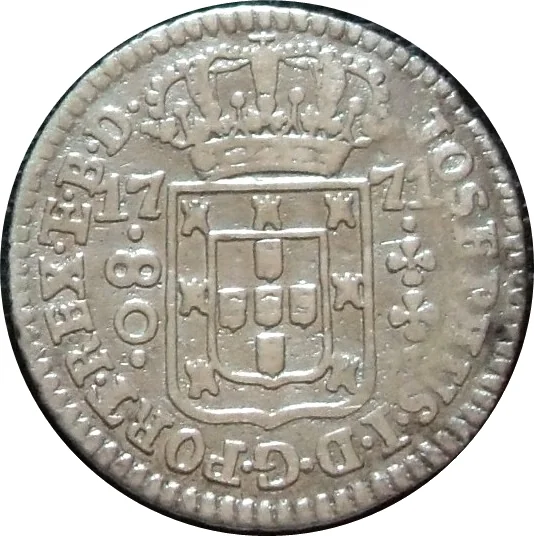
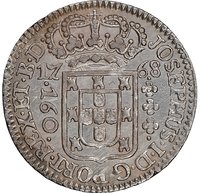
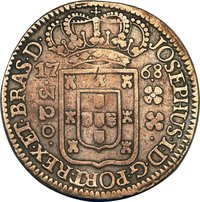
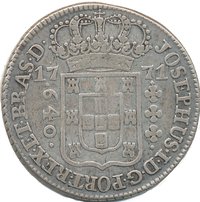
Portuguese arms between 80 and flowers, with date.
Inscription:
JOSEPHUS•I•D•G•P•REX•E•B•D•
17 71
•80•
•**•
17 71
•80•
•**•
Script: Latin
Reverse
Description:
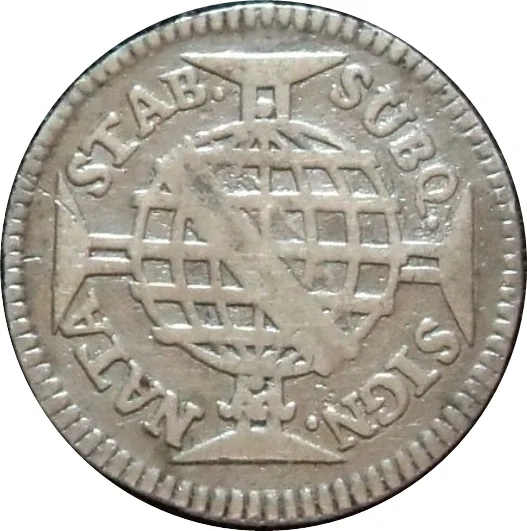
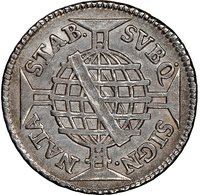
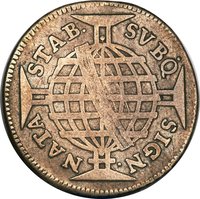
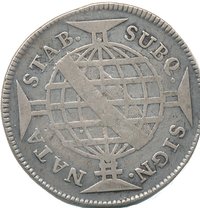
An armillary sphere before the Order of Christ cross.
Inscription:
SUBQ. SIGN. NATA STAB.
Script: Latin
Edge
Reeded.
Categories
| Symbols> Coat of Arms |
Mints
| Name | Mark |
|---|---|
| Imprensa Nacional - Casa da Moeda | — |
Mintings
| Year | Mint Mark | Mintage | Quality | Collection |
|---|---|---|---|---|
| 1768 | — | — | ||
| 1770 | — | 25,000 | ||
| 1771 | — | — |
Historical background
In 1768, Brazil's currency situation was characterized by a complex and often chaotic system inherited from its colonial status under Portugal. The primary circulating medium was the Portuguese real (plural: réis), but the economy suffered from a severe shortage of minted coinage. This scarcity was exacerbated by Portugal's mercantilist policies, which drained gold and silver from the Minas Gerais region to Lisbon, leaving the colony with insufficient specie for daily transactions. Consequently, a wide variety of foreign coins—particularly Spanish-American pesos (often called "patacas")—circulated alongside crude locally minted coins and even commodity money like sugar or tobacco in remote areas, all valued at fluctuating rates.
The monetary chaos was a direct concern for the Marquis of Pombal, Portugal's powerful Prime Minister, who sought to modernize and centralize the administration of the colony. In response, King José I had issued a royal decree in 1766 ordering the establishment of the first official mint in Brazil, the Casa da Moeda do Brasil, which began operations in Rio de Janeiro in 1768. This was a landmark attempt to impose order, aiming to standardize the currency, suppress the circulation of foreign coins, and retain precious metals within the colony by minting gold moedas and silver patacas bearing the Portuguese crown.
Despite this institutional effort, the currency problems of 1768 were deeply rooted and far from solved. The new mint's output was initially limited and could not immediately meet the vast demand across Brazil's expansive territory. Furthermore, the underlying economic structure—based on slavery, plantation exports, and tight control by Lisbon—continued to create monetary imbalances. Thus, while 1768 marked a pivotal step toward a unified colonial currency, it represented the beginning of a long and difficult process of monetary stabilization, with barter and irregular coinage remaining commonplace in daily life for years to come.
The monetary chaos was a direct concern for the Marquis of Pombal, Portugal's powerful Prime Minister, who sought to modernize and centralize the administration of the colony. In response, King José I had issued a royal decree in 1766 ordering the establishment of the first official mint in Brazil, the Casa da Moeda do Brasil, which began operations in Rio de Janeiro in 1768. This was a landmark attempt to impose order, aiming to standardize the currency, suppress the circulation of foreign coins, and retain precious metals within the colony by minting gold moedas and silver patacas bearing the Portuguese crown.
Despite this institutional effort, the currency problems of 1768 were deeply rooted and far from solved. The new mint's output was initially limited and could not immediately meet the vast demand across Brazil's expansive territory. Furthermore, the underlying economic structure—based on slavery, plantation exports, and tight control by Lisbon—continued to create monetary imbalances. Thus, while 1768 marked a pivotal step toward a unified colonial currency, it represented the beginning of a long and difficult process of monetary stabilization, with barter and irregular coinage remaining commonplace in daily life for years to come.
Series: 1768 Brazil circulation coins
⭐ Rare