

1 Quattrino – Ascoli
Italy


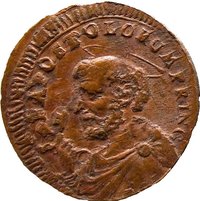
Obverse
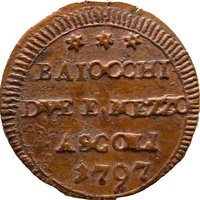
Reverse
Edge
Categories
| Symbol> Crown |
| Symbols> Coat of Arms |
Mints
| Name | Mark |
|---|---|
| Ascoli Piceno | — |
Mintings
| Year | Mint Mark | Mintage | Quality | Collection |
|---|---|---|---|---|
| 1797 | — | — |
Historical background
In 1797, the city of Ascoli Piceno, like much of central Italy, was caught in the turbulent wake of the French Revolutionary Wars. Following Napoleon Bonaparte's invasion of the Italian peninsula in 1796, the old political order was dismantled. The Papal States, to which Ascoli belonged, were forced into the Treaty of Tolentino in February 1797, ceding territory and paying heavy indemnities. This political upheaval directly destabilized the monetary system, as French authorities began to impose their financial demands and introduce new revolutionary currency alongside the existing, now-devalued, Papal coinage.
The currency situation in Ascoli thus became one of chaotic duality and scarcity. The circulating medium consisted of a confused mixture of old Papal scudi and baiocchi, new French-minted coins like the franc and liard, and often-depreciated provisional paper money issued by local republican authorities. The French extraction of vast sums of specie (gold and silver coin) as war contributions drained the region of sound money, leading to a severe shortage of reliable currency for everyday commerce. This forced citizens and merchants to navigate complex and fluctuating exchange rates between the old and new systems.
Consequently, the local economy in and around Ascoli suffered from inflation, uncertainty, and a crisis of trust. Prices became unstable as the value of different coins shifted based on political decrees and their metallic content. This monetary confusion mirrored the broader social dislocation of the period, undermining traditional economic life and placing a heavy burden on the populace, who faced rising costs amidst the political transition from papal rule to the short-lived Repubblica Anconitana, a French sister republic.
The currency situation in Ascoli thus became one of chaotic duality and scarcity. The circulating medium consisted of a confused mixture of old Papal scudi and baiocchi, new French-minted coins like the franc and liard, and often-depreciated provisional paper money issued by local republican authorities. The French extraction of vast sums of specie (gold and silver coin) as war contributions drained the region of sound money, leading to a severe shortage of reliable currency for everyday commerce. This forced citizens and merchants to navigate complex and fluctuating exchange rates between the old and new systems.
Consequently, the local economy in and around Ascoli suffered from inflation, uncertainty, and a crisis of trust. Prices became unstable as the value of different coins shifted based on political decrees and their metallic content. This monetary confusion mirrored the broader social dislocation of the period, undermining traditional economic life and placing a heavy burden on the populace, who faced rising costs amidst the political transition from papal rule to the short-lived Repubblica Anconitana, a French sister republic.

✨ Legendary