

15 tari – Malta
Add to wishlist
Malta
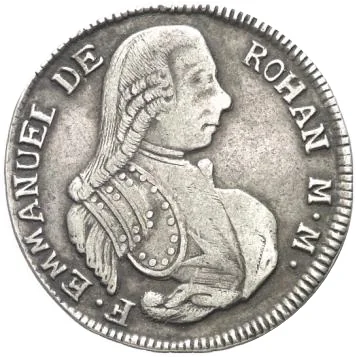
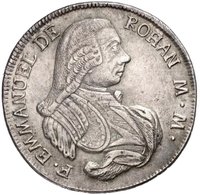
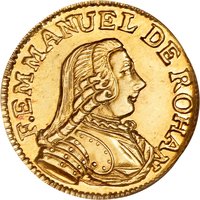
Obverse
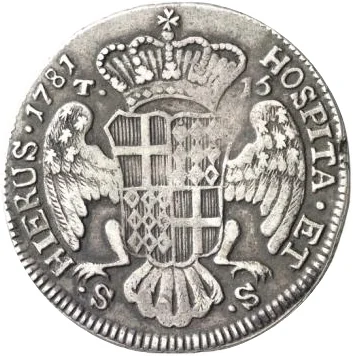
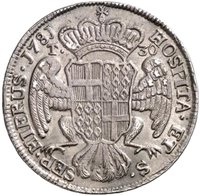
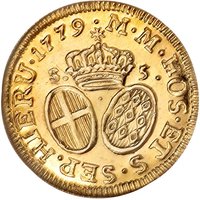
Reverse
Description:
Crowned eagle with date on breast.
Inscription:
HOSPITA . ET S. / S. HIERUS.1781
Script: Latin
Edge
Mintings
| Year | Mint Mark | Mintage | Quality | Collection |
|---|---|---|---|---|
| 1781 | — | — |
Historical background
In 1781, Malta's currency situation was a complex tapestry reflecting its unique political and economic position. The islands were under the rule of the Sovereign Military Order of St. John, a Catholic military order that minted its own coinage. The primary circulating coins were the Scudo, subdivided into 12 Tari, each of 20 Grani. However, this official system existed alongside a multitude of foreign currencies that flooded the bustling ports of Valletta, a key trading hub in the central Mediterranean. Merchants commonly used Spanish silver dollars (pieces of eight), Venetian sequins, and other Italian and Ottoman coins, creating a de facto multi-currency environment where exchange rates fluctuated based on metal content and trade demands.
This monetary plurality presented significant challenges. The constant inflow and outflow of foreign specie, coupled with the periodic debasement of the Order's own coinage to fund its operations and fortifications, led to chronic instability. Counterfeiting was also a serious problem, eroding trust in the already fragile system. For the local population, this meant everyday transactions were fraught with uncertainty, as the value of coins could vary, and complex calculations were needed to convert between different monetary units. The economy, heavily reliant on trade, corsairing, and services to foreign navies, was thus vulnerable to these monetary shocks.
The situation in 1781 was a point of growing tension and would eventually compel the Order to undertake monetary reforms. Just a few years later, in 1785, Grand Master Emmanuel de Rohan-Polduc would issue a landmark proclamation to standardise the coinage, demonstrating that the pressures of the early 1780s had become unsustainable. Therefore, the currency landscape of 1781 Malta was one of disordered transition, caught between the Order's desire for sovereign monetary control and the practical realities of a commercially open, internationally exposed island economy.
This monetary plurality presented significant challenges. The constant inflow and outflow of foreign specie, coupled with the periodic debasement of the Order's own coinage to fund its operations and fortifications, led to chronic instability. Counterfeiting was also a serious problem, eroding trust in the already fragile system. For the local population, this meant everyday transactions were fraught with uncertainty, as the value of coins could vary, and complex calculations were needed to convert between different monetary units. The economy, heavily reliant on trade, corsairing, and services to foreign navies, was thus vulnerable to these monetary shocks.
The situation in 1781 was a point of growing tension and would eventually compel the Order to undertake monetary reforms. Just a few years later, in 1785, Grand Master Emmanuel de Rohan-Polduc would issue a landmark proclamation to standardise the coinage, demonstrating that the pressures of the early 1780s had become unsustainable. Therefore, the currency landscape of 1781 Malta was one of disordered transition, caught between the Order's desire for sovereign monetary control and the practical realities of a commercially open, internationally exposed island economy.
✨ Legendary