

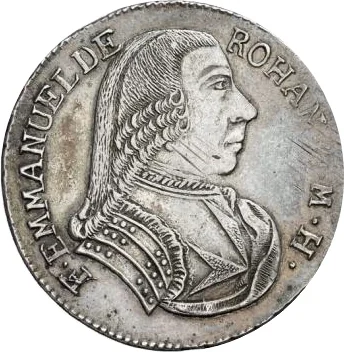
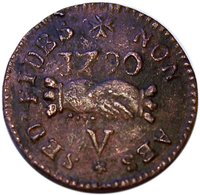
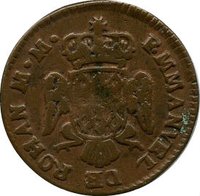
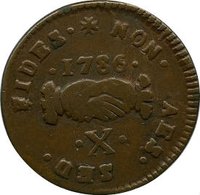
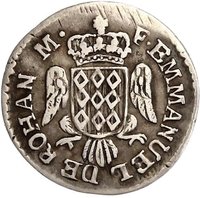
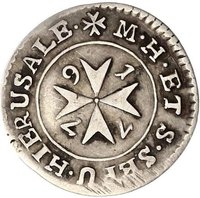
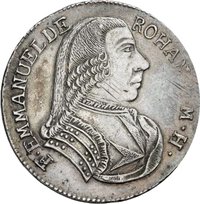
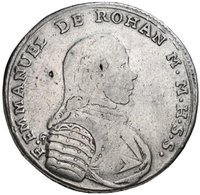
Obverse
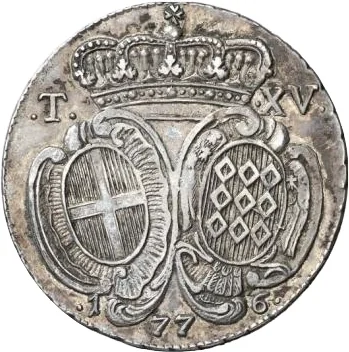
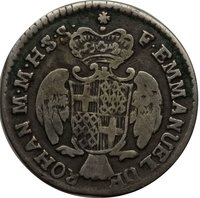
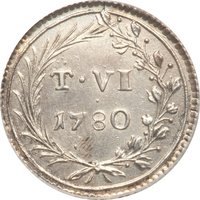
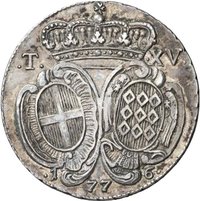
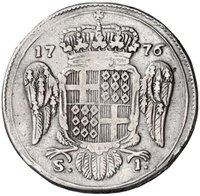
Reverse
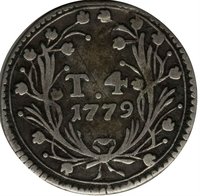
Edge
Mintings
| Year | Mint Mark | Mintage | Quality | Collection |
|---|---|---|---|---|
| 1776 | — | — | ||
| 1777 | — | — |
Historical background
In 1776, Malta's currency situation was complex and fragmented, reflecting its strategic position and recent political history. The islands were under the governance of the Order of Saint John, a wealthy but declining military-religious order. The official unit of account was the Scudo, divided into 12 Tari, each of 20 Grani. However, a multitude of physical coins circulated, including the Order's own silver scudi and copper grani, alongside a heavy influx of foreign specie. Spanish silver dollars (pieces of eight), Sicilian and Neapolitan coins, and French Louis d'or were all common in commerce due to Malta's role as a Mediterranean trading hub and the Order's international connections.
This proliferation of foreign coins, each with fluctuating intrinsic values, created chronic problems of exchange and valuation. The Knights attempted to fix rates by official proclamation, but market forces often prevailed, leading to confusion and facilitating clipping and counterfeiting. Furthermore, the local copper coinage was frequently overvalued by decree to generate seigniorage revenue for the cash-strapped Order, a practice that often led to inflation and public discontent, especially among the poor who used copper for daily transactions.
Thus, while Malta in 1776 was not experiencing a monetary crisis, its system was inherently unstable and administratively burdensome. The economy relied on a patchwork of domestic and international currencies, managed through periodic edicts rather than a unified, trusted monetary policy. This situation would persist until the French occupation in 1798, which introduced a new, decimal-based currency, and was later fundamentally reformed under British rule in the 19th century.
This proliferation of foreign coins, each with fluctuating intrinsic values, created chronic problems of exchange and valuation. The Knights attempted to fix rates by official proclamation, but market forces often prevailed, leading to confusion and facilitating clipping and counterfeiting. Furthermore, the local copper coinage was frequently overvalued by decree to generate seigniorage revenue for the cash-strapped Order, a practice that often led to inflation and public discontent, especially among the poor who used copper for daily transactions.
Thus, while Malta in 1776 was not experiencing a monetary crisis, its system was inherently unstable and administratively burdensome. The economy relied on a patchwork of domestic and international currencies, managed through periodic edicts rather than a unified, trusted monetary policy. This situation would persist until the French occupation in 1798, which introduced a new, decimal-based currency, and was later fundamentally reformed under British rule in the 19th century.
Series: 1776 Malta circulation coins
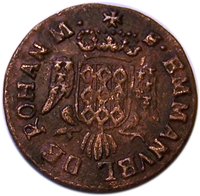
✨ Legendary