

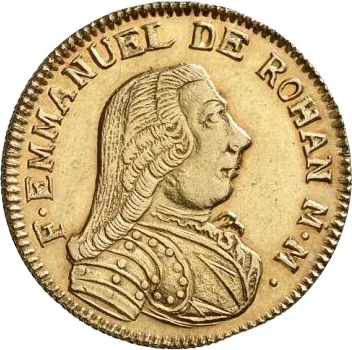
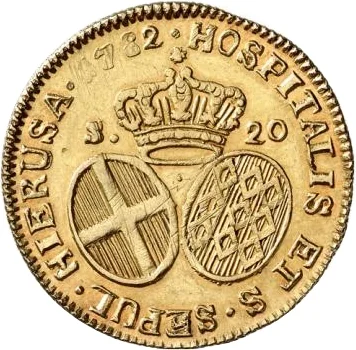
20 scudi – Malta
Add to wishlist
Malta
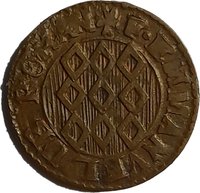
Obverse
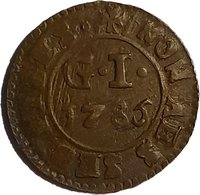
Reverse
Description:
Crowned shield between two arms, dots separate legend and date.
Inscription:
HOSPITALIS ET S.SEPUL. HIERUSA.1782.
S. 20
S. 20
Script: Latin
Edge
Mintings
| Year | Mint Mark | Mintage | Quality | Collection |
|---|---|---|---|---|
| 1782 | — | — |
Historical background
In 1782, Malta’s currency situation was complex and strained, reflecting the island’s unique political and economic position. Officially, the islands were ruled by the Order of Saint John, a sovereign military order, but they operated under the de facto protection and heavy economic influence of the Kingdom of the Two Sicilies and other European powers. The primary circulating coin was the Scudo, subdivided into 12 Tari, each of 20 Grani. However, the system was not based on a strong, minted national currency. Instead, the economy relied heavily on a chaotic mix of foreign coins, primarily Spanish silver dollars (pieces of eight), Venetian sequins, and other Italian and French coins, all circulating at fluctuating and often arbitrary exchange rates set by the Order’s treasury.
This multiplicity of foreign specie created chronic problems of instability and fraud. The scarcity of small change for everyday transactions was a persistent issue, leading to the circulation of cut or clipped foreign coins and locally produced copper grani tokens of dubious value. Furthermore, the Order itself often faced financial difficulties, funding its naval activities and fortifications through loans and levies, which put pressure on the money supply. The lack of a standardized, trusted currency hindered commerce and made the Maltese economy vulnerable to manipulation by merchants and money-changers.
The situation in 1782 was, in fact, a prelude to a significant monetary reform. Recognizing the untenable chaos, Grand Master Emmanuel de Rohan-Polduc initiated a major change the following year. In 1783, he established the Zecca (mint) in Valletta and began issuing a standardized, decimal-based national coinage, the Scudo Maltense, divided into 100 Cauri. This reform, planned in the early 1780s and implemented in 1783, aimed to centralize monetary authority, displace the foreign coinage, and bring much-needed stability. Therefore, the background of 1782 is one of a monetary system in its final years of disorder, on the cusp of a transformative and modernizing reform.
This multiplicity of foreign specie created chronic problems of instability and fraud. The scarcity of small change for everyday transactions was a persistent issue, leading to the circulation of cut or clipped foreign coins and locally produced copper grani tokens of dubious value. Furthermore, the Order itself often faced financial difficulties, funding its naval activities and fortifications through loans and levies, which put pressure on the money supply. The lack of a standardized, trusted currency hindered commerce and made the Maltese economy vulnerable to manipulation by merchants and money-changers.
The situation in 1782 was, in fact, a prelude to a significant monetary reform. Recognizing the untenable chaos, Grand Master Emmanuel de Rohan-Polduc initiated a major change the following year. In 1783, he established the Zecca (mint) in Valletta and began issuing a standardized, decimal-based national coinage, the Scudo Maltense, divided into 100 Cauri. This reform, planned in the early 1780s and implemented in 1783, aimed to centralize monetary authority, displace the foreign coinage, and bring much-needed stability. Therefore, the background of 1782 is one of a monetary system in its final years of disorder, on the cusp of a transformative and modernizing reform.
✨ Legendary