

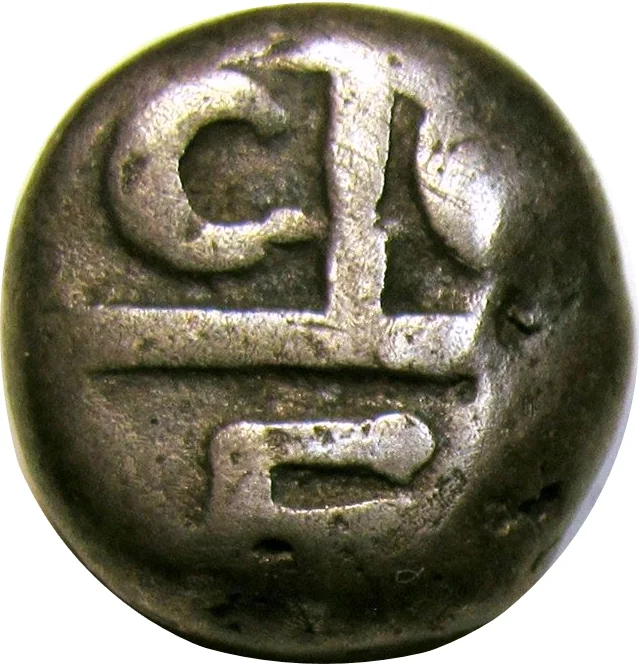
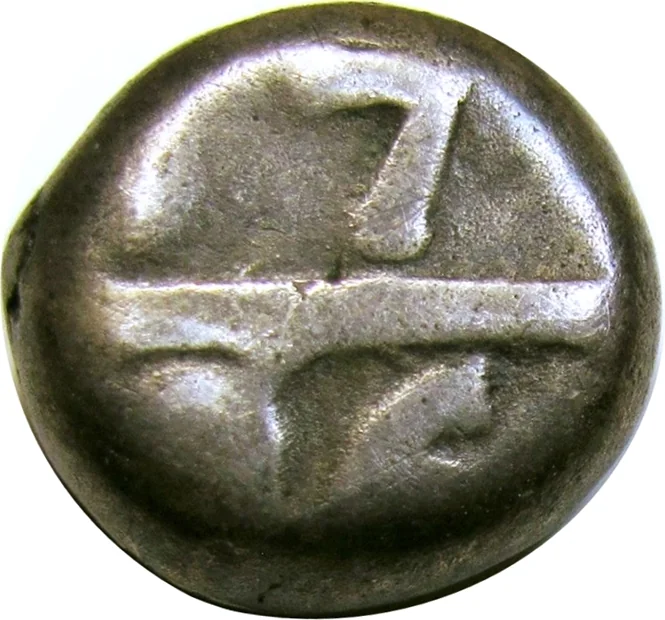
½ Dudu – Madras Presidency
India
Context

Material
References
KM: #Click to copy to clipboard305
Numista: #82530
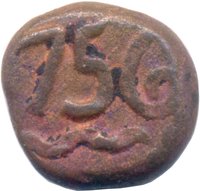
Obverse
Description:
CC/E or GC/E bale mark
Inscription:
CC
E
E
Reverse
Description:
Date stacked, split by a line.
Inscription:
17
86
86
Edge
Plain
Mintings
| Year | Mint Mark | Mintage | Quality | Collection |
|---|---|---|---|---|
| 1755 | — | — | ||
| 1777 | — | — | ||
| 1784 | — | — | ||
| 1786 | — | — |
Historical background
In 1755, the currency situation within the Madras Presidency was complex and transitional, reflecting the broader political and economic contest between the declining Mughal Empire, rising regional powers, and the expanding influence of the English East India Company. The Company, based at Fort St. George, operated within a multi-currency environment. The most authoritative unit of account was the Madras Pagoda, a gold coin originally based on South Indian Hindu temple issues, but the actual circulation was dominated by a plethora of silver rupees from various issuers. These included Mughal rupees from Arcot, as well as coins struck by the Nawab of Carnatic and other regional rulers, leading to issues of varying weight, purity, and value.
This monetary heterogeneity created significant challenges for trade and administration. Merchants and the Company itself had to constantly assess and discount coins, relying on "shroffs" (money-changers and assayers) to verify authenticity and value. The Company attempted to impose order by fixing exchange rates between the pagoda (used for its own accounts and larger transactions) and the circulating rupees, but these official rates often conflicted with volatile market realities. Furthermore, the ongoing Carnatic Wars (1746-1763) exacerbated the situation, as competing French and English companies, along with their Indian allies, all minted or imported coins to finance their military campaigns, flooding the region with currencies of even more dubious and fluctuating value.
Thus, the currency landscape of 1755 was one of fragmented sovereignty and economic uncertainty. The East India Company was not yet the supreme political power—that would follow the decisive British victory at Plassey in 1757 and their growing control over the Nawab of Arcot's finances. Consequently, while the Company administered its own settlement, it lacked the centralized authority to impose a uniform monetary system across the Presidency. The situation demanded a pragmatic, if cumbersome, acceptance of a hybrid system, laying the groundwork for the Company's later, more forceful interventions in currency standardization as its territorial and fiscal control solidified in the decades to come.
This monetary heterogeneity created significant challenges for trade and administration. Merchants and the Company itself had to constantly assess and discount coins, relying on "shroffs" (money-changers and assayers) to verify authenticity and value. The Company attempted to impose order by fixing exchange rates between the pagoda (used for its own accounts and larger transactions) and the circulating rupees, but these official rates often conflicted with volatile market realities. Furthermore, the ongoing Carnatic Wars (1746-1763) exacerbated the situation, as competing French and English companies, along with their Indian allies, all minted or imported coins to finance their military campaigns, flooding the region with currencies of even more dubious and fluctuating value.
Thus, the currency landscape of 1755 was one of fragmented sovereignty and economic uncertainty. The East India Company was not yet the supreme political power—that would follow the decisive British victory at Plassey in 1757 and their growing control over the Nawab of Arcot's finances. Consequently, while the Company administered its own settlement, it lacked the centralized authority to impose a uniform monetary system across the Presidency. The situation demanded a pragmatic, if cumbersome, acceptance of a hybrid system, laying the groundwork for the Company's later, more forceful interventions in currency standardization as its territorial and fiscal control solidified in the decades to come.

✨ Legendary