

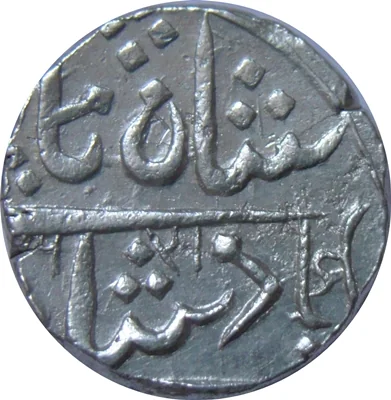
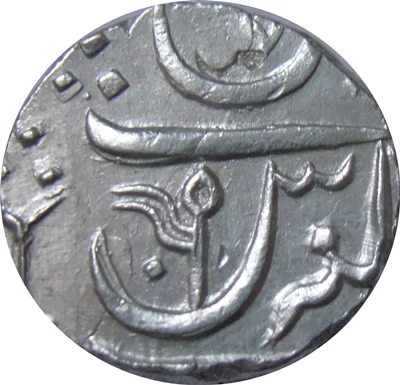

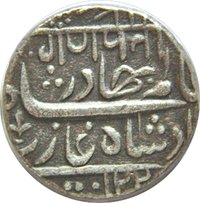
Obverse
Description:
Anonymous report
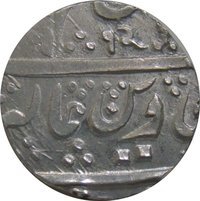
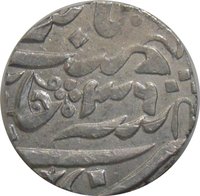
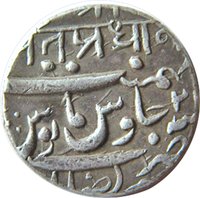
Reverse
Edge
Mintings
| Year | Mint Mark | Mintage | Quality | Collection |
|---|---|---|---|---|
| 1792 | — | — | ||
| 1794 | — | — | ||
| 1798 | — | — | ||
| 1805 | — | — | ||
| 1812 | — | — | ||
| 1814 | — | — | ||
| 1815 | — | — | ||
| 1817 | — | — | ||
| 1819 | — | — | ||
| 1820 | — | — | ||
| 1821 | — | — | ||
| 1836 | — | — |
Historical background
By 1792, the Maratha Empire's currency system reflected its complex political structure and the immense strain of continuous warfare. The empire was not a monolithic state but a confederacy under the Peshwa in Pune, with powerful semi-autonomous rulers like the Holkars, Scindias, and Bhonsles minting their own coins in their respective territories. The primary silver currency was the rupee, but its weight, purity, and design varied between mints in cities like Pune, Satara, Nagpur, Indore, and Gwalior, creating a heterogeneous monetary landscape. Alongside these, copper paisa coins and gold hon or mohur coins circulated, with exchange rates often fluctuating based on local authority and the availability of precious metals.
This period followed the significant financial and territorial blow of the Third Anglo-Maratha War (1775-1782), which resulted in heavy indemnities paid to the British East India Company. By 1792, the Maratha state was financially depleted, yet embroiled in major military campaigns in the north against the Rohillas and later preparing for the showdown with Tipu Sultan of Mysore. The constant demand for war funding led to debasement of coinage in some areas, as rulers sought to stretch their silver reserves. Furthermore, revenue collection was increasingly farmed out, and the influx of Company rupees from trade and subsidies began to introduce a competing currency, subtly undermining the Peshwa's monetary control.
Thus, the currency situation in 1792 was one of decentralized fragility under acute fiscal pressure. While the system functioned for daily trade, the lack of standardization was a symptom of the confederacy's weakening central authority. The financial exhaustion from past wars, combined with the costs of ongoing conflicts, made the empire's diverse coinage vulnerable to the more uniform and economically powerful currencies of the European trading companies, presaging the greater political and economic challenges that would culminate in the empire's dissolution in the early 19th century.
This period followed the significant financial and territorial blow of the Third Anglo-Maratha War (1775-1782), which resulted in heavy indemnities paid to the British East India Company. By 1792, the Maratha state was financially depleted, yet embroiled in major military campaigns in the north against the Rohillas and later preparing for the showdown with Tipu Sultan of Mysore. The constant demand for war funding led to debasement of coinage in some areas, as rulers sought to stretch their silver reserves. Furthermore, revenue collection was increasingly farmed out, and the influx of Company rupees from trade and subsidies began to introduce a competing currency, subtly undermining the Peshwa's monetary control.
Thus, the currency situation in 1792 was one of decentralized fragility under acute fiscal pressure. While the system functioned for daily trade, the lack of standardization was a symptom of the confederacy's weakening central authority. The financial exhaustion from past wars, combined with the costs of ongoing conflicts, made the empire's diverse coinage vulnerable to the more uniform and economically powerful currencies of the European trading companies, presaging the greater political and economic challenges that would culminate in the empire's dissolution in the early 19th century.
✨ Legendary