

1 souverain – Austrian Netherlands
Add to wishlist
Belgium
Context
Years: 1793–1796
Country: Belgium
Issuer: Austrian Netherlands
Ruler: Francis II
Currency:
(1744—1798)
Demonetized: Yes
Total mintage: 8,386
Material
References
KM: #
Numista: #81871
Value
Bullion value: $780.21
Obverse
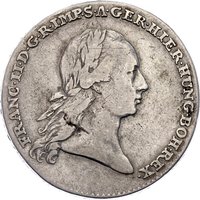
Description:
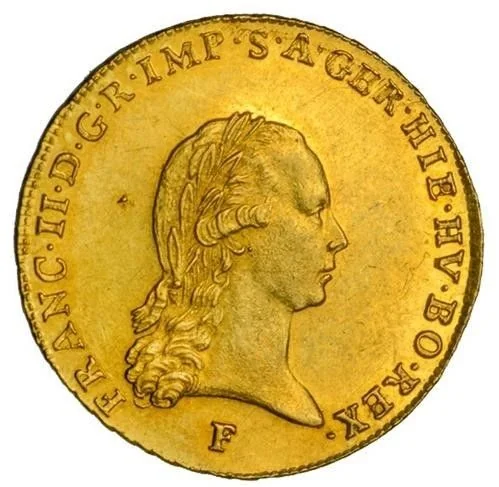
Laureate head right.
Inscription:
FRANC. II. D. G. R. IMP. S. A. GER. HIE. HV. BO. REX.
F
F
Script: Latin
Reverse
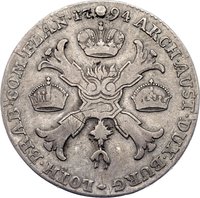
Description:
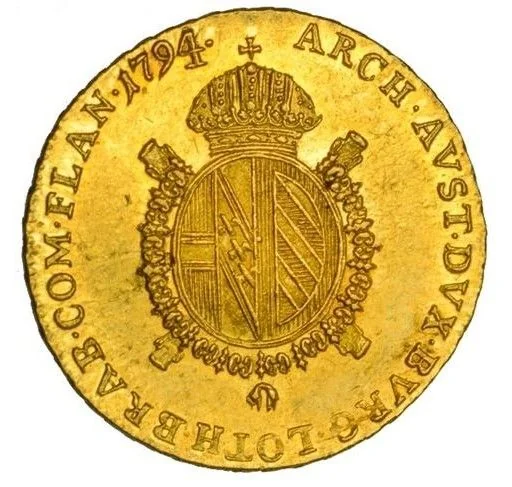
Shield with Austria-Lorraine-Burgundy arms, crowned and within the Golden Fleece collar. Date in legend.
Inscription:
ARCH. AVST. DVX. BVRG. LOTH. BRAB. COM. FLAN.
Script: Latin
Edge
Mints
| Name | Mark |
|---|---|
| Hall | F |
Historical background
In 1793, the currency situation in the Austrian Netherlands (approximately modern-day Belgium and Luxembourg) was one of profound instability and complexity, exacerbated by war and political upheaval. The territory was a patchwork of different monetary systems, with both domestic and foreign coins in circulation. The official currency was based on the Brabant guilder (or florin), subdivided into 20 stuivers, but in practice, coins from the Dutch Republic, France, the Holy Roman Empire, and even older Spanish issues all circulated simultaneously. This led to chronic confusion, as the value of these coins fluctuated based on their metal content and the credibility of the issuing authority, requiring constant publication of exchange rate tables for merchants.
The core of the crisis was triggered by the outbreak of the French Revolutionary Wars. Following the Battle of Jemappes in late 1792, French revolutionary forces occupied the region and attempted to impose a radical economic overhaul. They declared the mandatory acceptance of their paper currency, the assignat, which was rapidly depreciating due to over-printing and lack of public confidence. This decree destabilized markets further, as people hoarded reliable silver and gold coins (Gresham's Law in action), leading to a severe shortage of sound money for everyday transactions.
By early 1793, the Austrian Habsburg forces had temporarily reconquered the territory after the Battle of Neerwinden, but they could not restore monetary order. The brief French occupation had shattered the existing financial system, and the ongoing war meant both Austrian and French authorities were primarily focused on extracting resources from the region rather than stabilizing its economy. Consequently, the population faced rampant inflation, a crippling lack of trustworthy coinage, and a general collapse of commercial confidence, making 1793 a year of severe economic distress within a fiercely contested warzone.
The core of the crisis was triggered by the outbreak of the French Revolutionary Wars. Following the Battle of Jemappes in late 1792, French revolutionary forces occupied the region and attempted to impose a radical economic overhaul. They declared the mandatory acceptance of their paper currency, the assignat, which was rapidly depreciating due to over-printing and lack of public confidence. This decree destabilized markets further, as people hoarded reliable silver and gold coins (Gresham's Law in action), leading to a severe shortage of sound money for everyday transactions.
By early 1793, the Austrian Habsburg forces had temporarily reconquered the territory after the Battle of Neerwinden, but they could not restore monetary order. The brief French occupation had shattered the existing financial system, and the ongoing war meant both Austrian and French authorities were primarily focused on extracting resources from the region rather than stabilizing its economy. Consequently, the population faced rampant inflation, a crippling lack of trustworthy coinage, and a general collapse of commercial confidence, making 1793 a year of severe economic distress within a fiercely contested warzone.
✨ Legendary