

1 Kronenthaler – Austrian Netherlands
Belgium
Context
Year: 1794
Country: Belgium 
Issuer: Austrian Netherlands
Ruler: Francis II
Currency:
(1744—1798)
Demonetized: Yes
Total mintage: 280,765
Material
References
KM: #Click to copy to clipboard62.3
Numista: #28745
Value
Bullion value: $73.56
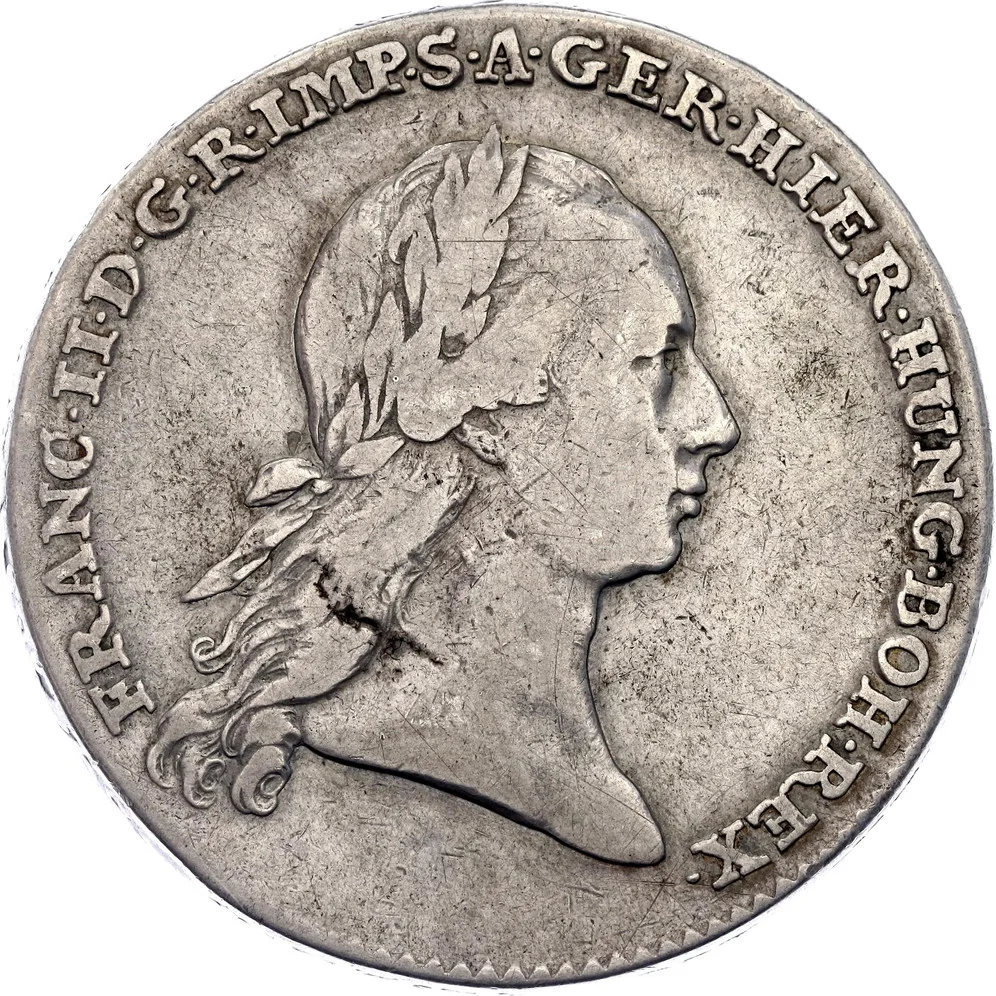
Obverse
Description:
Laureate head right
Inscription:
FRANC·II·D·G·R·IMP·S·A·GER·HIER·HUNG·BOH·REX·
Script: Latin
Engraver: Théodore Van Berckel
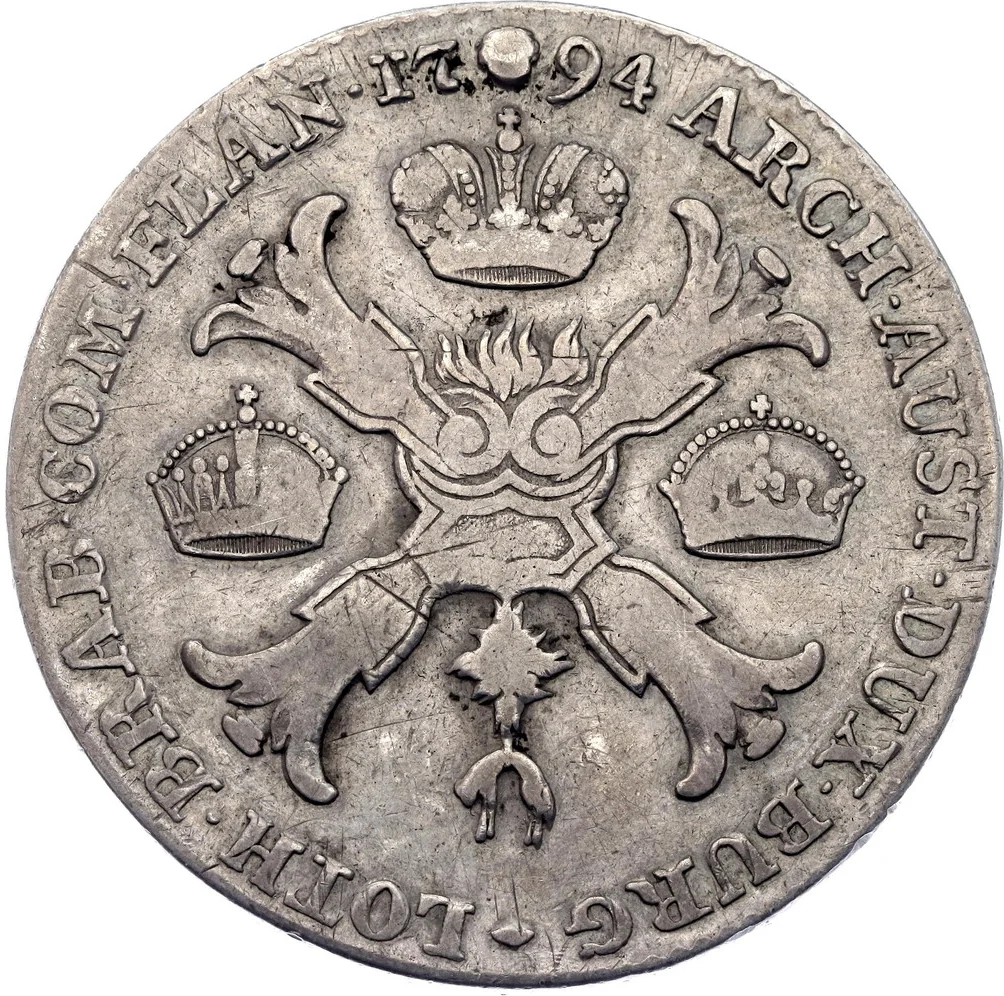
Reverse
Description:
Date divided at top.
Inscription:
ARCH·AUST·DUX·BURG·LOTH·BRAB·COM·FLAN·
17-94
17-94
Script: Latin
Engraver: Théodore Van Berckel
Edge
Suscript (embossed).
Legend:
FIDE ET LEGE
Mints
| Name | Mark |
|---|---|
| Royal Mint of Belgium | — |
Mintings
| Year | Mint Mark | Mintage | Quality | Collection |
|---|---|---|---|---|
| 1794 | — | 280,765 |
Historical background
By 1794, the currency situation in the Austrian Netherlands (approximately modern-day Belgium and Luxembourg) was one of profound instability and complexity, exacerbated by war and political upheaval. The region operated on a bimetallic system based on the Brabant guilder (or florin), but its circulation was flooded with a chaotic mix of domestic and foreign coins. Dutch guilders, French livres tournois, Austrian kronenthalers, and various German state thalers all circulated simultaneously, their values fluctuating constantly against each other and against the official accounting standard. This created a paralyzing environment for commerce, as daily transactions required difficult calculations and exposed merchants and the public to significant exchange rate risks.
The core of the crisis was the French Revolutionary Wars. Following the Battle of Jemappes in 1792, French Republican forces had first occupied the territory, issuing vast quantities of assignats (French paper money backed by confiscated church lands) to fund their occupation. Although the Austrians briefly regained control in 1793, the French returned with a decisive offensive in mid-1794. Each regime change brought forced requisitions, new monetary decrees, and a further erosion of trust in the circulating medium. The assignats, which the French authorities attempted to impose at artificial rates, depreciated rapidly, becoming a deeply unpopular and unreliable currency.
Consequently, by the time of the decisive French victory at Fleurus in June 1794, the monetary system was in a state of near-collapse. Reliable specie (gold and silver coin) was hoarded, disappearing from everyday use, while discredited paper and debased coinage filled the vacuum. This financial chaos mirrored the political transition, as the French annexation later that year would formally end Austrian rule and eventually lead to the territory's integration into the French monetary zone, with the franc replacing the old Brabant guilder. Thus, the currency situation of 1794 stands as a stark illustration of how war and occupation can unravel a pre-existing financial order.
The core of the crisis was the French Revolutionary Wars. Following the Battle of Jemappes in 1792, French Republican forces had first occupied the territory, issuing vast quantities of assignats (French paper money backed by confiscated church lands) to fund their occupation. Although the Austrians briefly regained control in 1793, the French returned with a decisive offensive in mid-1794. Each regime change brought forced requisitions, new monetary decrees, and a further erosion of trust in the circulating medium. The assignats, which the French authorities attempted to impose at artificial rates, depreciated rapidly, becoming a deeply unpopular and unreliable currency.
Consequently, by the time of the decisive French victory at Fleurus in June 1794, the monetary system was in a state of near-collapse. Reliable specie (gold and silver coin) was hoarded, disappearing from everyday use, while discredited paper and debased coinage filled the vacuum. This financial chaos mirrored the political transition, as the French annexation later that year would formally end Austrian rule and eventually lead to the territory's integration into the French monetary zone, with the franc replacing the old Brabant guilder. Thus, the currency situation of 1794 stands as a stark illustration of how war and occupation can unravel a pre-existing financial order.
💎 Extremely Rare