

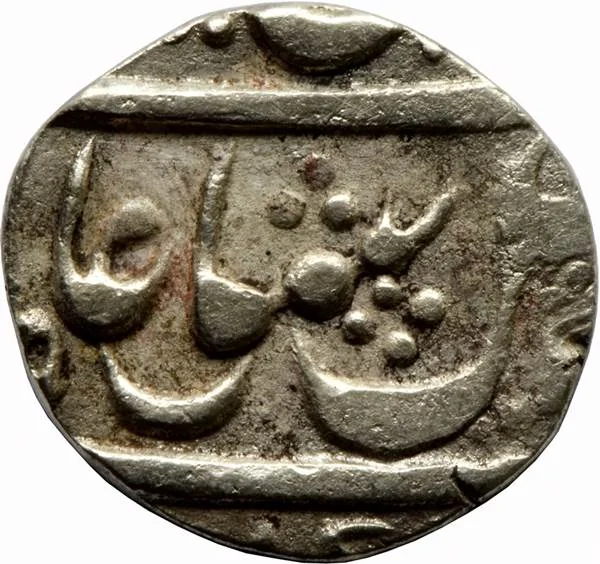
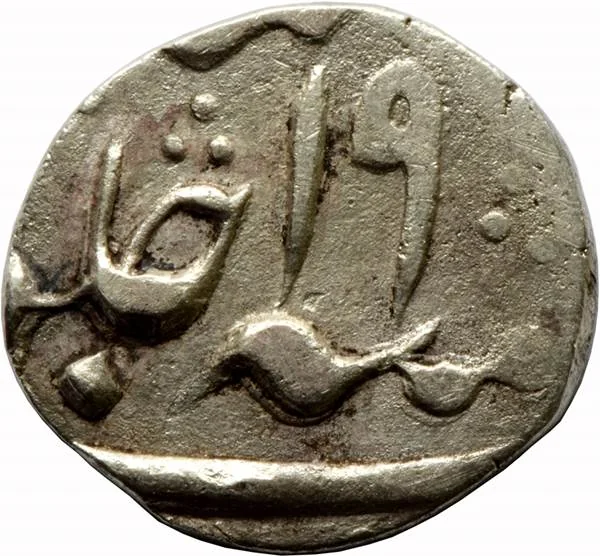
¼ Rupee – Bengal Presidency
India
Context

Material
References
KM: #Click to copy to clipboard82.3
Numista: #81099
Value
Bullion value: $8.36
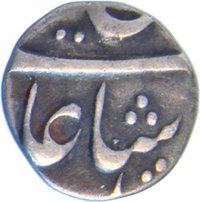
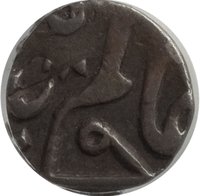
Obverse
Description:
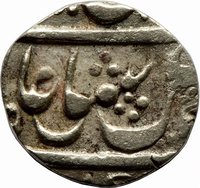
Legend (Persian): Coined across seven climes by divine grace, protector of faith Muhammad, Shah Alam Badshah.
Inscription:
شاه عالم بادشاه
حامي دين محمد
ساى فضل لله
سكة زد بر حفت كشور
حامي دين محمد
ساى فضل لله
سكة زد بر حفت كشور
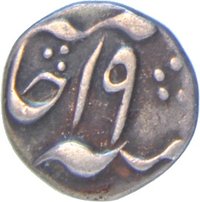
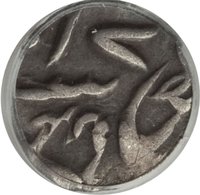
Reverse
Description:
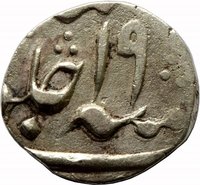
Zarb Murshidabad, Year 19 of the reign.
Inscription:
١٩
Edge
Plain
Mintings
| Year | Mint Mark | Mintage | Quality | Collection |
|---|---|---|---|---|
| — | — | — |
Historical background
In 1777, the Bengal Presidency under the East India Company was grappling with a severe and complex monetary crisis. The root cause was a critical shortage of specie, particularly silver, which was the basis of the rupee. This drain was driven by several factors: the Company's need to remit vast sums of "tribute" to Britain, substantial outflows of silver to China to pay for tea, and the general costs of administering and expanding its territorial control. The scarcity of silver rupees led to a proliferation of debased and counterfeit coins, severely undermining public confidence in the currency and disrupting trade.
The Company's response, prior to 1777, had been largely ineffective and even contradictory. Attempts to introduce a standardized "Company Rupee" competed with a chaotic mix of older Mughal and regional coins still in circulation. Furthermore, the Company's own high revenue demands, payable in silver, exacerbated the shortage by hoarding the very coins it needed to circulate in the economy. This created a vicious cycle where trade contracted, credit dried up, and the administration struggled to pay its troops and civil servants, threatening both economic stability and political control.
By 1777, the situation demanded decisive intervention. The Presidency was on the cusp of major reforms, which would culminate in the pivotal Coinage Act of 1793. The immediate background in 1777 was one of experimentation and growing recognition that monetary sovereignty was essential for governance. Efforts were being made to assert control over mints, suppress forgeries, and establish a uniform currency, setting the stage for the Company to transition from a trading entity to a state power with a managed fiscal system, though these efforts remained fraught with difficulty and partial success at the time.
The Company's response, prior to 1777, had been largely ineffective and even contradictory. Attempts to introduce a standardized "Company Rupee" competed with a chaotic mix of older Mughal and regional coins still in circulation. Furthermore, the Company's own high revenue demands, payable in silver, exacerbated the shortage by hoarding the very coins it needed to circulate in the economy. This created a vicious cycle where trade contracted, credit dried up, and the administration struggled to pay its troops and civil servants, threatening both economic stability and political control.
By 1777, the situation demanded decisive intervention. The Presidency was on the cusp of major reforms, which would culminate in the pivotal Coinage Act of 1793. The immediate background in 1777 was one of experimentation and growing recognition that monetary sovereignty was essential for governance. Efforts were being made to assert control over mints, suppress forgeries, and establish a uniform currency, setting the stage for the Company to transition from a trading entity to a state power with a managed fiscal system, though these efforts remained fraught with difficulty and partial success at the time.
✨ Legendary