

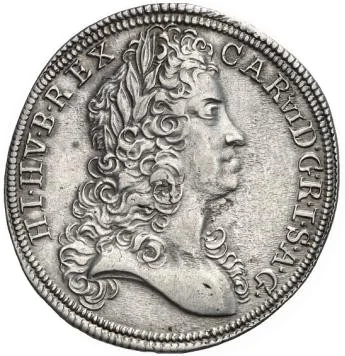
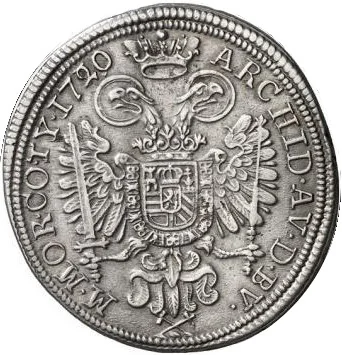
½ Thaler – Kingdom of Bohemia
Context
Year: 1720
Country: Bohemia
Issuer: Kingdom of Bohemia
Ruler: Charles VI
Currency:
(1520—1754)
Demonetized: Yes
Material
References
KM: #Click to copy to clipboard691
Numista: #80890
Value
Bullion value: $39.28
Obverse
Description:
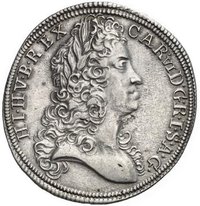
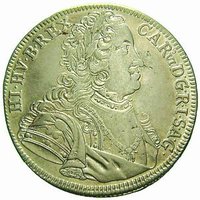
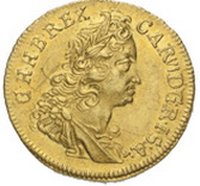
Laureate bust facing right, shoulders bare. Head and bust truncation break legend (starting at 1h), no inner circle.
Inscription:
CAR VI D G R I S A G HI HV B REX
Script: Latin
Reverse
Description:
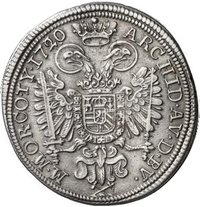
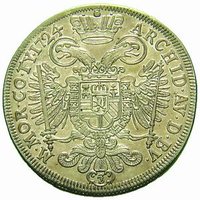
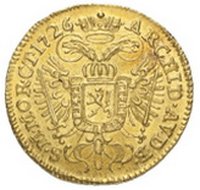
Crowned double-headed eagle holding a scepter and sword. Its central shield displays the arms of Castile, Hungary, Austria, and Burgundy, with Bohemia at the heart. The legend, divided by a mint mark (crossed hammers), lacks an inner circle and ends with the date.
Inscription:
ARCHID AV D BV / M MOR CO TY 1720
Script: Latin
Edge
Mints
| Name | Mark |
|---|---|
| Kuttenberg | — |
Mintings
| Year | Mint Mark | Mintage | Quality | Collection |
|---|---|---|---|---|
| 1720 | — | — |
Historical background
In 1720, the Kingdom of Bohemia, a core province of the Habsburg Monarchy, was grappling with the severe aftermath of the great currency debasement and financial crisis initiated under Emperor Charles VI. The primary circulating coin, the Konventionsmünze, had been drastically devalued. In 1719, the state had officially reduced the silver content of the gulden by nearly 50%, a desperate measure to generate revenue for the depleted imperial treasury following the costly wars of the Spanish and Ottoman succession. This deliberate debasement led to a flood of unstable, low-quality coinage, causing rampant inflation, a loss of public confidence in the currency, and significant disruption to trade and wages.
The situation was further complicated by the persistence of older, higher-quality silver coins, particularly the Reichsthaler. As Gresham's law took hold—"bad money drives out good"—these full-weight thalers were hoarded by the populace or exported, leaving the debased Konventionsmünze as the primary medium for everyday transactions. This created a chaotic monetary environment with multiple effective exchange rates, hindering commerce and creating widespread economic uncertainty. The crisis was not contained within Bohemia but was a systemic issue across the Habsburg lands, reflecting the monarchy's broader fiscal mismanagement.
In response, the year 1720 itself saw the Habsburg court in Vienna attempting to address the turmoil. Authorities began planning a comprehensive monetary reform, which would culminate in the 1722 Münzordnung (coinage ordinance). This reform aimed to stabilize the currency by defining a new, fixed relationship between the gulden and the Reichsthaler, establishing a stable Konventionsthaler standard. Thus, the currency situation in 1720 Bohemia was one of profound instability, marking the painful transition from the crisis of debasement toward a more orderly, state-controlled monetary system.
The situation was further complicated by the persistence of older, higher-quality silver coins, particularly the Reichsthaler. As Gresham's law took hold—"bad money drives out good"—these full-weight thalers were hoarded by the populace or exported, leaving the debased Konventionsmünze as the primary medium for everyday transactions. This created a chaotic monetary environment with multiple effective exchange rates, hindering commerce and creating widespread economic uncertainty. The crisis was not contained within Bohemia but was a systemic issue across the Habsburg lands, reflecting the monarchy's broader fiscal mismanagement.
In response, the year 1720 itself saw the Habsburg court in Vienna attempting to address the turmoil. Authorities began planning a comprehensive monetary reform, which would culminate in the 1722 Münzordnung (coinage ordinance). This reform aimed to stabilize the currency by defining a new, fixed relationship between the gulden and the Reichsthaler, establishing a stable Konventionsthaler standard. Thus, the currency situation in 1720 Bohemia was one of profound instability, marking the painful transition from the crisis of debasement toward a more orderly, state-controlled monetary system.
✨ Legendary