

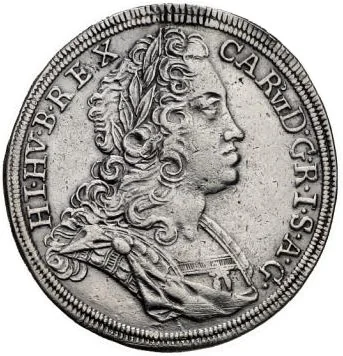
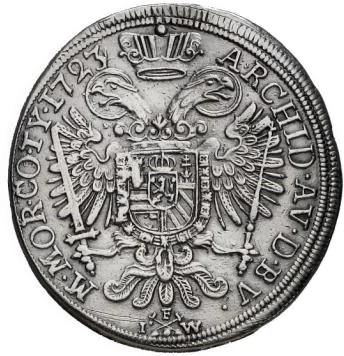
½ Thaler – Kingdom of Bohemia
Context
Years: 1719–1726
Country: Bohemia
Issuer: Kingdom of Bohemia
Ruler: Charles VI
Currency:
(1520—1754)
Demonetized: Yes
Material
References
KM: #Click to copy to clipboard688
Numista: #80858
Value
Bullion value: $39.84
Obverse
Description:
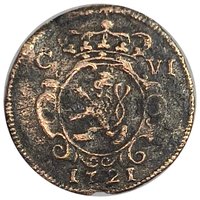
Laureate right-facing emperor portrait. Bust divides legend, no inner circle. Legend begins at 1 o'clock.
Inscription:
CAR VI D G R I S A G / HI HV B REX
Script: Latin
Reverse
Description:
Double-headed crowned eagle with central shield of Castile, Hungary, Austria, and Burgundy; Bohemia arms at center. Eagle holds sceptre and sword. Mint mark below divides legend, date at end.
Inscription:
ARCHID AV D BV / M MOR CO TY 1723
I F W
I F W
Script: Latin
Edge
Mints
| Name | Mark |
|---|---|
| Kuttenberg | — |
Mintings
| Year | Mint Mark | Mintage | Quality | Collection |
|---|---|---|---|---|
| 1719 | — | — | ||
| 1720 | — | — | ||
| 1721 | — | — | ||
| 1722 | — | — | ||
| 1723 | — | — | ||
| 1724 | — | — | ||
| 1725 | — | — | ||
| 1726 | — | — |
Historical background
In 1719, the currency situation in the Kingdom of Bohemia, a core crown land of the Habsburg Monarchy, was defined by the aftermath of the great currency reform of 1700. This reform, initiated by Emperor Leopold I, had successfully ended a period of severe monetary instability by introducing a stable silver-based convention currency, the Konventionsmünze. The standard coin was the Konventionstaler, containing a defined amount of fine silver, and its fractional unit, the Konventionsgulden (or florin), became the central unit of account for administration and large transactions. By 1719, this system provided a much-needed foundation of monetary stability for state finances and trade.
However, a significant problem persisted: a chronic shortage of small, divisional coinage for everyday use. The state mints, focused on producing high-value silver coins, neglected the minting of kreuzers and hellers. This scarcity was acutely felt by the general population, peasants, and laborers, who conducted daily market transactions in this small change. The void was often filled by worn, clipped, or counterfeit coins, and by older, debased coins from previous reigns that continued to circulate locally, creating a disconnect between the official accounting system and the physical coins in common use.
Furthermore, the Bohemian economy was still recovering from the depopulation and devastation of the Thirty Years' War (1618-1648) and more recent conflicts like the War of the Spanish Succession. While the silver mines of Kutná Hora were past their medieval peak, they still contributed to the monarchy's bullion supply. The currency stability post-1700 aided economic recovery, but the Habsburg state's frequent military expenditures meant fiscal pressure was constant. In 1719, the monetary landscape was thus one of a stable official standard coexisting with a messy and inconvenient reality of small-coin scarcity, a tension typical of many early modern economies.
However, a significant problem persisted: a chronic shortage of small, divisional coinage for everyday use. The state mints, focused on producing high-value silver coins, neglected the minting of kreuzers and hellers. This scarcity was acutely felt by the general population, peasants, and laborers, who conducted daily market transactions in this small change. The void was often filled by worn, clipped, or counterfeit coins, and by older, debased coins from previous reigns that continued to circulate locally, creating a disconnect between the official accounting system and the physical coins in common use.
Furthermore, the Bohemian economy was still recovering from the depopulation and devastation of the Thirty Years' War (1618-1648) and more recent conflicts like the War of the Spanish Succession. While the silver mines of Kutná Hora were past their medieval peak, they still contributed to the monarchy's bullion supply. The currency stability post-1700 aided economic recovery, but the Habsburg state's frequent military expenditures meant fiscal pressure was constant. In 1719, the monetary landscape was thus one of a stable official standard coexisting with a messy and inconvenient reality of small-coin scarcity, a tension typical of many early modern economies.
✨ Legendary