

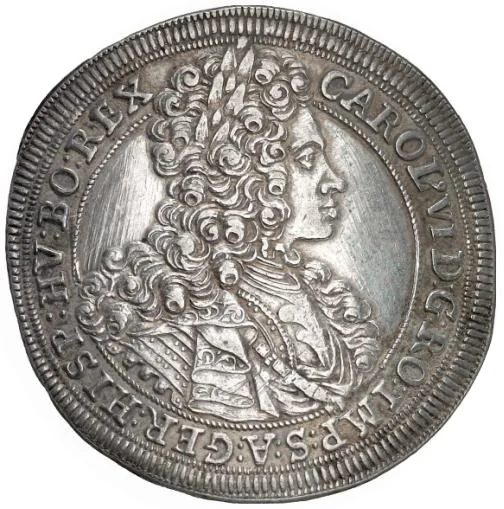
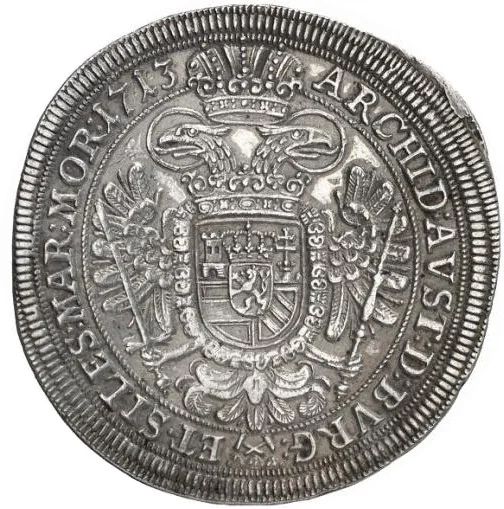
½ Thaler – Kingdom of Bohemia
Context
Years: 1713–1717
Country: Bohemia
Issuer: Kingdom of Bohemia
Ruler: Charles VI
Currency:
(1520—1754)
Demonetized: Yes
Material
References
KM: #Click to copy to clipboard501
Numista: #80611
Value
Bullion value: $39.84
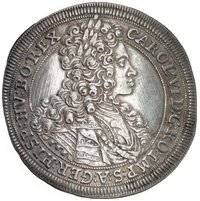
Obverse
Description:
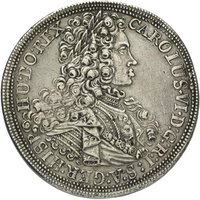
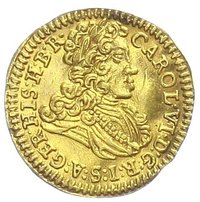
Armored laureate portrait facing right within a beaded circle. The head divides the legend, which begins at 1 o'clock.
Inscription:
CAROL VI D G RO IMP S A GER HISP HV BO REX
Script: Latin
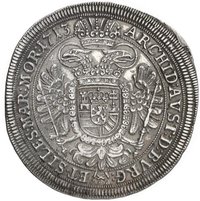
Reverse
Description:
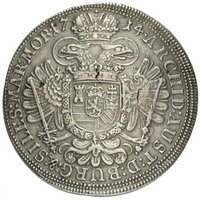
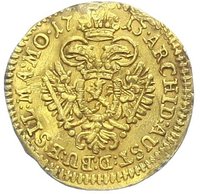
Double-headed crowned eagle with central shield of Castile, Hungary, Austria, and Burgundy; Bohemia arms at center. Eagle holds sceptre and sword. Design within beaded circle, with mint mark (crossed hammers) and date in legend.
Inscription:
ARCHID AVST D BVRG / ET SILES MAR MOR 1713
ou
ARCHID AUST DUX BUR / ET SIL MAR MOR 1713
ou
ARCHID AUST DUX BUR / ET SIL MAR MOR 1713
Script: Latin
Edge
Mints
| Name | Mark |
|---|---|
| Kuttenberg | — |
Mintings
| Year | Mint Mark | Mintage | Quality | Collection |
|---|---|---|---|---|
| 1713 | ll | — | ||
| 1714 | ll | — | ||
| 1715 | ll | — | ||
| 1716 | ll | — | ||
| 1717 | ll | — |
Historical background
In 1713, the Kingdom of Bohemia, a core hereditary land of the Habsburg Monarchy, operated within a complex and strained monetary system. The primary currency was the silver Konventionstaler, governed by the 1690 Leipzig currency treaty, which standardized coinage across the Holy Roman Empire. However, the reality was one of monetary confusion, as a vast array of domestic and foreign coins circulated simultaneously. Decades of war, particularly the Thirty Years' War and the recent War of the Spanish Succession, had severely depleted the treasury and led to repeated debasements. The state's response was often to issue lower-quality Landmünzen (provincial coins) for local use, creating a disparity between "good" silver money used for foreign trade and "bad" depreciated coinage used in everyday life.
The financial pressures on the Habsburg state were immense, and Bohemia, as a wealthy province, bore a significant tax burden. The government frequently resorted to manipulating coinage to generate short-term revenue, a practice known as Münzverschlechterung. This involved reducing the precious metal content in newly minted coins while officially maintaining their face value, leading to inflation and a loss of public trust. Furthermore, the Bohemian lands suffered from a chronic shortage of small-denomination coins, hampering daily commerce and causing hardship for the common population. This unstable environment encouraged hoarding of full-value silver and widespread suspicion towards newly minted coin.
The year 1713 itself falls within a period of attempted stabilization under Emperor Charles VI. The conclusion of the War of the Spanish Succession with the Treaty of Utrecht that year allowed for a greater focus on domestic administration. However, a fundamental reform of the Habsburg monetary system was still two decades away; it would not be realized until the Wiener Münzvertrag (Vienna Coinage Treaty) of 1753. Therefore, the currency situation in Bohemia in 1713 was characterized by a fragile and unpopular patchwork of coins, a legacy of wartime finance, and a slow, uncertain journey toward the monetary stability desired for economic recovery.
The financial pressures on the Habsburg state were immense, and Bohemia, as a wealthy province, bore a significant tax burden. The government frequently resorted to manipulating coinage to generate short-term revenue, a practice known as Münzverschlechterung. This involved reducing the precious metal content in newly minted coins while officially maintaining their face value, leading to inflation and a loss of public trust. Furthermore, the Bohemian lands suffered from a chronic shortage of small-denomination coins, hampering daily commerce and causing hardship for the common population. This unstable environment encouraged hoarding of full-value silver and widespread suspicion towards newly minted coin.
The year 1713 itself falls within a period of attempted stabilization under Emperor Charles VI. The conclusion of the War of the Spanish Succession with the Treaty of Utrecht that year allowed for a greater focus on domestic administration. However, a fundamental reform of the Habsburg monetary system was still two decades away; it would not be realized until the Wiener Münzvertrag (Vienna Coinage Treaty) of 1753. Therefore, the currency situation in Bohemia in 1713 was characterized by a fragile and unpopular patchwork of coins, a legacy of wartime finance, and a slow, uncertain journey toward the monetary stability desired for economic recovery.
✨ Legendary