

6 Mariengroschen – Brunswick-Lüneburg-Calenberg-Hannover
Germany

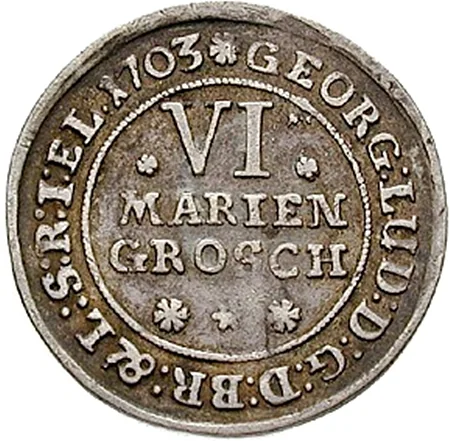
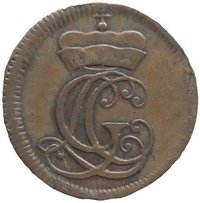
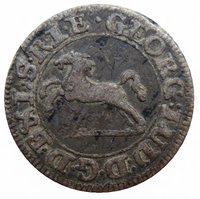
Obverse
Description:
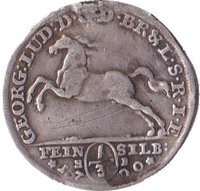
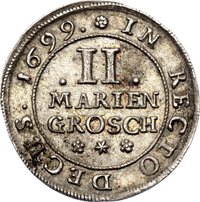
Denomination in circle, legend around, date at end.
Inscription:
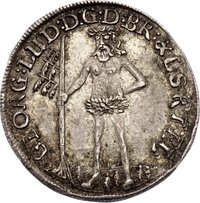
GEORG:LUD:D:G:D:BR:& L:S:R:I:EL.1703*
*VI*
MARIEN
GROSCH
***
*VI*
MARIEN
GROSCH
***
Script: Latin
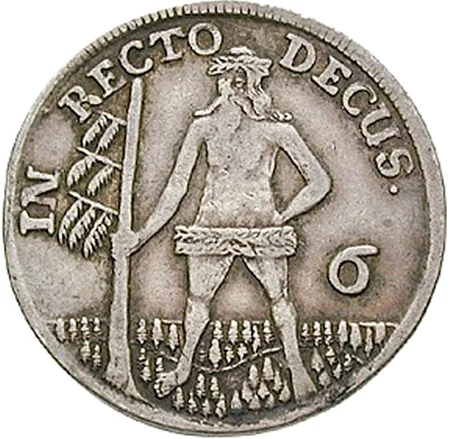
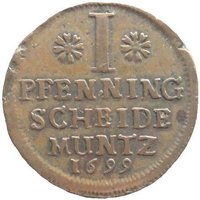
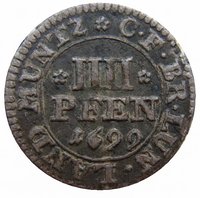
Reverse
Edge
Mintings
| Year | Mint Mark | Mintage | Quality | Collection |
|---|---|---|---|---|
| 1699 | — | — | ||
| 1700 | — | — | ||
| 1701 | — | — | ||
| 1702 | — | — | ||
| 1703 | — | — | ||
| 1704 | — | — | ||
| 1705 | — | — | ||
| 1706 | — | — | ||
| 1707 | — | — | ||
| 1708 | — | — | ||
| 1709 | — | — | ||
| 1710 | — | — | ||
| 1711 | — | — |
Historical background
In 1699, the currency situation in the Duchy of Brunswick-Lüneburg, specifically the Principality of Calenberg (with its capital in Hannover), was complex and fragmented, reflecting the broader monetary disarray of the Holy Roman Empire. The territory did not have a single, unified coinage system. Instead, it operated within a web of regional monetary conventions, most notably the Reichsthaler (Imperial Thaler) as a large silver accounting unit and the Gulden (florin) as a more common unit. However, daily commerce relied on a plethora of physically circulating coins, including various Groschen, Mariengroschen, and Pfennig denominations, often from neighboring mints or older issues, leading to chronic confusion over intrinsic silver content and exchange rates.
This instability was exacerbated by the active monetary policies of Duke George Louis (the future King George I of Great Britain). His mints, particularly in Hannover, were engaged in significant coinage debasement—reducing the precious metal content in newly minted coins while officially maintaining their face value. This practice, known as Kippermünze, was a short-term fiscal strategy to raise revenue for the duke’s considerable expenses, including his political ambitions and the maintenance of a standing army. Consequently, the public faced a dual system: older, "good" full-weight coins were hoarded or exported, while the newer, inferior coins flooded local markets, driving inflation and eroding trust.
The year 1699 sits within a period of ongoing monetary crisis that would prompt attempted reforms. The chaotic circulation hindered trade and created economic uncertainty for both merchants and the peasantry. While the Banko accounting system used in Hamburg provided some stability for large transactions, the everyday monetary experience in Calenberg-Hannover was one of complexity and depreciation. This untenable situation would eventually lead to more concerted, though still challenging, efforts at standardization and stabilization in the early 18th century under the guidance of officials like Leibniz.
This instability was exacerbated by the active monetary policies of Duke George Louis (the future King George I of Great Britain). His mints, particularly in Hannover, were engaged in significant coinage debasement—reducing the precious metal content in newly minted coins while officially maintaining their face value. This practice, known as Kippermünze, was a short-term fiscal strategy to raise revenue for the duke’s considerable expenses, including his political ambitions and the maintenance of a standing army. Consequently, the public faced a dual system: older, "good" full-weight coins were hoarded or exported, while the newer, inferior coins flooded local markets, driving inflation and eroding trust.
The year 1699 sits within a period of ongoing monetary crisis that would prompt attempted reforms. The chaotic circulation hindered trade and created economic uncertainty for both merchants and the peasantry. While the Banko accounting system used in Hamburg provided some stability for large transactions, the everyday monetary experience in Calenberg-Hannover was one of complexity and depreciation. This untenable situation would eventually lead to more concerted, though still challenging, efforts at standardization and stabilization in the early 18th century under the guidance of officials like Leibniz.
💎 Extremely Rare