

17 Kreuzers – Austrian Empire
Austria
Context
Years: 1751–1765
Country: Austria 
Issuer: Austrian Empire
Ruler: Francis I of Lorraine
Currency:
(1754—1857)
Demonetized: Yes
Material
References
KM: #Click to copy to clipboard2026.1
Numista: #79567
Value
Bullion value: $9.53
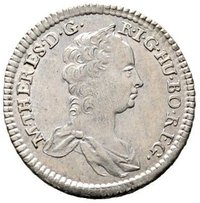
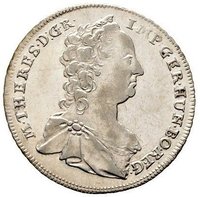
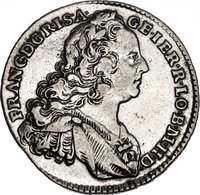
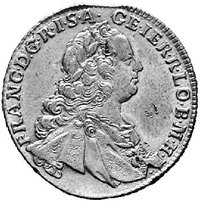
Obverse
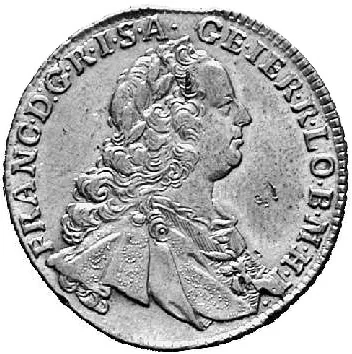
Description:
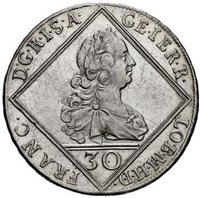
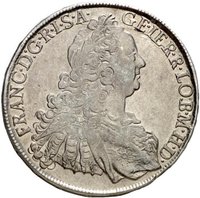
Right-facing laureate portrait with surrounding legend.
Inscription:
FRANC D G R I S A / GE IER R LO B M H D
Script: Latin
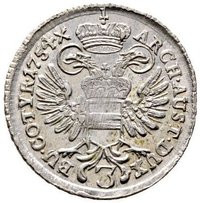
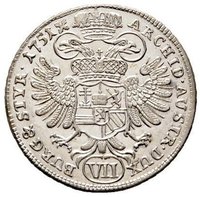
Reverse
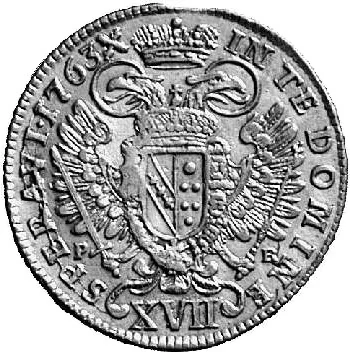
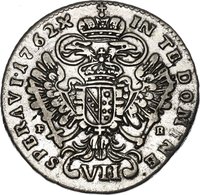
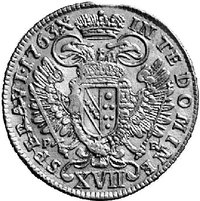
Description:
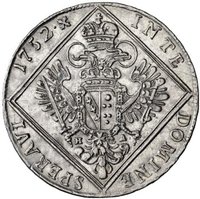
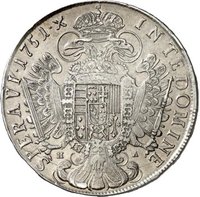
Double-headed imperial eagle with Lorraine and Tuscany arms. Value in Roman numerals below. Legend begins at 1 o'clock.
Inscription:
IN TE DOMINE SPERAVI
XVII
XVII
Script: Latin
Edge
Plain
Mints
| Name | Mark |
|---|---|
| Alba Iulia | CA |
| Graz | GR |
| Hall | HA |
| Kremnica | KB |
| Baia Mare | NB |
| Prague | PR |
| Münze Österreich | WI |
Mintings
| Year | Mint Mark | Mintage | Quality | Collection |
|---|---|---|---|---|
| 1751 | CA | — | ||
| 1751 | GR | — | ||
| 1751 | HA | — | ||
| 1751 | KB | — | ||
| 1751 | NB | — | ||
| 1751 | PR | — | ||
| 1751 | WI | — | ||
| 1752 | GR | — | ||
| 1752 | HA | — | ||
| 1752 | KB | — | ||
| 1752 | NB | — | ||
| 1752 | PR | — | ||
| 1752 | WI | — | ||
| 1753 | GR | — | ||
| 1753 | HA | — | ||
| 1753 | KB | — | ||
| 1753 | NB | — | ||
| 1753 | PR | — | ||
| 1753 | WI | — | ||
| 1754 | GR | — | ||
| 1754 | HA | — | ||
| 1754 | KB | — | ||
| 1754 | NB | — | ||
| 1754 | PR | — | ||
| 1755 | KB | — | ||
| 1755 | NB | — | ||
| 1756 | KB | — | ||
| 1757 | KB | — | ||
| 1758 | HA | — | ||
| 1758 | KB | — | ||
| 1759 | KB | — | ||
| 1760 | GR | — | ||
| 1760 | KB | — | ||
| 1761 | GR | — | ||
| 1761 | HA | — | ||
| 1761 | KB | — | ||
| 1762 | HA | — | ||
| 1762 | KB | — | ||
| 1762 | NB | — | ||
| 1762 | PR | — | ||
| 1762 | GR | — | ||
| 1763 | GR | — | ||
| 1763 | HA | — | ||
| 1763 | KB | — | ||
| 1763 | NB | — | ||
| 1763 | PR | — | ||
| 1764 | GR | — | ||
| 1764 | KB | — | ||
| 1764 | NB | — | ||
| 1765 | KB | — | ||
| 1765 | NB | — |
Historical background
In 1751, the currency situation within the Habsburg Monarchy, often referred to as the Austrian Empire, was characterized by significant complexity and ongoing reform. The state operated on a bimetallic system, nominally based on both silver and gold, but the reality was a chaotic mix of domestic and foreign coins circulating at varying values. The primary silver coin was the Conventionsthaler (or Konventionstaler), established by the monetary convention of 1750/1753 with Bavaria. This treaty aimed to standardize the silver content of large coins across southern Germany and the Habsburg lands, setting the Conventionstaler at a defined fineness. However, the system was not yet fully implemented or uniform across all hereditary lands.
Alongside these large silver coins, everyday commerce relied on a confusing plethora of smaller silver and copper coins, such as kreuzers and pfennigs. The value of these coins relative to the Conventionstaler often fluctuated, and their metal content was frequently debased by the state to generate seigniorage revenue, especially to pay for the recent War of the Austrian Succession (1740-1748). This practice eroded public trust and caused inflation, as the face value of coins exceeded their intrinsic metal worth. Furthermore, foreign coins, particularly Dutch and Saxon thalers, circulated widely, adding another layer of complication to trade and taxation.
Empress Maria Theresa and her advisors, notably Count Friedrich Wilhelm von Haugwitz, were actively engaged in centralizing state finances and administration during this period. The currency reforms embodied by the Conventionstaler were a part of this broader effort to create a more stable and unified economic space to strengthen the monarchy's fiscal and military power. While 1751 represents a point of transition toward greater standardization, the monetary landscape remained fragmented, with the government grappling with the legacy of war debt and the practical challenges of imposing order on a diverse and tradition-bound imperial economy.
Alongside these large silver coins, everyday commerce relied on a confusing plethora of smaller silver and copper coins, such as kreuzers and pfennigs. The value of these coins relative to the Conventionstaler often fluctuated, and their metal content was frequently debased by the state to generate seigniorage revenue, especially to pay for the recent War of the Austrian Succession (1740-1748). This practice eroded public trust and caused inflation, as the face value of coins exceeded their intrinsic metal worth. Furthermore, foreign coins, particularly Dutch and Saxon thalers, circulated widely, adding another layer of complication to trade and taxation.
Empress Maria Theresa and her advisors, notably Count Friedrich Wilhelm von Haugwitz, were actively engaged in centralizing state finances and administration during this period. The currency reforms embodied by the Conventionstaler were a part of this broader effort to create a more stable and unified economic space to strengthen the monarchy's fiscal and military power. While 1751 represents a point of transition toward greater standardization, the monetary landscape remained fragmented, with the government grappling with the legacy of war debt and the practical challenges of imposing order on a diverse and tradition-bound imperial economy.
💎 Very Rare