

6 Kreuzers – Austrian Empire
Austria

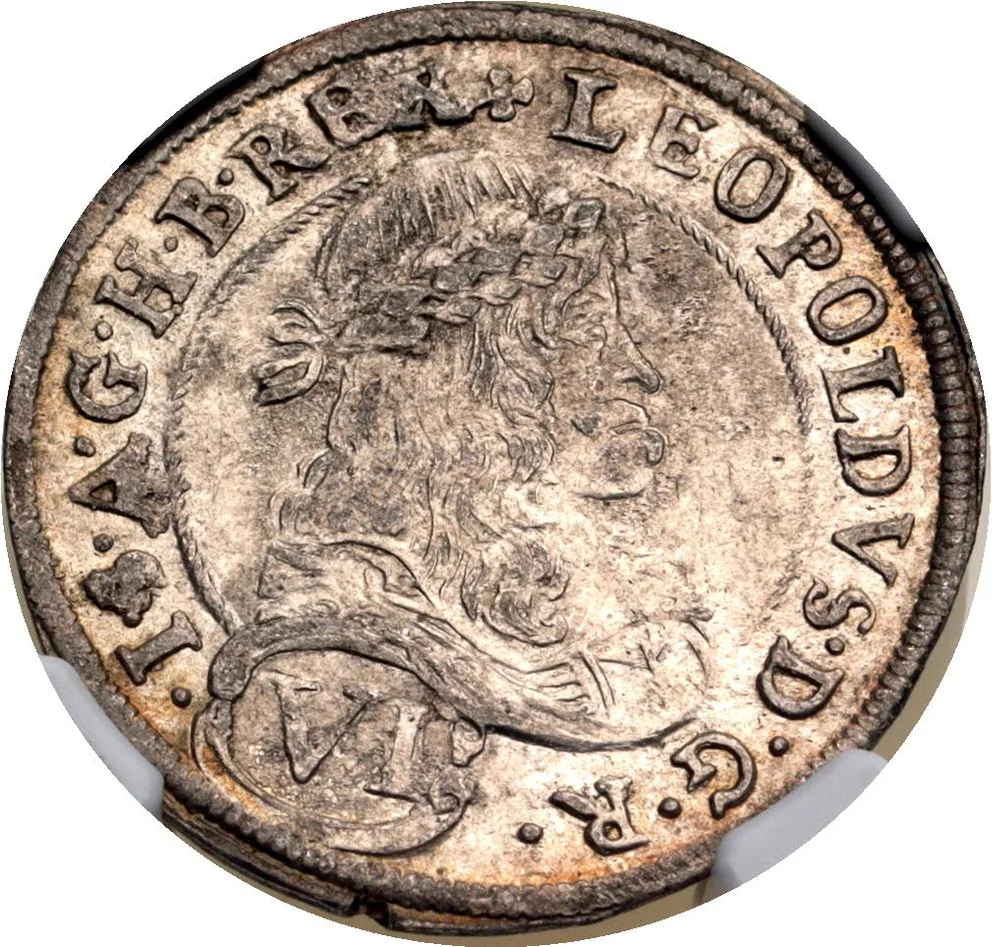
Obverse
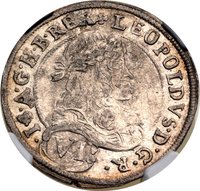
Description:
Laureate portrait in beaded circle. Value in frame below splits legend: R•I or I•S.
Inscription:
LEOPOLDVS D G R (VI) I S A G H B R
ou
LEOPOLDVS D G R I (VI) S A G H B R
ou
LEOPOLDVS D G R I (VI) S A G H B R
Script: Latin
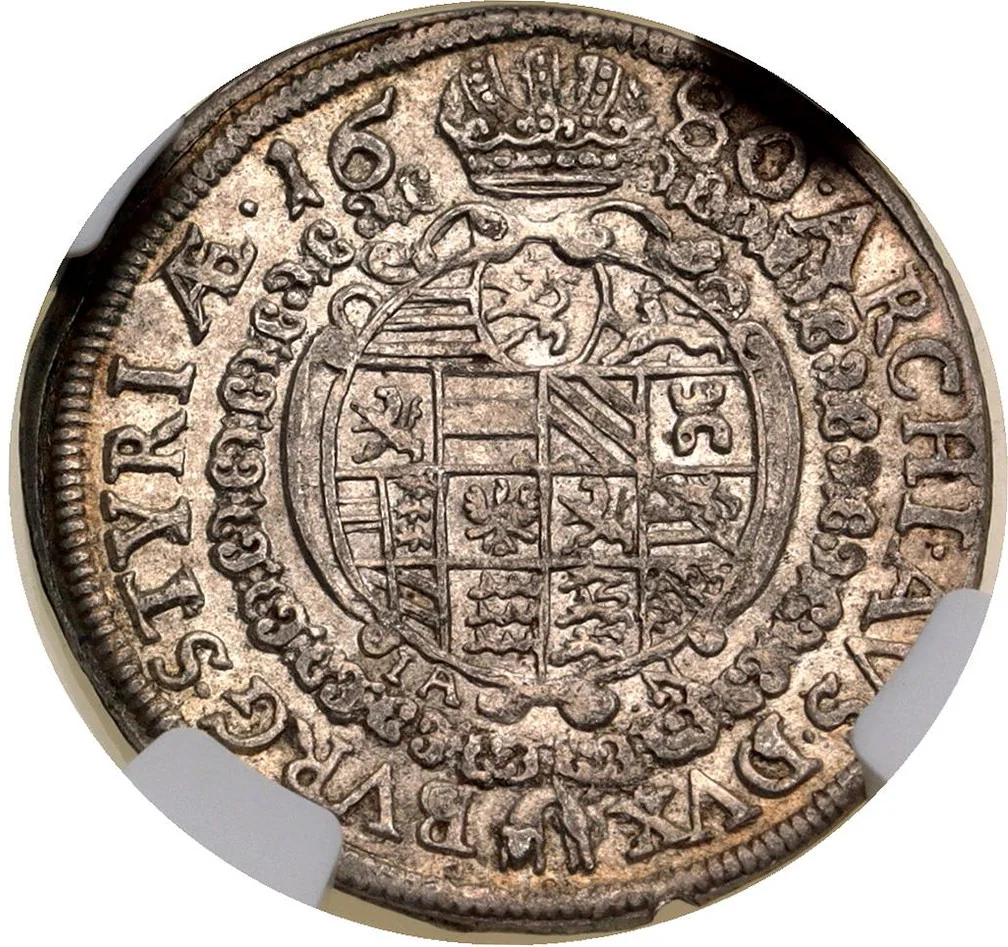
Reverse
Description:
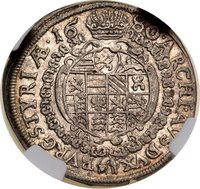
A crowned ornate shield with the arms of Styria, encircled by the Order of the Golden Fleece, divides the date. The mint mark is below.
Inscription:
ARCHID AVS D B STYRIÆ 1680
IAN
IAN
Script: Latin
Edge
Mints
| Name | Mark |
|---|---|
| Graz | — |
Mintings
| Year | Mint Mark | Mintage | Quality | Collection |
|---|---|---|---|---|
| 1676 | — | — | ||
| 1679 | — | — | ||
| 1680 | — | — | ||
| 1681 | — | — | ||
| 1682 | — | — | ||
| 1683 | — | — | ||
| 1684 | — | — | ||
| 1685 | — | — | ||
| 1686 | — | — | ||
| 1687 | — | — | ||
| 1688 | — | — | ||
| 1689 | — | — | ||
| 1690 | — | — | ||
| 1691 | — | — | ||
| 1692 | — | — |
Historical background
In 1676, the currency situation within the Habsburg-ruled Austrian Empire was complex and strained, characterized by a fragmented and debased monetary system. The Empire was not a unified economic entity; instead, its various lands—including Austria, Bohemia, and Hungary—operated with different regional currencies, such as the Reichsthaler, Kreuzer, and Gulden. The primary circulating coin was the silver Reichsthaler, but its value and silver content were not uniform across the realm, leading to confusion and hindering trade. Furthermore, decades of warfare, particularly the ongoing conflicts with the Ottoman Empire and the aftermath of the Thirty Years' War, had placed immense fiscal pressure on the Vienna court, often resolved by reducing the precious metal content in coins to mint more currency, a practice known as debasement.
This debasement led to severe inflation and a loss of public trust in the currency. As the state issued coins with lower intrinsic value, older, purer coins were hoarded or melted down (Gresham's Law in action), worsening the circulation of "bad money." This created a chaotic environment where exchange rates between the myriad of coins fluctuated wildly, and foreign merchants often demanded payment in older, trusted specie. The financial administration under Emperor Leopold I was aware of these problems but was largely reactive, prioritizing immediate military financing over systemic monetary reform. Consequently, the economy suffered from high transaction costs, price instability, and a general hindrance to commercial development.
Efforts to address this situation were piecemeal and largely ineffective in 1676. While there were periodic ordinances (Münzordnungen) aimed at standardizing coinage, enforcement across the Empire's diverse and semi-autonomous territories was weak. The power of local estates and minting rights held by various princes and cities often undermined central decrees from Vienna. Therefore, the year 1676 represents a point within a prolonged period of monetary disorder, where the Habsburg state's fiscal demands from near-continuous warfare directly conflicted with the need for a stable and uniform currency, a tension that would persist for decades.
This debasement led to severe inflation and a loss of public trust in the currency. As the state issued coins with lower intrinsic value, older, purer coins were hoarded or melted down (Gresham's Law in action), worsening the circulation of "bad money." This created a chaotic environment where exchange rates between the myriad of coins fluctuated wildly, and foreign merchants often demanded payment in older, trusted specie. The financial administration under Emperor Leopold I was aware of these problems but was largely reactive, prioritizing immediate military financing over systemic monetary reform. Consequently, the economy suffered from high transaction costs, price instability, and a general hindrance to commercial development.
Efforts to address this situation were piecemeal and largely ineffective in 1676. While there were periodic ordinances (Münzordnungen) aimed at standardizing coinage, enforcement across the Empire's diverse and semi-autonomous territories was weak. The power of local estates and minting rights held by various princes and cities often undermined central decrees from Vienna. Therefore, the year 1676 represents a point within a prolonged period of monetary disorder, where the Habsburg state's fiscal demands from near-continuous warfare directly conflicted with the need for a stable and uniform currency, a tension that would persist for decades.
⭐ Rare