

1 Schilling – Duchy of Livonia
Context
Years: 1587–1622
Country: Livonia
Issuer: Duchy of Livonia
Ruler: Sigismund III Vasa
Currency:
(1581—1629)
Subdivision: 1 Schilling = 1⁄108 Thaler
Demonetized: Yes
Material
Diameter: 18 mm
Weight: 0.85 g
Thickness: 0.4 mm
Shape: Round
Composition: Billon
Technique: Roller milled
References
KM: #Click to copy to clipboard5
Numista: #78799
Obverse
Description:
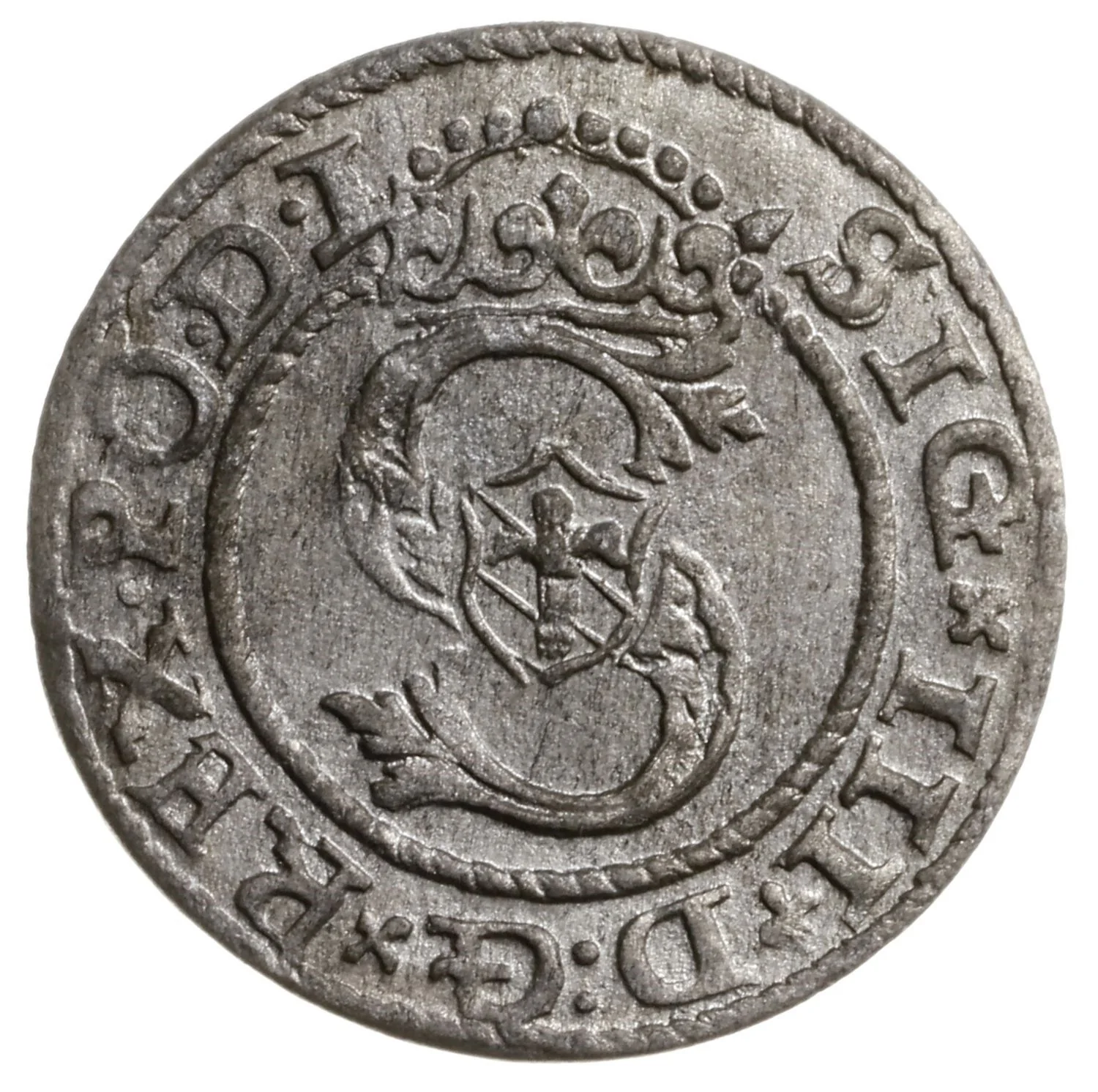
Crowned S monogram with Vasa arms, encircled by legend.
Inscription:
SIG : III : D : G : REX · PO · D · L
Script: Latin
Reverse
Description:
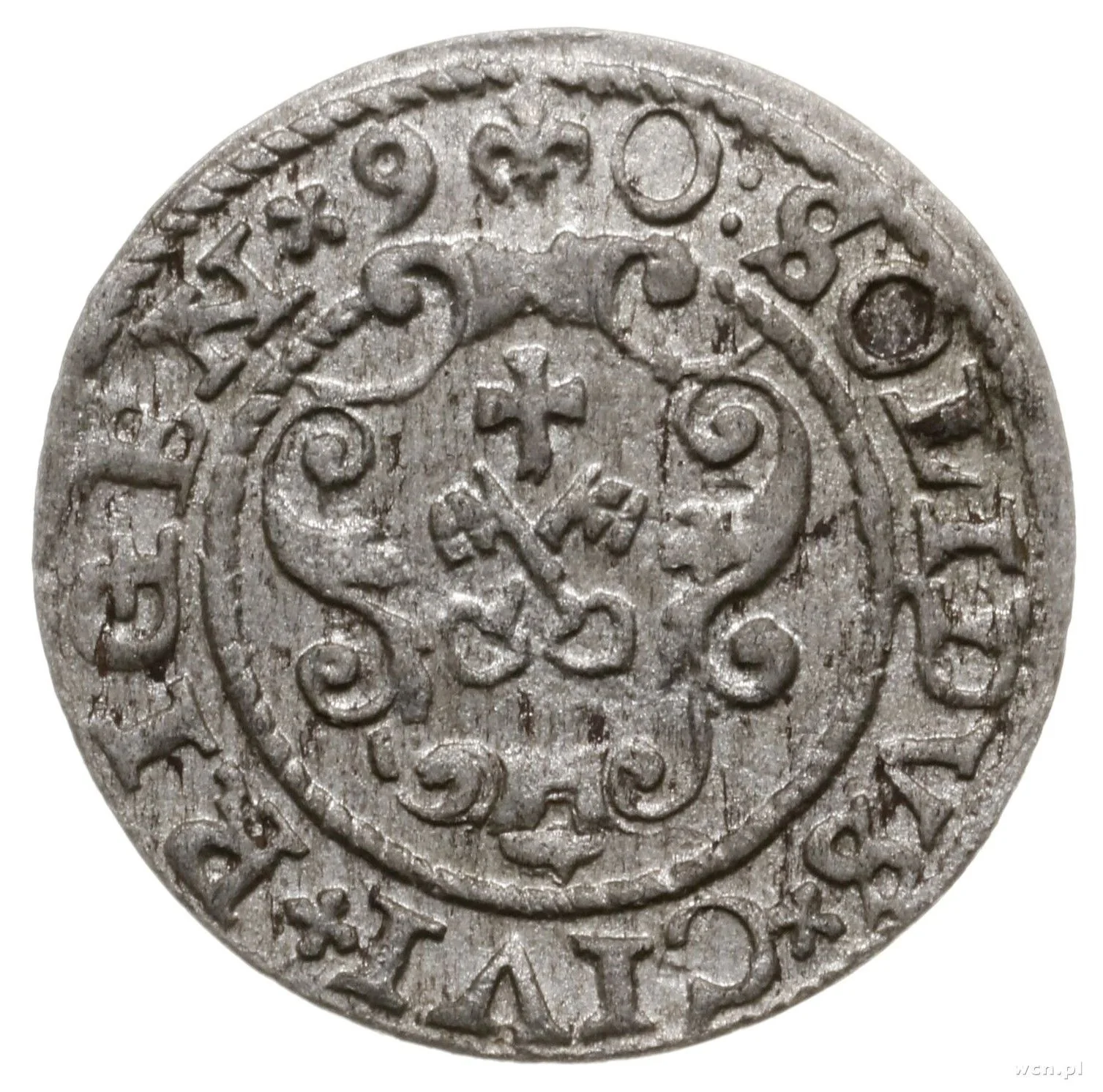
Crossed keys beneath a cross on a decorated shield, encircled by a legend.
Inscription:
SOLIDVS : CIVI : RIGENS : 9 - 0 :
Script: Latin
Edge
Plain
Mints
| Name | Mark |
|---|---|
| Riga | — |
Mintings
| Year | Mint Mark | Mintage | Quality | Collection |
|---|---|---|---|---|
| 1587 | — | — | ||
| — | — | — | ||
| 1588 | — | — | ||
| 1589 | — | — | ||
| 1590 | — | — | ||
| 1591 | — | — | ||
| 1592 | — | — | ||
| 1593 | — | — | ||
| 1594 | — | — | ||
| 1595 | — | — | ||
| 1596 | — | — | ||
| 1597 | — | — | ||
| 1598 | — | — | ||
| 1599 | — | — | ||
| 1600 | — | — | ||
| 1601 | — | — | ||
| 1602 | — | — | ||
| 1603 | — | — | ||
| 1604 | — | — | ||
| 1605 | — | — | ||
| 1606 | — | — | ||
| 1607 | — | — | ||
| 1609 | — | — | ||
| 1610 | — | — | ||
| 1612 | — | — | ||
| 1613 | — | — | ||
| 1614 | — | — | ||
| 1615 | — | — | ||
| 1616 | — | — | ||
| 1617 | — | — | ||
| 1618 | — | — | ||
| 1619 | — | — | ||
| 1620 | — | — | ||
| 1621 | — | — | ||
| 1622 | — | — |
Historical background
In 1587, the Duchy of Livonia, a fragile and contested polity, faced a severe and chaotic currency crisis. The Duchy, established in 1561 as a vassal state of the Grand Duchy of Lithuania (and later the Polish-Lithuanian Commonwealth after the Union of Lublin in 1569), was a strategic battleground during the Livonian War. The protracted conflict, which finally ended in 1583, had devastated the region's economy and disrupted trade, leaving the monetary system in disarray. The authority to mint coins, a key sovereign right, was poorly enforced, leading to a flood of debased and foreign coins circulating within its borders.
The primary issue was the proliferation of inferior currency, particularly small Lithuanian schillings and Polish ternars, which were minted in large quantities with low silver content. These "small coins" drove out better-quality money, as described by Gresham's Law, crippling everyday commerce. Furthermore, a vast amount of foreign coinage from neighboring states like Sweden, Russia, and the German principalities circulated unchecked, creating a confusing and unreliable monetary environment. The Duchy's own minting activity was inconsistent and insufficient to establish a stable standard, leaving merchants and peasants alike vulnerable to devaluation and fraud.
This monetary anarchy severely hampered economic recovery and state administration. It eroded trust in transactions, discouraged trade, and reduced the Duchy's already limited fiscal revenues, as taxes collected in debased coinage held little real value. The situation underscored the Duchy's weak sovereignty, as it lacked the power to control its own monetary space. Ultimately, the currency crisis of 1587 was a symptom of the broader political instability that would lead to the Duchy's full incorporation into the Polish-Lithuanian Commonwealth just a few years later, in 1598.
The primary issue was the proliferation of inferior currency, particularly small Lithuanian schillings and Polish ternars, which were minted in large quantities with low silver content. These "small coins" drove out better-quality money, as described by Gresham's Law, crippling everyday commerce. Furthermore, a vast amount of foreign coinage from neighboring states like Sweden, Russia, and the German principalities circulated unchecked, creating a confusing and unreliable monetary environment. The Duchy's own minting activity was inconsistent and insufficient to establish a stable standard, leaving merchants and peasants alike vulnerable to devaluation and fraud.
This monetary anarchy severely hampered economic recovery and state administration. It eroded trust in transactions, discouraged trade, and reduced the Duchy's already limited fiscal revenues, as taxes collected in debased coinage held little real value. The situation underscored the Duchy's weak sovereignty, as it lacked the power to control its own monetary space. Ultimately, the currency crisis of 1587 was a symptom of the broader political instability that would lead to the Duchy's full incorporation into the Polish-Lithuanian Commonwealth just a few years later, in 1598.
🌱 Fairly Common