

1 Schilling (Solidus / Silins) – Swedish Livonia
Context
Years: 1644–1645
Country: Livonia
Issuer: Swedish Livonia
Ruler: Christina
Currency:
(1629—1710)
Subdivision: 1 Schilling (Solidus / Silins) = 1⁄48 Thaler
Demonetized: Yes
Material
References
KM: #Click to copy to clipboard1
Numista: #78793
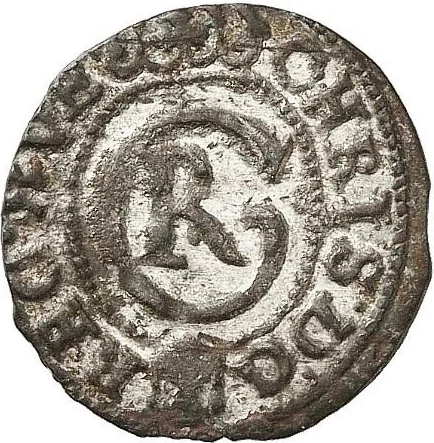
Obverse
Description:
Crowned monogram encircled by legend.
Inscription:
CHRIS · D · G - REG · SVE ·
CR
CR
Script: Latin
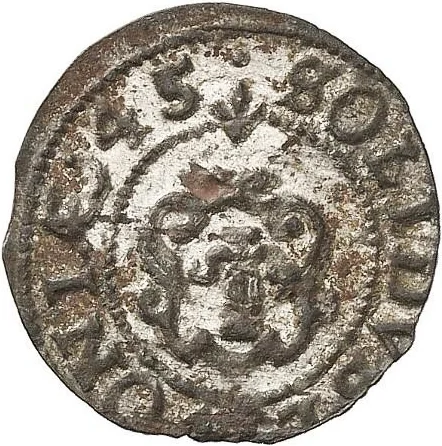
Reverse
Description:
Arms in shield, encircled by legend.
Inscription:
SOLIDVS · LIVONIÆ · 45 ·
Script: Latin
Edge
Plain
Mintings
| Year | Mint Mark | Mintage | Quality | Collection |
|---|---|---|---|---|
| 1644 | — | — | ||
| 1645 | — | — |
Historical background
In 1644, Swedish Livonia (encompassing modern-day Estonia and northern Latvia) was a war-torn province grappling with severe monetary instability. The ongoing Thirty Years' War (1618-1648) and concurrent conflicts like the Torstenson War with Denmark placed immense fiscal strain on the Swedish Empire. To finance its military ambitions, Stockholm heavily debased the coinage circulating in its Baltic dominions, flooding Livonia with low-quality copper mynt and heavily clipped silver coins. This created a chaotic multi-currency environment where older, full-value coins were hoarded, and the new, inferior coins were accepted only at a deep discount, leading to price inflation and mercantile distrust.
The situation was exacerbated by the presence of numerous foreign currencies, primarily Polish ort and schilling coins from neighbouring Polish Livonia, as well as German and Dutch thalers used in Baltic trade. These foreign coins, often of more reliable silver content, competed with the official Swedish currency, further complicating transactions. Local merchants and landlords effectively set their own exchange rates, creating a fragmented and unpredictable economic landscape. The provincial authorities in Riga struggled to enforce royal monetary ordinances, as the practical needs of commerce and the scarcity of good specie overrode official policy.
Ultimately, the currency chaos of 1644 reflected Livonia’s role as a financial frontier for the Swedish Empire—a buffer zone where the crown’s wartime fiscal expedients were felt most acutely. The debasement served as a hidden tax, extracting resources from the province to fund conflicts elsewhere, but at the cost of disrupting local agriculture and the vital Riga trade. This monetary instability would persist until after the wars' conclusion, when Sweden attempted broader currency reforms to consolidate its control over the Baltic economy.
The situation was exacerbated by the presence of numerous foreign currencies, primarily Polish ort and schilling coins from neighbouring Polish Livonia, as well as German and Dutch thalers used in Baltic trade. These foreign coins, often of more reliable silver content, competed with the official Swedish currency, further complicating transactions. Local merchants and landlords effectively set their own exchange rates, creating a fragmented and unpredictable economic landscape. The provincial authorities in Riga struggled to enforce royal monetary ordinances, as the practical needs of commerce and the scarcity of good specie overrode official policy.
Ultimately, the currency chaos of 1644 reflected Livonia’s role as a financial frontier for the Swedish Empire—a buffer zone where the crown’s wartime fiscal expedients were felt most acutely. The debasement served as a hidden tax, extracting resources from the province to fund conflicts elsewhere, but at the cost of disrupting local agriculture and the vital Riga trade. This monetary instability would persist until after the wars' conclusion, when Sweden attempted broader currency reforms to consolidate its control over the Baltic economy.
💎 Very Rare