

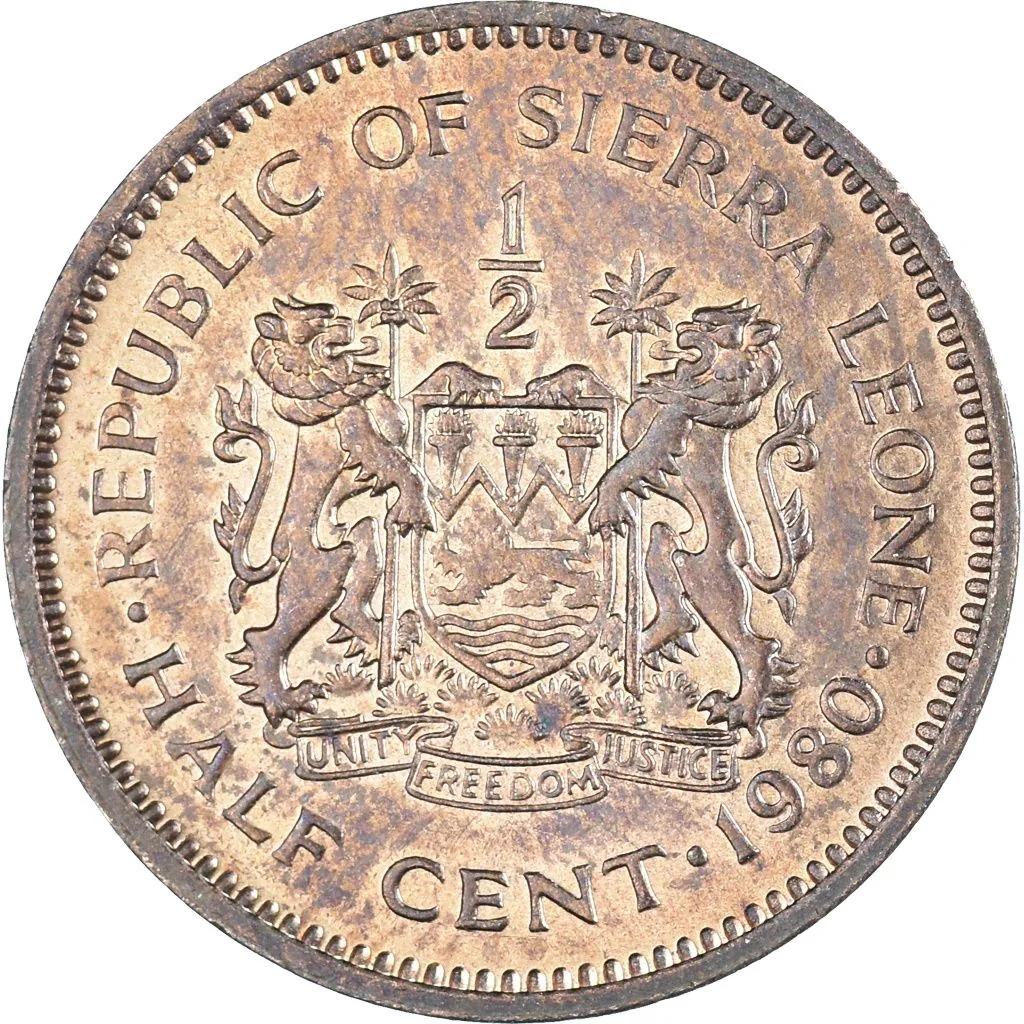
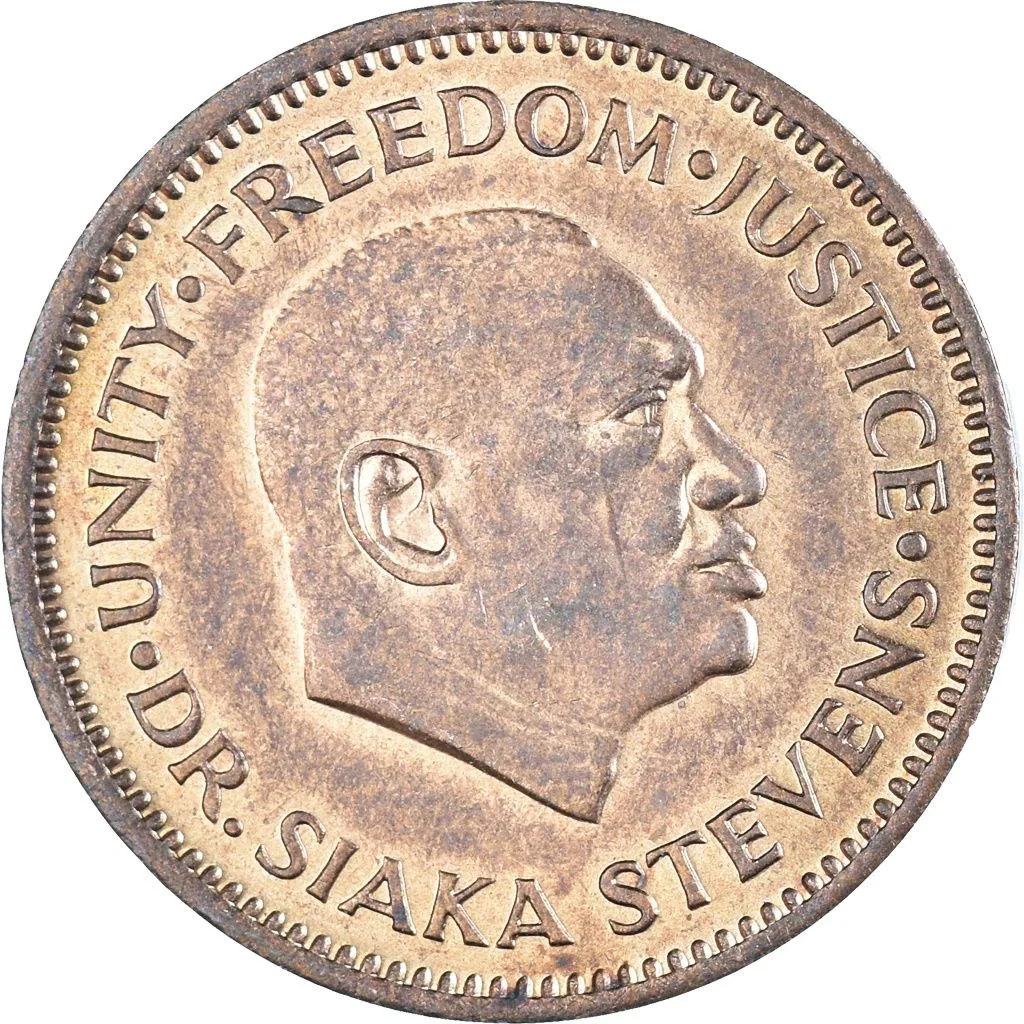
½ Cent – Sierra Leone
Sierra Leone
Context
Year: 1980
Issuer: Sierra Leone 
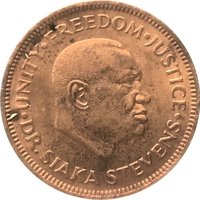
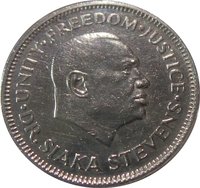
Ruler: Siaka Stevens
Currency:
(1964—2023)
Demonetization: 1 January 2024
Total mintage: 10,000
Material
References
KM: #Click to copy to clipboard31
Numista: #12000
Value
Exchange value: 0.005 SLL
Categories
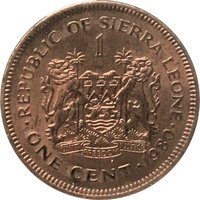
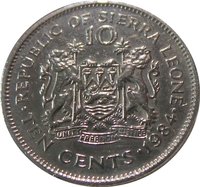
| Symbols> Coat of Arms |
| Animal> Feline |
| Person> Politician |
Mints
| Name | Mark |
|---|---|
| Royal Mint | — |
Mintings
| Year | Mint Mark | Mintage | Quality | Collection |
|---|---|---|---|---|
| 1980 | — | — | ||
| 1980 | — | 10,000 | Proof |
Historical background
In 1980, Sierra Leone's currency, the Leone, was in a period of relative but fragile stability, underpinned by the economic boom of the preceding decade. The discovery and exploitation of significant diamond and iron ore deposits in the 1970s had fueled growth and increased foreign exchange reserves. This allowed the country, under President Siaka Stevens' government, to maintain a fixed exchange rate pegged to a basket of currencies, with the Leone trading at a strong official rate of approximately 1 Leone to 2 U.S. dollars. This stability was largely artificial, supported by capital controls and the central bank's management of the limited foreign currency inflows from the mining sector.
However, this façade masked deep structural economic weaknesses. The economy was overwhelmingly dependent on a narrow base of mineral exports, particularly diamonds, which were plagued by widespread smuggling and corruption that siphoned off official revenues. The agricultural sector, once the backbone of the economy, had been neglected, leading to a growing need for expensive food imports. Furthermore, rampant government spending, patronage networks, and inefficient state-owned enterprises created persistent budget deficits, which were increasingly financed by borrowing from the central bank—a precursor to inflationary pressures.
Consequently, by the close of 1980, the foundations of the Leone's stability were eroding. While the official exchange rate remained fixed, a thriving black market for foreign currency had emerged, where the Leone traded at a significant discount, signaling a lack of confidence and a severe overvaluation. This dual exchange rate system highlighted the growing disconnect between government policy and economic reality, setting the stage for the severe currency depreciation and economic turmoil that would define Sierra Leone in the debt-laden and inflationary years of the 1980s.
However, this façade masked deep structural economic weaknesses. The economy was overwhelmingly dependent on a narrow base of mineral exports, particularly diamonds, which were plagued by widespread smuggling and corruption that siphoned off official revenues. The agricultural sector, once the backbone of the economy, had been neglected, leading to a growing need for expensive food imports. Furthermore, rampant government spending, patronage networks, and inefficient state-owned enterprises created persistent budget deficits, which were increasingly financed by borrowing from the central bank—a precursor to inflationary pressures.
Consequently, by the close of 1980, the foundations of the Leone's stability were eroding. While the official exchange rate remained fixed, a thriving black market for foreign currency had emerged, where the Leone traded at a significant discount, signaling a lack of confidence and a severe overvaluation. This dual exchange rate system highlighted the growing disconnect between government policy and economic reality, setting the stage for the severe currency depreciation and economic turmoil that would define Sierra Leone in the debt-laden and inflationary years of the 1980s.
🌱 Fairly Common