

20 Kreuzers – Austrian Empire
Austria
Context
Years: 1776–1780
Country: Austria 
Issuer: Austrian Empire
Ruler: Joseph II
Currency:
(1754—1857)
Demonetized: Yes
Material
References
KM: #Click to copy to clipboard2067.2
Numista: #78626
Value
Bullion value: $11.26
Obverse
Description:
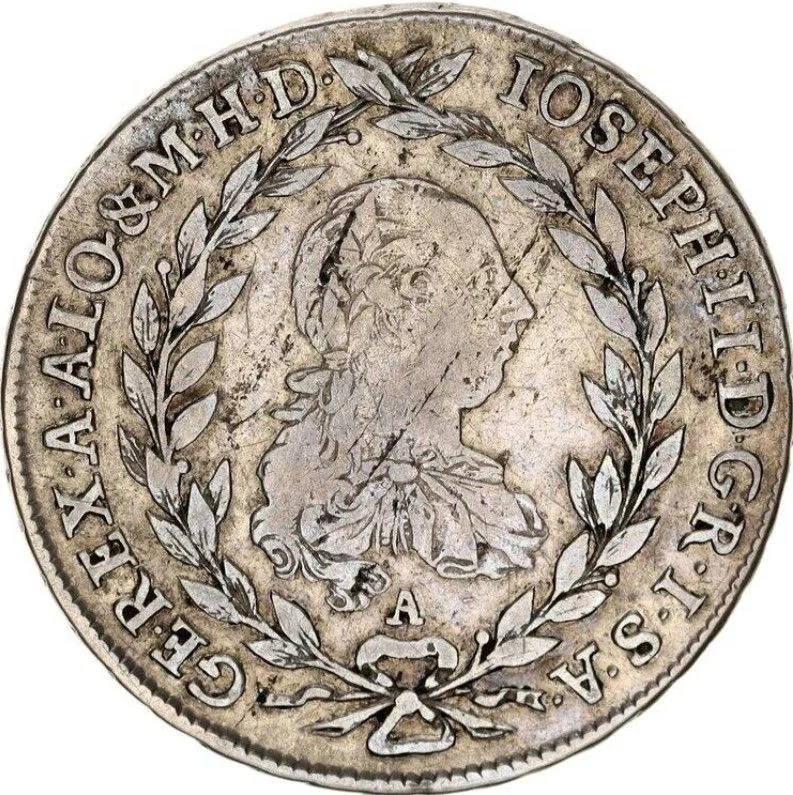
Laureate bust right in wreath, no lion on shoulder. Mintmark below. Legend begins at 1 o'clock.
Inscription:
IOSEPH · II · D · G · R · I · S · A · GE · REX · A · A · LO & M · H · D ·
Script: Latin
Reverse
Description:
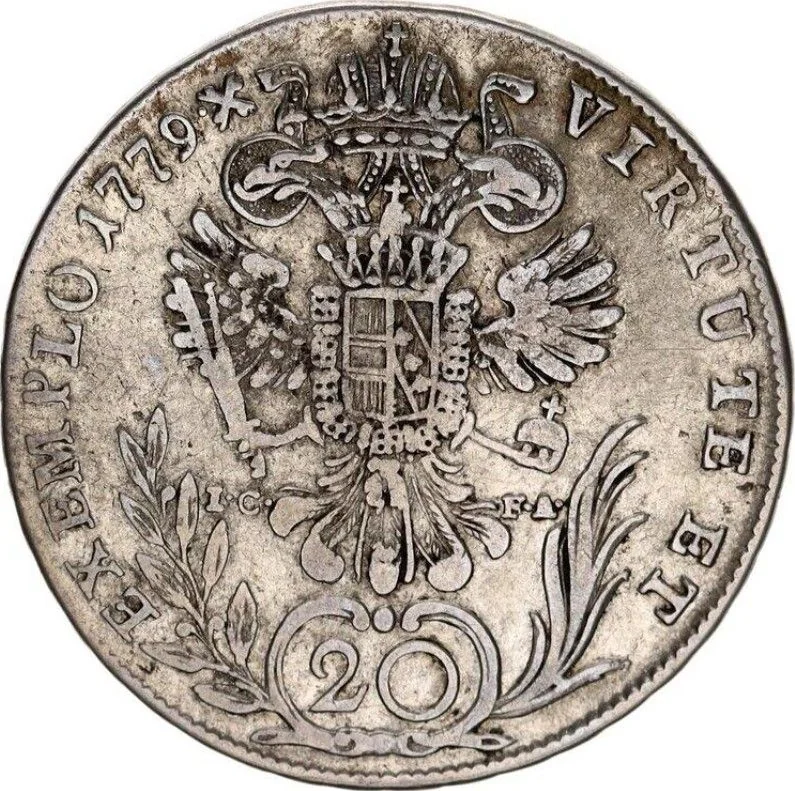
Imperial double-headed eagle with Austria-Lorraine arms. Value in laurel and palm frame. Mintmarks flank tail feathers.
Inscription:
VIRTUTE ET EXEMPLO · 1779 X
I.C. F.A.
20
I.C. F.A.
20
Script: Latin
Edge
Plain
Mints
| Name | Mark |
|---|---|
| Münze Österreich | A |
| Kremnica | B |
| Alba Iulia | E |
Mintings
Historical background
In 1776, the Habsburg Monarchy, often referred to as the Austrian Empire, operated under a complex and strained currency system. The core unit was the Conventionsthaler (or Konventionstaler), established by the monetary convention of 1753 with Bavaria. This silver-based thaler was the standard for large transactions and state finance, divided into 120 Kreuzer. However, the empire was not a unified economic zone; its diverse lands, including Austria, Bohemia, Hungary, and the Austrian Netherlands, also circulated a plethora of regional and local coins, creating a cumbersome environment for trade.
The system was under significant pressure due to the financial demands of state-building and military conflicts, notably the recent Seven Years' War (1756-1763). To raise funds, the state had increasingly resorted to debasement—reducing the precious metal content in coins—and the issuance of low-quality subsidiary coinage. This practice, while providing short-term revenue, led to inflation, a loss of public confidence, and Gresham's Law in action, where "bad" money (debased coins) drove "good" money (full-weight silver) out of circulation and often abroad.
Consequently, by 1776, Empress Maria Theresa and her advisors, particularly Chancellor Kaunitz, were grappling with the consequences of a weakened currency. The disparity between the official Convention standard and the actual circulating medium caused economic friction and hampered central control. This unstable monetary environment underscored the broader challenges of administering a fragmented empire and set the stage for future, though only partially successful, attempts at fiscal and monetary reform in the following decades.
The system was under significant pressure due to the financial demands of state-building and military conflicts, notably the recent Seven Years' War (1756-1763). To raise funds, the state had increasingly resorted to debasement—reducing the precious metal content in coins—and the issuance of low-quality subsidiary coinage. This practice, while providing short-term revenue, led to inflation, a loss of public confidence, and Gresham's Law in action, where "bad" money (debased coins) drove "good" money (full-weight silver) out of circulation and often abroad.
Consequently, by 1776, Empress Maria Theresa and her advisors, particularly Chancellor Kaunitz, were grappling with the consequences of a weakened currency. The disparity between the official Convention standard and the actual circulating medium caused economic friction and hampered central control. This unstable monetary environment underscored the broader challenges of administering a fragmented empire and set the stage for future, though only partially successful, attempts at fiscal and monetary reform in the following decades.
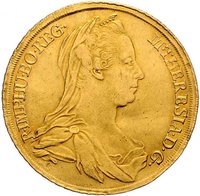
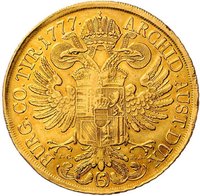
💎 Extremely Rare