

1 Thaler – Austrian Empire
Austria
Context
Years: 1773–1780
Country: Austria 
Issuer: Austrian Empire
Ruler: Joseph II
Currency:
(1754—1857)
Demonetized: Yes
Material
References
KM: #Click to copy to clipboard2075
Numista: #314647
Value
Bullion value: $81.76
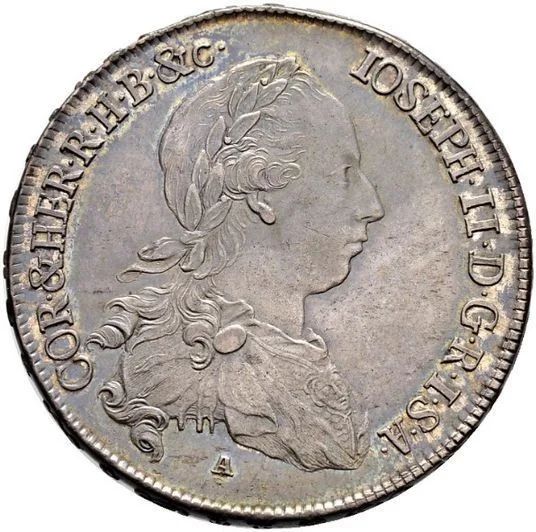
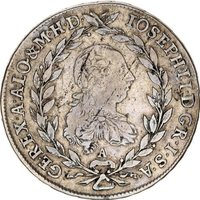
Obverse
Description:
Laureate head right
Inscription:
IOSEPH : II • D : G • R • I • S • A • COR • & • HER • R • H • B • & c•
A
A
Script: Latin
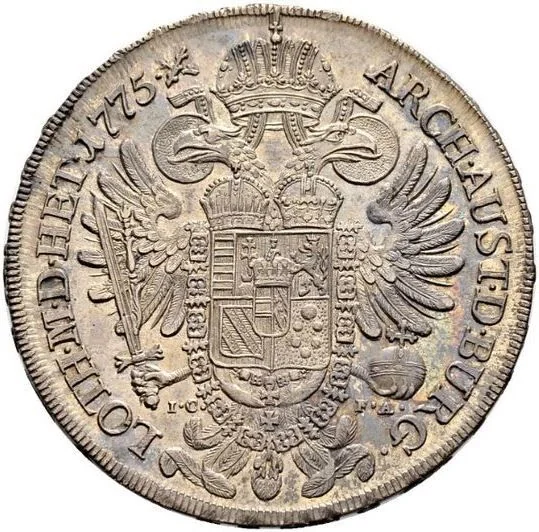
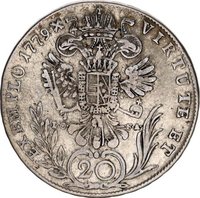
Reverse
Description:
Imperial double-headed eagle
Inscription:
ARCH • AUST • D • BURG LOTH • M • D • HET • 1775 •
I • C • F • A •
I • C • F • A •
Script: Latin
Edge
Mints
| Name | Mark |
|---|---|
| Münze Österreich | — |
Mintings
| Year | Mint Mark | Mintage | Quality | Collection |
|---|---|---|---|---|
| 1773 | IC-SK | — | ||
| 1774 | IC-FA | — | ||
| 1774 | IC-SK | — | ||
| 1775 | IC-FA | — | ||
| 1776 | IC-FA | — | ||
| 1778 | IC-FA | — | ||
| 1779 | IC-FA | — | ||
| 1780 | IC-FA | — |
Historical background
In 1773, the currency situation within the Habsburg Monarchy, often referred to as the Austrian Empire, was characterized by significant complexity and instability. The core of the problem was a chronic state of fiscal distress, exacerbated by the enormous costs of the Seven Years' War (1756-1763) and ongoing military expenditures. To finance these debts, the state had increasingly resorted to debasing the coinage, particularly the silver Conventionsthaler and the smaller Kreuzer coins. This meant reducing the precious metal content, leading to a proliferation of underweight and inferior coins in circulation and a severe loss of public confidence in the currency.
The monetary landscape was further complicated by a fragmented system. While the Conventionsthaler (valued at 2 Gulden or 120 Kreuzer) served as a theoretical standard based on the 1753 Bavarian-Austrian monetary convention, its real value was undermined. Alongside official coinage, various older regional issues and foreign coins circulated, creating a chaotic exchange environment. This period also saw a rise in the use of paper money, not as official banknotes, but as Einlösungsscheine (redemption notes), essentially government IOUs issued to pay suppliers and soldiers. These often traded at a steep discount to their face value, adding another layer of de facto depreciation.
Empress Maria Theresa and her advisors, notably State Chancellor Prince Kaunitz, were acutely aware of the damaging economic effects of this monetary confusion, which hampered trade, tax collection, and state credit. The year 1773 fell within a period of attempted reform. Efforts were focused on stabilizing the coinage by improving minting standards and controlling the money supply. However, comprehensive and successful monetary unification would remain elusive until the major reforms initiated by Count Kübeck in the mid-19th century. Thus, 1773 represents a point of ongoing struggle, where the pressures of war debt and administrative fragmentation continued to challenge the monarchy's quest for a stable and uniform currency.
The monetary landscape was further complicated by a fragmented system. While the Conventionsthaler (valued at 2 Gulden or 120 Kreuzer) served as a theoretical standard based on the 1753 Bavarian-Austrian monetary convention, its real value was undermined. Alongside official coinage, various older regional issues and foreign coins circulated, creating a chaotic exchange environment. This period also saw a rise in the use of paper money, not as official banknotes, but as Einlösungsscheine (redemption notes), essentially government IOUs issued to pay suppliers and soldiers. These often traded at a steep discount to their face value, adding another layer of de facto depreciation.
Empress Maria Theresa and her advisors, notably State Chancellor Prince Kaunitz, were acutely aware of the damaging economic effects of this monetary confusion, which hampered trade, tax collection, and state credit. The year 1773 fell within a period of attempted reform. Efforts were focused on stabilizing the coinage by improving minting standards and controlling the money supply. However, comprehensive and successful monetary unification would remain elusive until the major reforms initiated by Count Kübeck in the mid-19th century. Thus, 1773 represents a point of ongoing struggle, where the pressures of war debt and administrative fragmentation continued to challenge the monarchy's quest for a stable and uniform currency.
✨ Legendary