

20 réis – Brazil
Add to wishlist
Brazil
Obverse
Description:
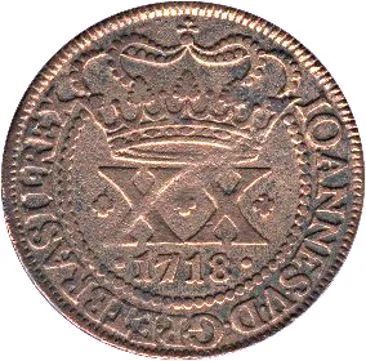
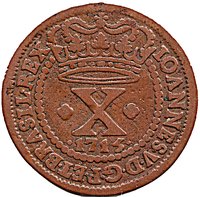
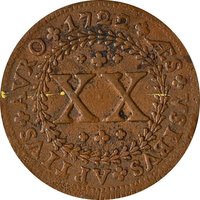
Pearl circle with crown, enclosing flowers, date, and value XX.
Inscription:
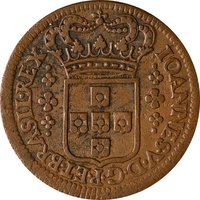
JOHANNES.V.D.G.P.ET.BRASIL.REX
+X+X+
·1718·
+X+X+
·1718·
Script: Latin
Reverse
Edge
Plain
Mints
| Name | Mark |
|---|---|
| Imprensa Nacional - Casa da Moeda | — |
Mintings
| Year | Mint Mark | Mintage | Quality | Collection |
|---|---|---|---|---|
| 1715 | — | — | ||
| 1718 | — | — | ||
| 1719 | — | — | ||
| 1729 | — | — |
Historical background
In 1715, Brazil was a Portuguese colony experiencing profound economic strain due to a severe shortage of metallic currency. The primary economic engine was sugar, but the industry was in decline due to competition from other colonies. While gold had been discovered in Minas Gerais around 1695, the initial boom had not yet translated into a stable, regulated coinage system for local use. Most gold was shipped to Portugal as bullion or dust, leaving the colony with a chronic lack of coins for everyday transactions. This scarcity crippled internal trade and complicated tax collection, forcing a reliance on cumbersome commodity money, barter, and even sugar itself as a medium of exchange.
The Portuguese Crown, under King João V, recognized the crisis and took decisive action. In 1694, the Casa da Moeda (Mint) had been established in Bahia, but it was relocated to Rio de Janeiro in 1698 due to the gold discoveries. By 1715, the mint in Rio was actively striking gold coins, but the most significant response to the currency famine was the royal decree of 1714, which ordered the minting of low-denomination silver coins specifically for circulation in Brazil. These coins, known as patacas, began production in 1715 and were crucial as they provided a much-needed fractional currency for daily commerce, distinct from the high-value gold coins.
Thus, 1715 represents a pivotal year of transition. It marked the beginning of a more organized monetary system aimed at servicing the local economy, rather than merely extracting wealth for the metropolis. The introduction of silver coinage was a direct attempt to alleviate the chronic shortage of means of payment and to formalize the economy of a colony whose wealth, particularly from gold, was becoming increasingly vital to the Portuguese Empire. However, underlying tensions remained, as Portugal maintained strict mercantilist controls, ensuring that the ultimate benefit of Brazil's mineral wealth flowed back to the crown.
The Portuguese Crown, under King João V, recognized the crisis and took decisive action. In 1694, the Casa da Moeda (Mint) had been established in Bahia, but it was relocated to Rio de Janeiro in 1698 due to the gold discoveries. By 1715, the mint in Rio was actively striking gold coins, but the most significant response to the currency famine was the royal decree of 1714, which ordered the minting of low-denomination silver coins specifically for circulation in Brazil. These coins, known as patacas, began production in 1715 and were crucial as they provided a much-needed fractional currency for daily commerce, distinct from the high-value gold coins.
Thus, 1715 represents a pivotal year of transition. It marked the beginning of a more organized monetary system aimed at servicing the local economy, rather than merely extracting wealth for the metropolis. The introduction of silver coinage was a direct attempt to alleviate the chronic shortage of means of payment and to formalize the economy of a colony whose wealth, particularly from gold, was becoming increasingly vital to the Portuguese Empire. However, underlying tensions remained, as Portugal maintained strict mercantilist controls, ensuring that the ultimate benefit of Brazil's mineral wealth flowed back to the crown.
⭐ Rare