

10 réis – Brazil
Add to wishlist
Brazil
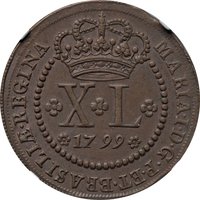
Obverse
Description:
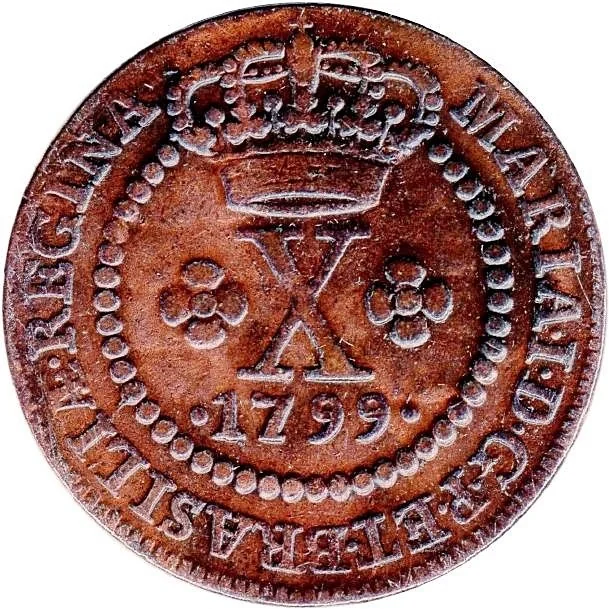
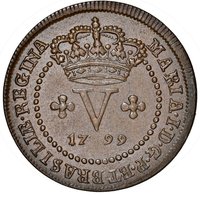
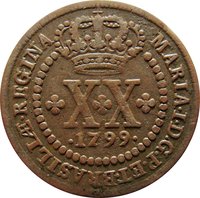
Flowers and date flanking value X, encircled by pearls and crowned.
Inscription:
MARIA.I.D.G.P.ET.BRASILIÆ.REGINA
+X+
·1799·
+X+
·1799·
Script: Latin
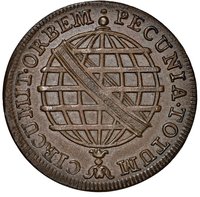
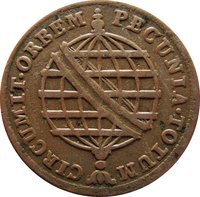
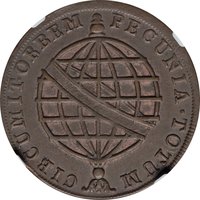
Reverse
Edge
Plain
Mints
| Name | Mark |
|---|---|
| Imprensa Nacional - Casa da Moeda | — |
Mintings
| Year | Mint Mark | Mintage | Quality | Collection |
|---|---|---|---|---|
| 1799 | — | — |
Historical background
In 1799, Brazil's currency situation was characterized by severe instability and scarcity, a direct consequence of Portugal's colonial economic policies. The Portuguese Crown tightly controlled Brazil's economy, mandating that all gold and diamonds extracted from the colony be sent directly to Lisbon. This drain of precious metals, combined with a chronic trade deficit with Portugal, left the colony with a critical shortage of coinage for daily transactions. The primary circulating coins were Portuguese réis, but their physical scarcity was so acute that it stifled internal commerce and led to widespread use of barter in many regions.
The colonial administration attempted to address this crisis through the issuance of paper money, a relatively novel and controversial solution. In 1799, the first official banknotes, known as bilhetes de caixa (cash notes), were emitted by the Casa da Moeda (the Mint) in Rio de Janeiro. These notes were intended to facilitate larger commercial transactions and pay government expenses, but they faced immediate public distrust. Their value was not firmly backed by specie (gold or silver), and they were not universally accepted, circulating mainly in the capital and its immediate vicinity while being viewed with skepticism elsewhere.
This monetary experiment unfolded amidst a backdrop of broader economic strain. The late 18th century saw a decline in gold production from the Minas Gerais region, reducing the colony's most important export. Furthermore, Portugal's own financial difficulties, exacerbated by the Napoleonic Wars, placed additional pressure on Brazil. Consequently, the currency landscape of 1799 was one of fragmentation: a mix of scarce and often adulterated metal coins, limited and distrusted paper notes, and primitive credit instruments, all of which hindered economic development and sowed the seeds for future inflationary troubles in the decades leading to independence.
The colonial administration attempted to address this crisis through the issuance of paper money, a relatively novel and controversial solution. In 1799, the first official banknotes, known as bilhetes de caixa (cash notes), were emitted by the Casa da Moeda (the Mint) in Rio de Janeiro. These notes were intended to facilitate larger commercial transactions and pay government expenses, but they faced immediate public distrust. Their value was not firmly backed by specie (gold or silver), and they were not universally accepted, circulating mainly in the capital and its immediate vicinity while being viewed with skepticism elsewhere.
This monetary experiment unfolded amidst a backdrop of broader economic strain. The late 18th century saw a decline in gold production from the Minas Gerais region, reducing the colony's most important export. Furthermore, Portugal's own financial difficulties, exacerbated by the Napoleonic Wars, placed additional pressure on Brazil. Consequently, the currency landscape of 1799 was one of fragmentation: a mix of scarce and often adulterated metal coins, limited and distrusted paper notes, and primitive credit instruments, all of which hindered economic development and sowed the seeds for future inflationary troubles in the decades leading to independence.
Series: 1799 Brazil circulation coins
⭐ Rare