

30 kreuzer – Austrian Empire
Add to wishlist
Austria
Context
Years: 1744–1745
Country: Austria
Issuer: Austrian Empire
Ruler: Maria Theresa
Currency:
(1520—1754)
Demonetized: Yes
Material
References
KM: #
Numista: #78398
Value
Bullion value: $17.52
Obverse
Description:
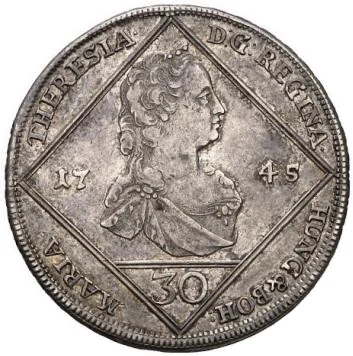
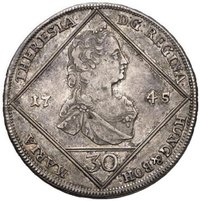
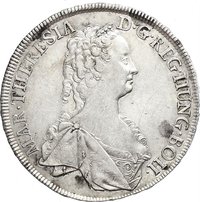
Maria Theresia's right-facing portrait divides the date, with the value below a line, all within a legend-dividing rhombus.
Inscription:
MARIA / THERESIA / D G REGINA / HUNG & BOH
Script: Latin
Reverse
Description:
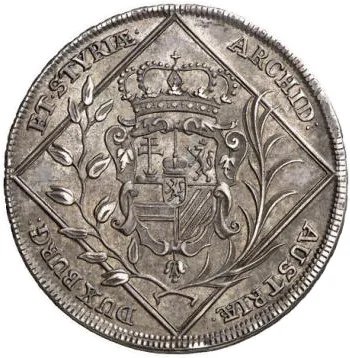
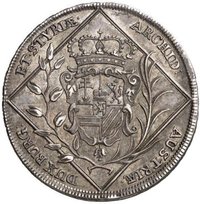
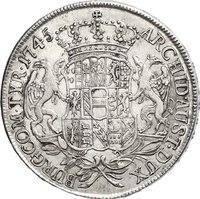
Crowned arms within a wreath and a rhombus, featuring the Hungarian cross, Bohemian lion, Austrian and Burgundian arms, and central Styrian arms. Legend: "Archidux Austriae Dux Burgundiae et Styriae."
Inscription:
ARCHID / AUSTRIÆ / DUX BURG / ET STYRIÆ
Script: Latin
Edge
Mints
| Name | Mark |
|---|---|
| Graz | — |
Mintings
| Year | Mint Mark | Mintage | Quality | Collection |
|---|---|---|---|---|
| 1744 | — | — | ||
| 1745 | — | — |
Historical background
In 1744, the currency system of the Habsburg Monarchy (often called the Austrian Empire) was a complex and fragile patchwork, still reeling from the financial strains of the ongoing War of the Austrian Succession (1740-1748). The state treasury, depleted by the conflict and the loss of the wealthy province of Silesia to Prussia, relied heavily on the debasement of coinage to fund military campaigns. The primary silver coin, the Conventionsthaler, and its smaller denominations, were repeatedly minted with reduced silver content, leading to a proliferation of inferior coins and a severe loss of public confidence.
This period was marked by a chaotic duality in circulation. Older, full-value silver coins from earlier mints were hoarded by the population, disappearing from everyday use according to Gresham's Law ("bad money drives out good"). In their place, the new, lightweight coins and heavily debased copper Kreuzers flooded the market, causing price inflation and disrupting trade, particularly for the common people who used small change. Furthermore, the empire's various crown lands (like Hungary, Bohemia, and Austria itself) often had differing monetary practices, adding to the administrative confusion.
The situation prompted ongoing, but largely ineffective, attempts at reform. The state's urgent need for war finance consistently overrode long-term monetary stability. While officials understood the need for a uniform and sound currency, the practical solution in 1744 was continued manipulation. It was not until after the war, with the great reform of Empress Maria Theresa in 1753 and the establishment of the unified Conventionsthaler standard, that a more stable and trusted currency system was finally imposed across the Habsburg domains. Thus, 1744 represents a low point of inflationary crisis and monetary disorder within the protracted struggle to create a cohesive imperial economy.
This period was marked by a chaotic duality in circulation. Older, full-value silver coins from earlier mints were hoarded by the population, disappearing from everyday use according to Gresham's Law ("bad money drives out good"). In their place, the new, lightweight coins and heavily debased copper Kreuzers flooded the market, causing price inflation and disrupting trade, particularly for the common people who used small change. Furthermore, the empire's various crown lands (like Hungary, Bohemia, and Austria itself) often had differing monetary practices, adding to the administrative confusion.
The situation prompted ongoing, but largely ineffective, attempts at reform. The state's urgent need for war finance consistently overrode long-term monetary stability. While officials understood the need for a uniform and sound currency, the practical solution in 1744 was continued manipulation. It was not until after the war, with the great reform of Empress Maria Theresa in 1753 and the establishment of the unified Conventionsthaler standard, that a more stable and trusted currency system was finally imposed across the Habsburg domains. Thus, 1744 represents a low point of inflationary crisis and monetary disorder within the protracted struggle to create a cohesive imperial economy.
✨ Legendary