

6 Kreuzers – Austrian Empire
Austria
Context
Year: 1747
Country: Austria 
Issuer: Austrian Empire
Ruler: Maria Theresa
Currency:
(1520—1754)
Demonetized: Yes
Material
References
KM: #Click to copy to clipboard1753
Numista: #78392
Value
Bullion value: $9.23
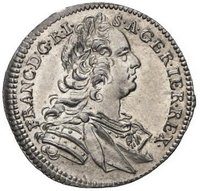
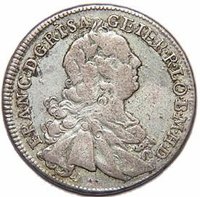
Obverse
Description:
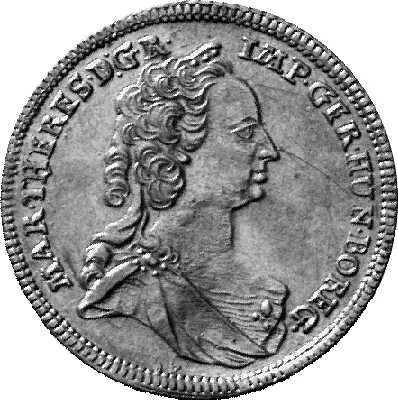
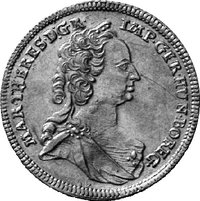
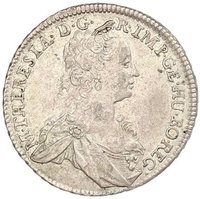
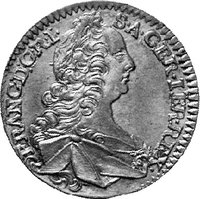
Bust of Maria Theresia facing right. Legend: "MARIA THERESIA D G ROM IMP GER HUNG BOH REG".
Inscription:
MAR THERES D G R / IMP GER HUN BO REG
Script: Latin
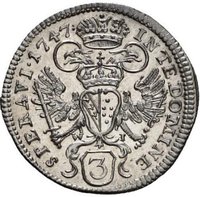
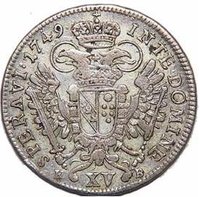
Reverse
Description:
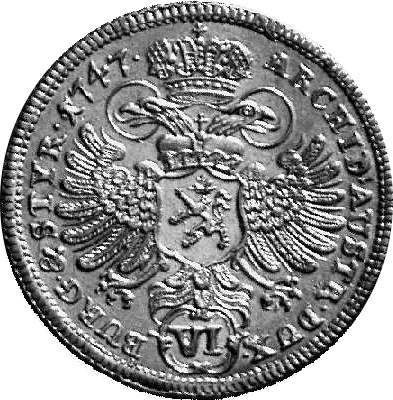
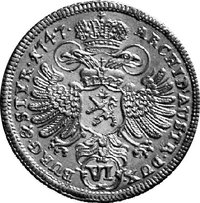
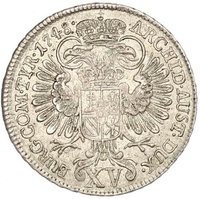
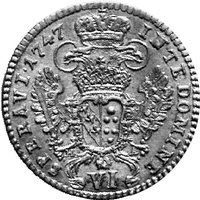
Imperial double eagle with Styrian panther shield, Roman numeral value below. Legend: "Archiducisa Austriae Ducisa Burgundiae et Styriae."
Inscription:
ARCHID AVSTR DVX / BVRG & STYR 1747
Script: Latin
Edge
Mints
| Name | Mark |
|---|---|
| Graz | — |
Mintings
| Year | Mint Mark | Mintage | Quality | Collection |
|---|---|---|---|---|
| 1747 | — | — |
Historical background
In 1747, the Habsburg Monarchy, commonly referred to as the Austrian Empire, was grappling with a severe and protracted currency crisis rooted in the financial demands of continuous warfare. The recent War of the Austrian Succession (1740-1748) had drained the state's coffers, forcing the government to engage in the debasement of the coinage. By reducing the precious metal content in coins while maintaining their face value, the state aimed to create more money to pay for military expenses. This practice, however, led to a proliferation of underweight and inferior coins, causing widespread inflation, a loss of public confidence in the currency, and economic instability.
The monetary system was a complex and fragmented patchwork, complicating any resolution. While the central authorities in Vienna issued Konventionsmünzen (convention coins), various constituent lands within the Empire, such as Bohemia and Hungary, also retained the right to mint their own subsidiary coinage. Furthermore, the Empire was part of the Wiener Münzvertrag (Vienna Mint Treaty) of 1753, which was in its formative period, aiming to standardize the gulden (florin) with the Reichsthaler from the Holy Roman Empire. In 1747, this system was not yet functioning smoothly, leading to confusion between older, debased coins and newer, theoretical standards, and facilitating arbitrage and hoarding of good-quality money.
Consequently, the year 1747 represents a low point of monetary disorder within a longer crisis. Prices were unstable, trade was hampered, and the government's credit was severely damaged. The situation created urgent pressure for comprehensive reform, which would culminate a few years later in the pivotal 1750 currency reform under Empress Maria Theresa. This reform successfully introduced a stable silver Conventionsthaler and the iconic Maria Theresa thaler, restoring confidence and providing a sound monetary basis for the remainder of the 18th century. Thus, 1747 stands as the troubled precursor to this necessary and transformative financial restructuring.
The monetary system was a complex and fragmented patchwork, complicating any resolution. While the central authorities in Vienna issued Konventionsmünzen (convention coins), various constituent lands within the Empire, such as Bohemia and Hungary, also retained the right to mint their own subsidiary coinage. Furthermore, the Empire was part of the Wiener Münzvertrag (Vienna Mint Treaty) of 1753, which was in its formative period, aiming to standardize the gulden (florin) with the Reichsthaler from the Holy Roman Empire. In 1747, this system was not yet functioning smoothly, leading to confusion between older, debased coins and newer, theoretical standards, and facilitating arbitrage and hoarding of good-quality money.
Consequently, the year 1747 represents a low point of monetary disorder within a longer crisis. Prices were unstable, trade was hampered, and the government's credit was severely damaged. The situation created urgent pressure for comprehensive reform, which would culminate a few years later in the pivotal 1750 currency reform under Empress Maria Theresa. This reform successfully introduced a stable silver Conventionsthaler and the iconic Maria Theresa thaler, restoring confidence and providing a sound monetary basis for the remainder of the 18th century. Thus, 1747 stands as the troubled precursor to this necessary and transformative financial restructuring.

✨ Legendary