

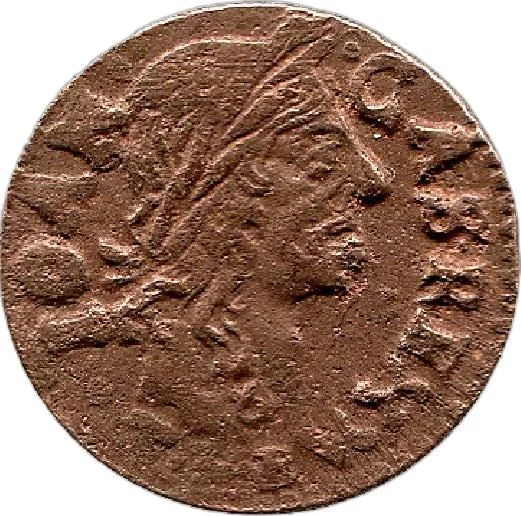
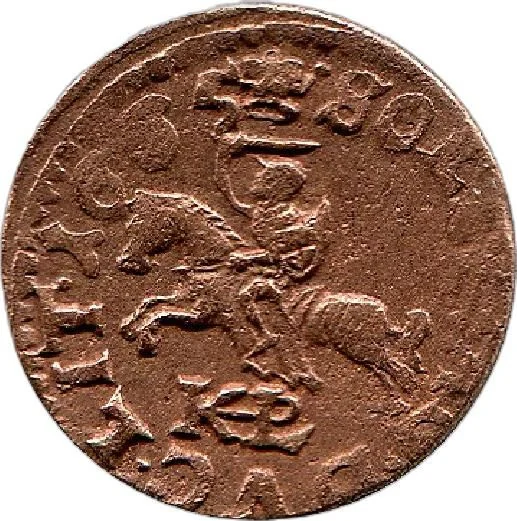
1 Schilling – Polish–Lithuanian Commonwealth
Poland
Context
Year: 1665
Country: Poland 
Issuer: Polish–Lithuanian Commonwealth
Ruler: John II Casimir Vasa
Currency:
(1573—1795)
Demonetized: Yes
References
KM: #Click to copy to clipboard50
Numista: #119359
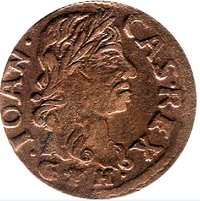
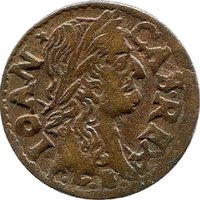
Obverse
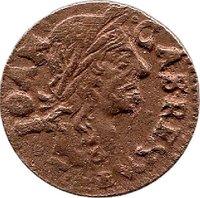
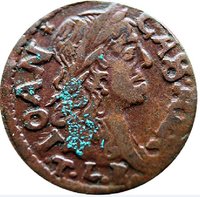
Inscription:
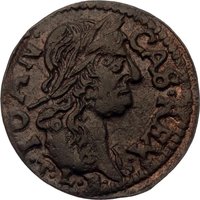
IOAN CAS REX T.L.B.
IOAN CAS RREX T.L.B.
IOAN CAS RREX T.L.B.
Script: Latin
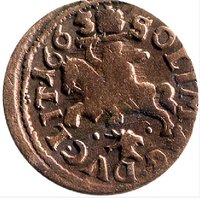
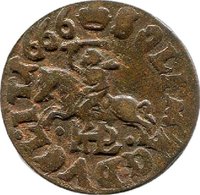
Reverse
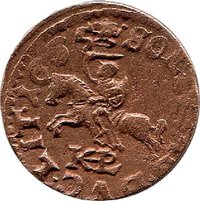
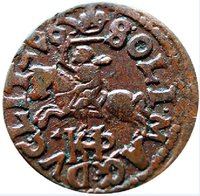
Inscription:
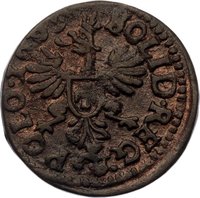
SOLI MAG DVC LIT 1665 (crown)
SOLI MAG DΛC LIT 1665 (crown)
SOLI MAG D(Λ)VC LIT 1665 (crown)
SOLI MAG DVC LI(O)T 1665 (crown)
SOLID MAG DΛC LIT 1665 (crown)
SOLI MAG DΛC LIT 1665 (crown)
SOLI MAG D(Λ)VC LIT 1665 (crown)
SOLI MAG DVC LI(O)T 1665 (crown)
SOLID MAG DΛC LIT 1665 (crown)
Script: Latin
Edge
Mints
| Name | Mark |
|---|---|
| Brest-Litovsk | — |
Mintings
| Year | Mint Mark | Mintage | Quality | Collection |
|---|---|---|---|---|
| 1665 | — | — |
Historical background
By 1665, the currency system of the Polish–Lithuanian Commonwealth was in a state of severe crisis, primarily driven by decades of destructive warfare. The mid-17th century, known as "The Deluge," saw the Commonwealth ravaged by the Khmelnytsky Uprising, the Swedish invasion, and war with Russia. To finance these endless conflicts, the state mints, particularly in Kraków, Ujazdów, and Vilnius, resorted to drastic debasement. They reduced the silver content in the primary coin, the tymf, and flooded the economy with low-quality copper szelągs (shillings), while the value of the good silver grosz and foreign thalers soared. This created a chaotic monetary duality where the official face value of coins bore no relation to their intrinsic metal worth.
The economic consequences were devastating and fueled social unrest. Peasants paying rents in devalued copper coin saw their lords demand payment in stable silver, while soldiers and mercenaries, paid in nearly worthless copper, resorted to looting or forming dangerous confederations (mutinies) to demand their arrears in good currency. The year 1665 itself was particularly volatile, as it marked the beginning of the Lubomirski Rokosz, a major noble rebellion. While sparked by political disputes, the rebellion's rank-and-file were heavily motivated by soldiers unpaid due to the bankrupt treasury, a direct result of the monetary collapse. Trade suffered as merchants faced unpredictable exchange rates and hoarding of good coin.
Attempts at reform had been made, notably the 1658 proposal to establish a national bank, but it failed in the Sejm (parliament) due to the nobility's distrust of central financial authority. By 1665, the monetary system was a key symptom of the Commonwealth's deeper political paralysis. The liberum veto and noble privileges prevented the strong, centralized action needed to recall bad coinage and restore confidence. Thus, the currency chaos of 1665 was not merely a financial issue but a stark reflection of the Commonwealth's inability to reform, directly contributing to its declining power and the instability that would plague it for the next century.
The economic consequences were devastating and fueled social unrest. Peasants paying rents in devalued copper coin saw their lords demand payment in stable silver, while soldiers and mercenaries, paid in nearly worthless copper, resorted to looting or forming dangerous confederations (mutinies) to demand their arrears in good currency. The year 1665 itself was particularly volatile, as it marked the beginning of the Lubomirski Rokosz, a major noble rebellion. While sparked by political disputes, the rebellion's rank-and-file were heavily motivated by soldiers unpaid due to the bankrupt treasury, a direct result of the monetary collapse. Trade suffered as merchants faced unpredictable exchange rates and hoarding of good coin.
Attempts at reform had been made, notably the 1658 proposal to establish a national bank, but it failed in the Sejm (parliament) due to the nobility's distrust of central financial authority. By 1665, the monetary system was a key symptom of the Commonwealth's deeper political paralysis. The liberum veto and noble privileges prevented the strong, centralized action needed to recall bad coinage and restore confidence. Thus, the currency chaos of 1665 was not merely a financial issue but a stark reflection of the Commonwealth's inability to reform, directly contributing to its declining power and the instability that would plague it for the next century.
⭐ Somewhat Rare