

1 schilling – Polish–Lithuanian Commonwealth
Add to wishlist
Poland
Context
Year: 1661
Country: Poland
Issuer: Polish–Lithuanian Commonwealth
Ruler: John II Casimir Vasa
Currency:
(1573—1795)
Demonetized: Yes
References
KM: #
Numista: #119294
Obverse
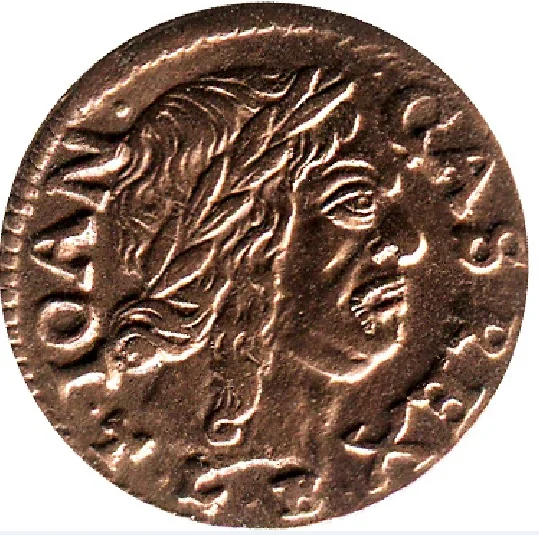
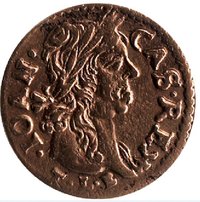
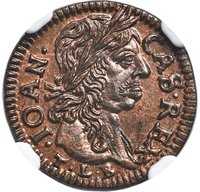
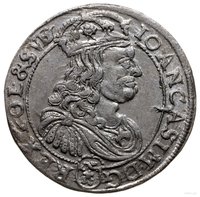
Inscription:
IOAN CAS REX T.L.B.
IOAN CAS REX T.T.B.
IO(N)AN CAS REX T.L.B.
IOAN CAS REX T.T.B.
IO(N)AN CAS REX T.L.B.
Script: Latin
Reverse
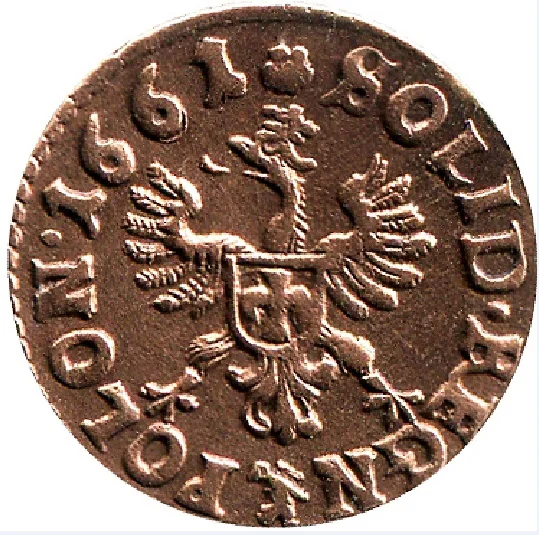
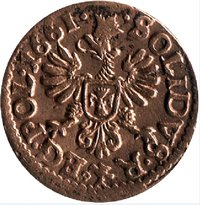
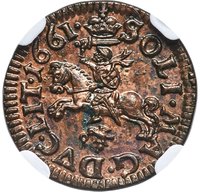
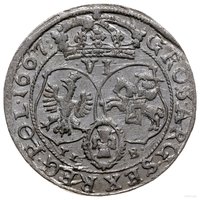
Inscription:
SOLI REGN (_) POLO 1661 (rose)
SOLI REGN (_) POLON 1661 (rose)
SOLI REGN (_) POLONI 1661 (rose)
SOLI REGNI (_) POLO 1661 (rose)
SOLI REGNI (_) POLONI 1661 (rose)
SOLID REG (_) POLO 1661 (rose)
SOLID REG (_) POLONI 1661 (rose)
SOLID REGN (_) POLO 1661 (rose)
SOLID REGN (_) POLON 1661 (rose)
SOLID REGN (_) POLONI 1661 (rose)
SOLID REGN (_) POLONI 661 (rose)
SOLID REGN (_) POLNI 1661 (rose)
SOLID REGN (_) POLOI 1661 (rose)
SOLID REGN (_) POLOID 1661 (rose)
SOLID REGN (_) POL(N)ON 1661 (rose)
SOLID REGN (_) POL(N)ONI 1661 (rose)
SOLID REGN (_) POL(I)ONI 1661 (rose)
SOLID REGN (_) POL(L)ON 1661 (rose)
SOLID RGEN (_) POLONI 1661 (rose)
SOLOI REGN (_) POLONI 1661 (rose)
SOLID REGN (Sakowicz arms) POLONI 1661 (rose)
SOLI REGN (_) POLON 1661 (rose)
SOLI REGN (_) POLONI 1661 (rose)
SOLI REGNI (_) POLO 1661 (rose)
SOLI REGNI (_) POLONI 1661 (rose)
SOLID REG (_) POLO 1661 (rose)
SOLID REG (_) POLONI 1661 (rose)
SOLID REGN (_) POLO 1661 (rose)
SOLID REGN (_) POLON 1661 (rose)
SOLID REGN (_) POLONI 1661 (rose)
SOLID REGN (_) POLONI 661 (rose)
SOLID REGN (_) POLNI 1661 (rose)
SOLID REGN (_) POLOI 1661 (rose)
SOLID REGN (_) POLOID 1661 (rose)
SOLID REGN (_) POL(N)ON 1661 (rose)
SOLID REGN (_) POL(N)ONI 1661 (rose)
SOLID REGN (_) POL(I)ONI 1661 (rose)
SOLID REGN (_) POL(L)ON 1661 (rose)
SOLID RGEN (_) POLONI 1661 (rose)
SOLOI REGN (_) POLONI 1661 (rose)
SOLID REGN (Sakowicz arms) POLONI 1661 (rose)
Script: Latin
Edge
Mintings
| Year | Mint Mark | Mintage | Quality | Collection |
|---|---|---|---|---|
| 1661 | — | — |
Historical background
By 1661, the Polish–Lithuanian Commonwealth was in the throes of a severe monetary crisis, primarily driven by the devastating wars of the mid-17th century. The Deluge (1655-1660), a period of invasion and occupation by Sweden, Russia, and Brandenburg, had ravaged the economy, emptying the state treasury and crippling agricultural and trade revenues. To finance its military defense, the state had resorted to drastic measures, most notably the massive debasement of its coinage. The treasury mints, particularly in Kraków, Ujazdów, and Bydgoszcz, began producing immense quantities of low-quality boratynki and tymfy—copper shillings and debased silver coins—whose nominal value far exceeded their intrinsic metal worth.
This deliberate inflation led to economic chaos, as the flood of debased currency drove good silver coins out of circulation (Gresham's Law) and caused skyrocketing prices, severely harming merchants, wage-earners, and the general populace. The situation was exacerbated by the widespread counterfeiting of these already poor coins, both domestically and abroad, further eroding trust in the monetary system. The crisis was not merely economic but also political, as the sejmik (local diets) and the powerful nobility (szlachta) vehemently protested the royal mints' operations, viewing the debasement as an unlawful royal imposition that confiscated their wealth through inflation.
Recognizing the dire need for reform, the Commonwealth's parliament, the Sejm, took decisive action in 1661. It passed legislation that aimed to stabilize the currency by closing the corrupt royal mints and pledging to withdraw the debased coinage from circulation. However, the implementation of these reforms was slow and painful, requiring a future recoinage and further taxation. Thus, 1661 stands as a pivotal year marking the peak of the monetary collapse and the first, fraught legislative attempt to restore financial order amidst the Commonwealth's profound political and military weakness.
This deliberate inflation led to economic chaos, as the flood of debased currency drove good silver coins out of circulation (Gresham's Law) and caused skyrocketing prices, severely harming merchants, wage-earners, and the general populace. The situation was exacerbated by the widespread counterfeiting of these already poor coins, both domestically and abroad, further eroding trust in the monetary system. The crisis was not merely economic but also political, as the sejmik (local diets) and the powerful nobility (szlachta) vehemently protested the royal mints' operations, viewing the debasement as an unlawful royal imposition that confiscated their wealth through inflation.
Recognizing the dire need for reform, the Commonwealth's parliament, the Sejm, took decisive action in 1661. It passed legislation that aimed to stabilize the currency by closing the corrupt royal mints and pledging to withdraw the debased coinage from circulation. However, the implementation of these reforms was slow and painful, requiring a future recoinage and further taxation. Thus, 1661 stands as a pivotal year marking the peak of the monetary collapse and the first, fraught legislative attempt to restore financial order amidst the Commonwealth's profound political and military weakness.
⭐ Somewhat Rare