

1 Schilling – Polish–Lithuanian Commonwealth
Poland
Context
Year: 1660
Country: Poland 
Issuer: Polish–Lithuanian Commonwealth
Ruler: John II Casimir Vasa
Currency:
(1573—1795)
Demonetized: Yes
References
KM: #Click to copy to clipboard110
Numista: #119292
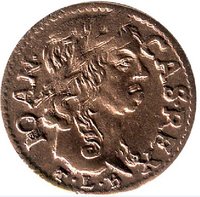
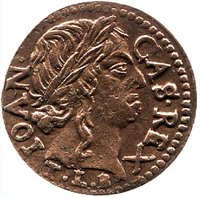
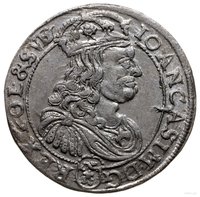
Obverse
Inscription:
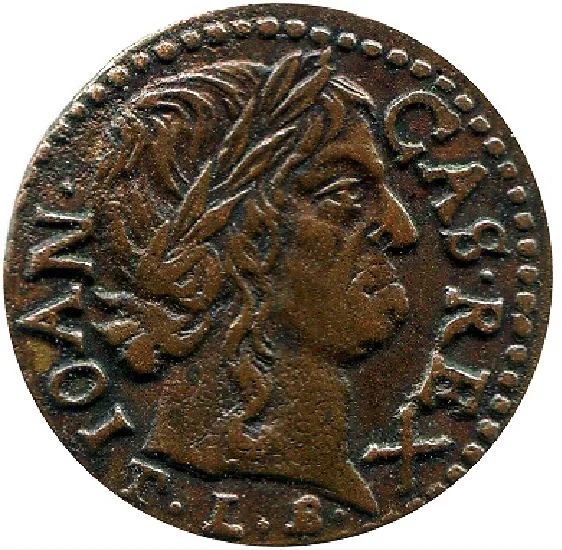
IOAN CAS REX T.L.B.
IOANN CAS REX T.L.B.
IOAИ CAS REX T.L.B.
I(A)O(O)AN CAS REX T.L.B.
IOAN CAS REX L.T.B.
IOANN CAS REX T.L.B.
IOAИ CAS REX T.L.B.
I(A)O(O)AN CAS REX T.L.B.
IOAN CAS REX L.T.B.
Script: Latin
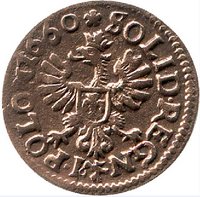
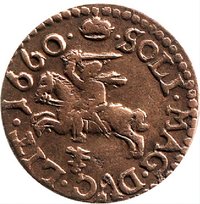
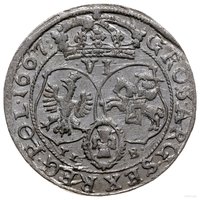
Reverse
Inscription:
Normal with rose type II and III
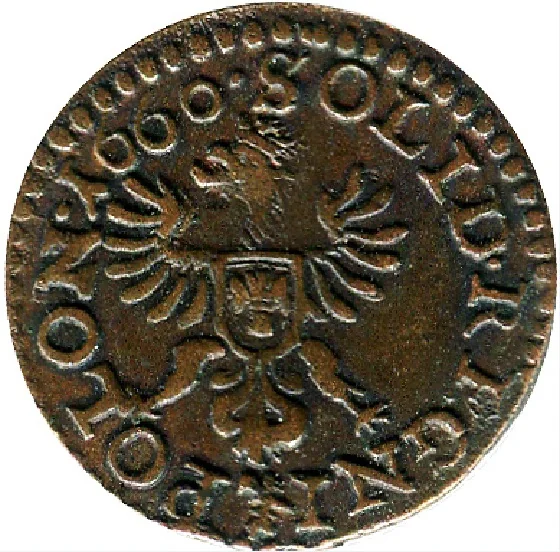
SOLID REGN (_) POLO 1660 (rose)
SOLID REGN (_) POLON 1660 (without rose)
SOLID REGN (_) POLON 1660 (rose)
SOLID REGN (_) POLONI 1660 (rose)
SOLID REGN (_) I POLON 1660 (rose)
SOLID REGNI (_) POLON 1660 (without rose)
SOLID REGNI (_) POLON 1660 (rose)
SOLID RЭGNI (_) POLON 1660 (rose)
SOLID RЭEGNI (_) POLON 1660 (rose)
SOLID/D REGNI (_) POLON 1660 (rose)
SOL(O)ID REGN (_) POLON 1660 (rose)
Hybrid with rose type I
SOLID REG (_) NI POL 1660 (rose)
SOLID REG (_) NI -- POL 1660 (rose)
SOLID REG (Ślepowron in right) NI POLO 1660 (rose)
SOLID REGN (_) I POLO 1660 (rose)
SOLID REGN (_) I P -- OLO 1660 (rose)
SOLID REGN (_) I POLN 1660 (rose)
SOLID REGN (_) I POLON 1660 (rose)
SOLID REGN (Ślepowron in right) I POLON 1660 (rose)
SOLID REGN (_) POLO 1660 (rose)
SOLID REGN (_) POLON 1660 (without rose)
SOLID REGN (_) POLON 1660 (rose)
SOLID REGN (_) POLONI 1660 (rose)
SOLID REGN (_) I POLON 1660 (rose)
SOLID REGNI (_) POLON 1660 (without rose)
SOLID REGNI (_) POLON 1660 (rose)
SOLID RЭGNI (_) POLON 1660 (rose)
SOLID RЭEGNI (_) POLON 1660 (rose)
SOLID/D REGNI (_) POLON 1660 (rose)
SOL(O)ID REGN (_) POLON 1660 (rose)
Hybrid with rose type I
SOLID REG (_) NI POL 1660 (rose)
SOLID REG (_) NI -- POL 1660 (rose)
SOLID REG (Ślepowron in right) NI POLO 1660 (rose)
SOLID REGN (_) I POLO 1660 (rose)
SOLID REGN (_) I P -- OLO 1660 (rose)
SOLID REGN (_) I POLN 1660 (rose)
SOLID REGN (_) I POLON 1660 (rose)
SOLID REGN (Ślepowron in right) I POLON 1660 (rose)
Script: Latin
Edge
Mintings
| Year | Mint Mark | Mintage | Quality | Collection |
|---|---|---|---|---|
| 1660 | — | — |
Historical background
By 1660, the Polish–Lithuanian Commonwealth was in the throes of a severe monetary crisis, often termed the "Potop" or "Deluge," which had devastated its economy. The Commonwealth's currency, based on a bimetallic system of silver złoty and copper shillings (solidi), was fundamentally destabilized. A primary cause was the massive, unauthorized minting of copper shillings by Swedish occupiers and the Lithuanian Treasurer, Tytus Liwiusz Boratini, during the Swedish invasion (1655-1660). These debased coins, known as boratynki, flooded the market, causing rampant inflation and a collapse in public trust, as their face value far exceeded their intrinsic metal worth.
This currency chaos was exacerbated by the wider devastation of the Deluge, which saw population loss, agricultural ruin, and the looting of state treasuries and royal mints. The state's ability to control its monetary policy was crippled, leading to a classic "bad money drives out good" scenario (Gresham's Law). Holders of full-weight silver coins hoarded or exported them, leaving only the depreciating copper currency in common circulation. This hyperinflation severely disrupted trade, tax revenues, and military financing at a time when the Commonwealth was still engaged in costly wars with Russia and recovering from conflict with Sweden.
In response, King John II Casimir Vasa and the Sejm attempted monetary reform. The crucial legislation came with the Currency Act of 1660, which aimed to restore confidence by demonetizing the debased copper coinage and returning to a stable silver-based system. The reform set a fixed exchange rate between new silver coins and the old copper ones, but the process was painful and only partially successful. It required significant state expenditure to redeem the copper coins, placing a further burden on an exhausted treasury, and the economic scars of the crisis would linger for decades, highlighting the profound link between political stability and monetary integrity.
This currency chaos was exacerbated by the wider devastation of the Deluge, which saw population loss, agricultural ruin, and the looting of state treasuries and royal mints. The state's ability to control its monetary policy was crippled, leading to a classic "bad money drives out good" scenario (Gresham's Law). Holders of full-weight silver coins hoarded or exported them, leaving only the depreciating copper currency in common circulation. This hyperinflation severely disrupted trade, tax revenues, and military financing at a time when the Commonwealth was still engaged in costly wars with Russia and recovering from conflict with Sweden.
In response, King John II Casimir Vasa and the Sejm attempted monetary reform. The crucial legislation came with the Currency Act of 1660, which aimed to restore confidence by demonetizing the debased copper coinage and returning to a stable silver-based system. The reform set a fixed exchange rate between new silver coins and the old copper ones, but the process was painful and only partially successful. It required significant state expenditure to redeem the copper coins, placing a further burden on an exhausted treasury, and the economic scars of the crisis would linger for decades, highlighting the profound link between political stability and monetary integrity.
⭐ Somewhat Rare