

1 filippo – Milan
Add to wishlist
Italy
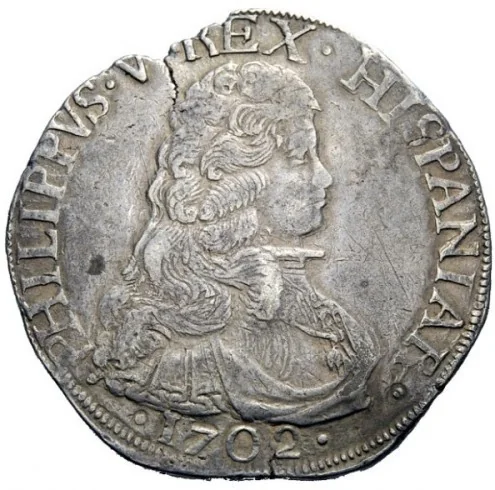
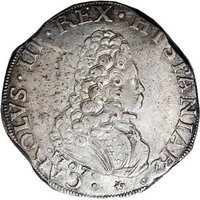
Obverse
Description:
Right-facing bust, date beneath.
Inscription:
PHILIPPVS·V·REX·HISPANIAR·
1702
1702
Script: Latin
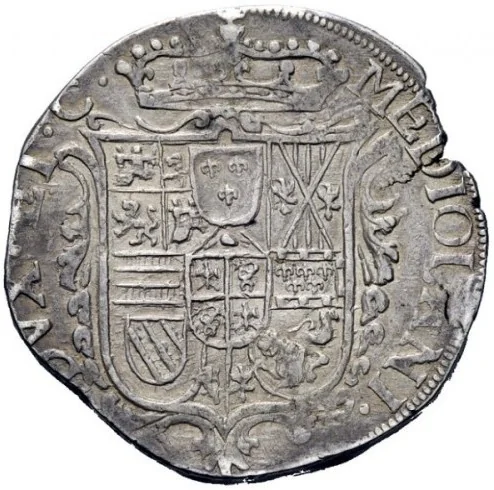
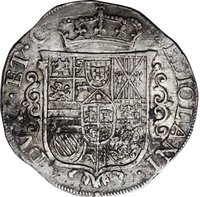
Reverse
Description:
Crowned shield with many arms in a baroque frame; legend starts upper right.
Inscription:
MEDIOLANI· DVX·ET·C·
Script: Latin
Edge
Categories
| Object> Armour |
| Symbols> Coat of Arms |
Mints
| Name | Mark |
|---|---|
| Milan | — |
Mintings
| Year | Mint Mark | Mintage | Quality | Collection |
|---|---|---|---|---|
| 1702 | — | — |
Historical background
In 1702, Milan found itself at the heart of the War of the Spanish Succession, a conflict that had severe repercussions on its monetary system. The Duchy of Milan, a key Spanish Habsburg possession in northern Italy, was a contested prize, with French, Austrian, and Savoyard armies fighting across Lombardy. This military turmoil led to rampant fiscal extraction by occupying forces, disrupting trade and agricultural production, which in turn strained the state's finances and the local economy's ability to sustain a stable currency.
The currency situation was characterized by severe debasement and chaotic circulation. To fund the war effort, authorities—both Spanish and, increasingly, the French who controlled the city—resorted to issuing heavily debased coinage, notably the sesino and the soldo. The intrinsic silver content of these coins was drastically reduced, leading to a sharp divergence between their face value and real metallic worth. This practice, combined with the circulation of older, full-weight coins from Milan and neighboring states, created a complex and unstable system where Gresham's Law ("bad money drives out good money") was acutely evident, causing hoarding and further scarcity of reliable specie.
Consequently, daily commerce in Milan was fraught with difficulty. Merchants and the public faced uncertainty and loss, as prices inflated and the value of money could change unpredictably. The monetary disorder reflected the broader political instability, as the very sovereignty over Milan was in flux. This period marked a low point in the integrity of the Milanese currency, a direct result of the desperate wartime finances that would only begin to find resolution after the war's conclusion and the subsequent Austrian Habsburg administration under the 1713 Treaty of Utrecht.
The currency situation was characterized by severe debasement and chaotic circulation. To fund the war effort, authorities—both Spanish and, increasingly, the French who controlled the city—resorted to issuing heavily debased coinage, notably the sesino and the soldo. The intrinsic silver content of these coins was drastically reduced, leading to a sharp divergence between their face value and real metallic worth. This practice, combined with the circulation of older, full-weight coins from Milan and neighboring states, created a complex and unstable system where Gresham's Law ("bad money drives out good money") was acutely evident, causing hoarding and further scarcity of reliable specie.
Consequently, daily commerce in Milan was fraught with difficulty. Merchants and the public faced uncertainty and loss, as prices inflated and the value of money could change unpredictably. The monetary disorder reflected the broader political instability, as the very sovereignty over Milan was in flux. This period marked a low point in the integrity of the Milanese currency, a direct result of the desperate wartime finances that would only begin to find resolution after the war's conclusion and the subsequent Austrian Habsburg administration under the 1713 Treaty of Utrecht.
✨ Legendary