

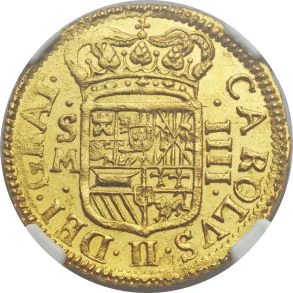
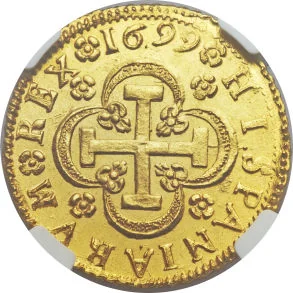
4 escudos – Spain
Add to wishlist
Spain
Context
Material
Diameter: 29 mm
Weight: 13 g
Gold Weight:: 11.92 g
Thickness: 1 mm
Shape: Round
Composition: 91.7% Gold
Magnetic: No
Technique: Roller milled
References
KM: #
Numista: #78018
Value
Bullion value: $1814.62
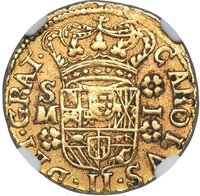
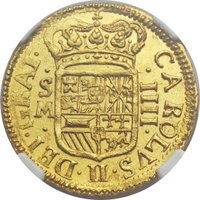
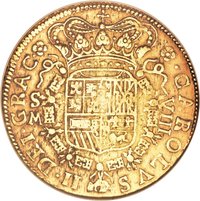
Obverse
Description:
Shield between mint mark and value. Circular legend.
Inscription:
CAROLVS·II·DEI·GRAT
S
M
IIII
S
M
IIII
Script: Latin
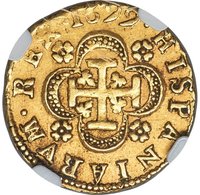
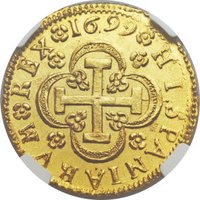
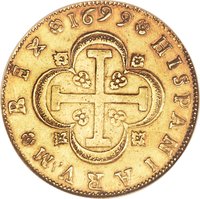
Reverse
Description:
Cross in four-lobed shape, flowers in corners, encircled by legend.
Inscription:
1699
HISPANIARUM REX
HISPANIARUM REX
Script: Latin
Edge
Mints
| Name | Mark |
|---|---|
| Royal Mint of Seville | — |
Mintings
| Year | Mint Mark | Mintage | Quality | Collection |
|---|---|---|---|---|
| 1699 | SM | — | ||
| 1700 | SM | — |
Historical background
In 1699, the Spanish monarchy under the recently crowned King Charles II was grappling with a profound and chronic monetary crisis that had been worsening for over a century. The core of the problem was the severe debasement of the ubiquitous silver real and the gold escudo. Successive governments had repeatedly reduced the precious metal content of these coins to finance Spain's endless military commitments in the Thirty Years' War, the Franco-Spanish War, and other conflicts, while domestic production from the American colonies declined. This created a classic manifestation of Gresham's Law: "bad money drives out good." High-quality full-weight coins were hoarded, melted down for their bullion value, or exported, leaving the economy flooded with inferior, clipped, and worn currency, undermining both domestic trade and international confidence.
The situation was further complicated by a chaotic mosaic of regional monies. Alongside the official Castilian currency, various Spanish kingdoms, such as Aragon, Catalonia, and Valencia, still minted their own distinct currencies (libertats, sueldos), while a vast array of foreign coins, particularly from the Spanish Netherlands and the Americas, circulated with fluctuating values. This lack of uniformity crippled internal commerce and made fiscal administration for the crown nearly impossible. The state's response, including repeated attempts to fix arbitrary exchange rates between different coins and issue new decrees on valuation, only generated confusion, market distrust, and widespread evasion.
Economically, the currency chaos contributed to price inflation, commercial stagnation, and a deep sense of instability. Politically, it reflected and exacerbated the weakness of the central Habsburg state, which was unable to control its own monetary system or halt its fiscal decay. As 1699 drew to a close, with the ailing and childless Charles II nearing death, the monetary disorder was a symptomatic crisis of a failing regime. The impending War of the Spanish Succession (1701-1714) would soon bring further devastation, leaving the eventual victor, the Bourbon Philip V, with the monumental task of completely overhauling the monetary system, which he finally achieved with the landmark 1718 minting ordinances.
The situation was further complicated by a chaotic mosaic of regional monies. Alongside the official Castilian currency, various Spanish kingdoms, such as Aragon, Catalonia, and Valencia, still minted their own distinct currencies (libertats, sueldos), while a vast array of foreign coins, particularly from the Spanish Netherlands and the Americas, circulated with fluctuating values. This lack of uniformity crippled internal commerce and made fiscal administration for the crown nearly impossible. The state's response, including repeated attempts to fix arbitrary exchange rates between different coins and issue new decrees on valuation, only generated confusion, market distrust, and widespread evasion.
Economically, the currency chaos contributed to price inflation, commercial stagnation, and a deep sense of instability. Politically, it reflected and exacerbated the weakness of the central Habsburg state, which was unable to control its own monetary system or halt its fiscal decay. As 1699 drew to a close, with the ailing and childless Charles II nearing death, the monetary disorder was a symptomatic crisis of a failing regime. The impending War of the Spanish Succession (1701-1714) would soon bring further devastation, leaving the eventual victor, the Bourbon Philip V, with the monumental task of completely overhauling the monetary system, which he finally achieved with the landmark 1718 minting ordinances.
Series: 1699 Spain circulation coins
✨ Legendary