

50 centavos – São Tomé and Príncipe
Add to wishlist
Sao Tome and Principe
Context
Years: 1928–1929
Country: Sao Tome and Principe
Issuer: São Tomé and Príncipe
Period:
(1910—1951)
Currency:
(1914—1974)
Demonetized: Yes
Total mintage: 400,000
Material
Diameter: 30 mm
Weight: 10.2 g
Thickness: 1.81 mm
Shape: Round
Composition: Bronze-nickel
Technique: Milled
Alignment: Medal alignment
flip
References
KM: #
Numista: #11993
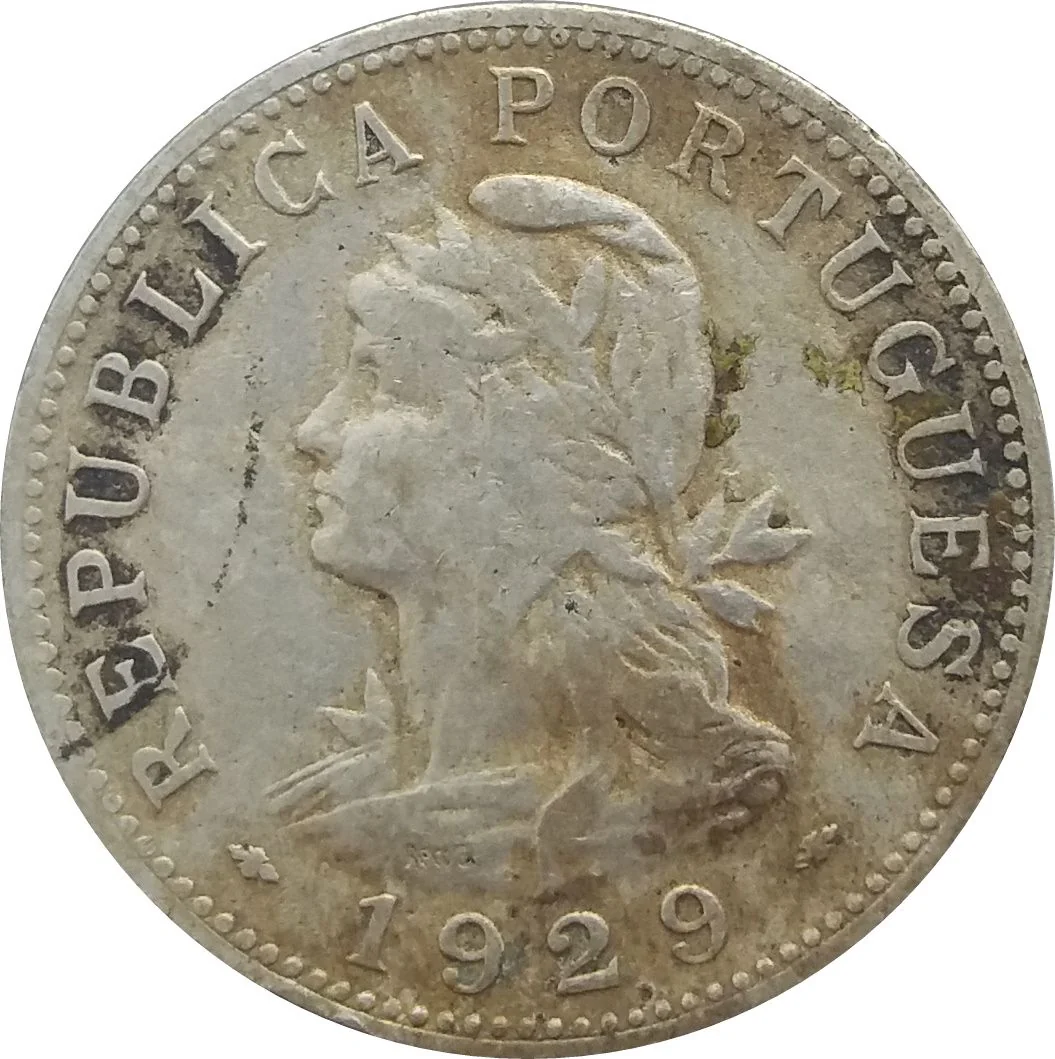
Obverse
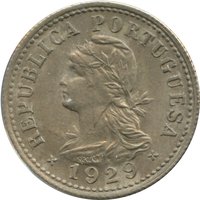
Description:
Liberty facing left.
Inscription:
REPUBLICA PORTUGUESA
1929
1929
Translation:
Portuguese Republic
1929
1929
Script: Latin
Language: Portuguese
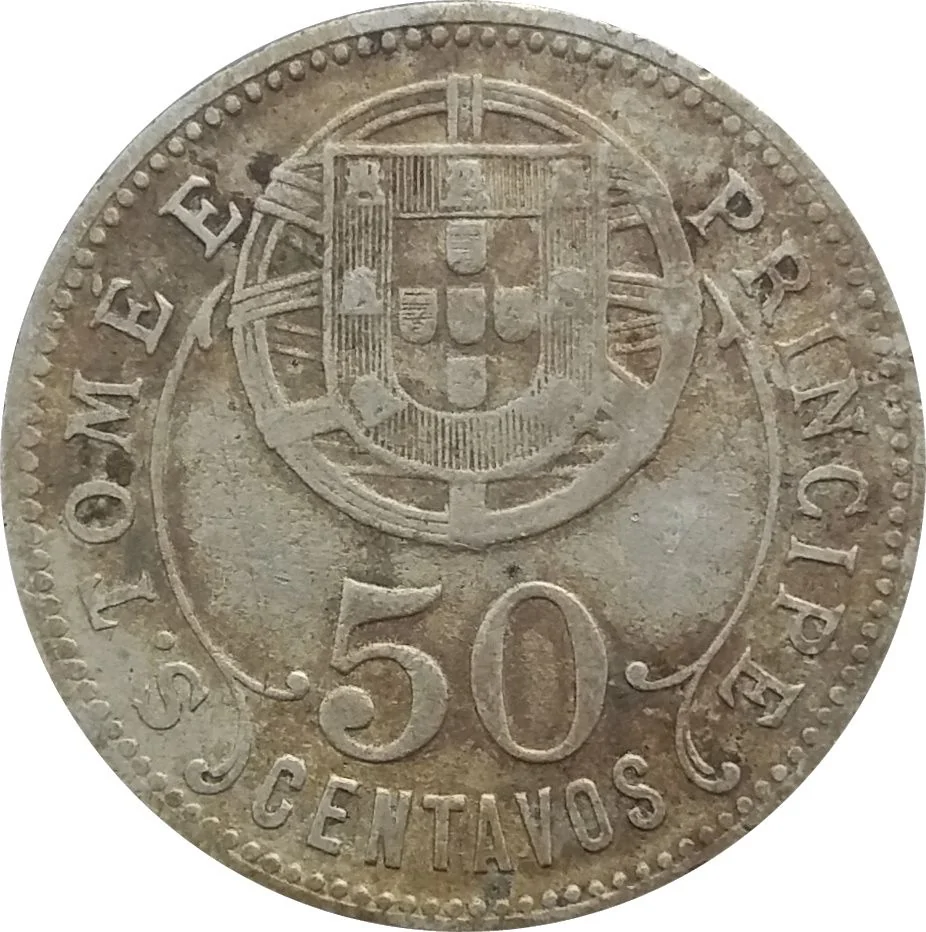
Reverse
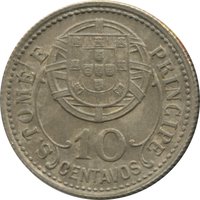
Description:
Shielded globe over value.
Inscription:
S.TOMÉ E PRINCIPE
50 CENTAVOS
50 CENTAVOS
Translation:
Saint Thomas and Prince
50 Centavos
50 Centavos
Script: Latin
Language: Portuguese
Edge
Reeded
Categories
| Symbol> Wreath |
| Symbol> Allegory |
| Symbols> Coat of Arms |
| Symbol> Phrygian cap |
Mints
| Name | Mark |
|---|---|
| Imprensa Nacional - Casa da Moeda | — |
Mintings
| Year | Mint Mark | Mintage | Quality | Collection |
|---|---|---|---|---|
| 1928 | — | 400,000 | ||
| 1929 | — | — |
Historical background
In 1928, São Tomé and Príncipe, a Portuguese colony since the 15th century, operated under a currency system fully integrated with and controlled by Portugal. The official currency was the São Tomé and Príncipe escudo (STPE), which had been introduced in 1914 to replace the real. Crucially, it was pegged at par with the Portuguese escudo (PTE), meaning the two currencies were legally interchangeable at a 1:1 ratio. This peg firmly anchored the colony's monetary policy and trade to Lisbon, ensuring financial stability but also ensuring that the archipelago had no independent monetary authority.
The economy driving this currency system was overwhelmingly dominated by plantation agriculture, specifically cocoa, which made the islands one of the world's leading producers. This monoculture created a dual economic reality: a lucrative export sector for Portuguese and other foreign companies, and a reliance on imported goods for most necessities. The fixed exchange rate facilitated the smooth repatriation of profits to Portugal and simplified trade, but it also meant the local economy was highly vulnerable to fluctuations in global cocoa prices and entirely dependent on Portugal for credit and currency issuance.
Therefore, the currency situation in 1928 reflected the broader colonial relationship. The monetary system was stable and orderly by design, but it served primarily to facilitate extraction and administrative control. There was no local central bank; the Banco Nacional Ultramarino, a Portuguese institution, acted as the issuer of banknotes and the main commercial bank. The currency's value and supply were entirely dictated by Lisbon's economic priorities, leaving São Tomé and Príncipe with no tools for autonomous economic management, a condition that would persist for decades until independence in 1975.
The economy driving this currency system was overwhelmingly dominated by plantation agriculture, specifically cocoa, which made the islands one of the world's leading producers. This monoculture created a dual economic reality: a lucrative export sector for Portuguese and other foreign companies, and a reliance on imported goods for most necessities. The fixed exchange rate facilitated the smooth repatriation of profits to Portugal and simplified trade, but it also meant the local economy was highly vulnerable to fluctuations in global cocoa prices and entirely dependent on Portugal for credit and currency issuance.
Therefore, the currency situation in 1928 reflected the broader colonial relationship. The monetary system was stable and orderly by design, but it served primarily to facilitate extraction and administrative control. There was no local central bank; the Banco Nacional Ultramarino, a Portuguese institution, acted as the issuer of banknotes and the main commercial bank. The currency's value and supply were entirely dictated by Lisbon's economic priorities, leaving São Tomé and Príncipe with no tools for autonomous economic management, a condition that would persist for decades until independence in 1975.
🌱 Common