

1 Liard – Prince-bishopric of Liege
Belgium
Context
Years: 1650–1660
Country: Belgium 
Issuer: Prince-bishopric of Liege
Ruler: Maximilian Henry of Bavaria
Currency:
(1650—1795)
Demonetized: Yes
Material
References
KM: #Click to copy to clipboard72
Numista: #77618
Obverse
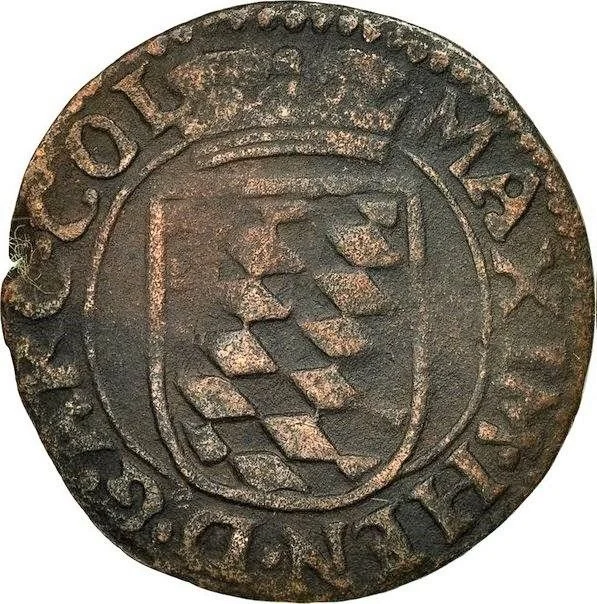
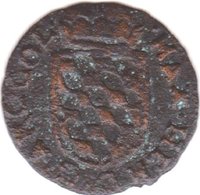
Description:
Bavarian lozenges within inner circle.
Inscription:
MAXIM • HEN • D • G • ARC • COL
Script: Latin
Reverse
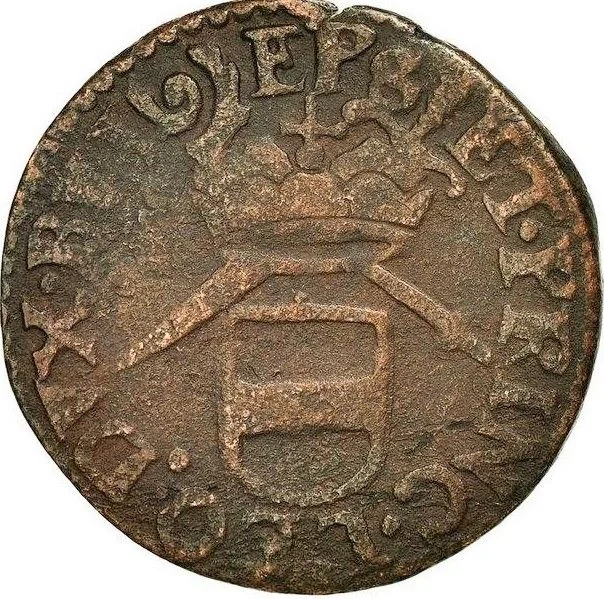
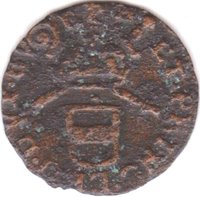
Description:
Arms of Bouillon over crossed crozier and sword.
Inscription:
EPS ET • PRINC • LEO • DVX • BV
Script: Latin
Edge
Plain
Mintings
| Year | Mint Mark | Mintage | Quality | Collection |
|---|---|---|---|---|
| — | — | — |
Historical background
In the mid-17th century, the Prince-Bishopric of Liège maintained a unique monetary situation shaped by its political autonomy and economic realities. As an independent ecclesiastical state within the Holy Roman Empire, it possessed the right of battre monnaie (to mint coinage). However, its economy was deeply integrated with its powerful neighbors, the Spanish Netherlands and the Dutch Republic, whose heavier, high-quality silver coins—like the Dutch leeuwendaalder and Spanish patagon—circulated widely alongside local issues. This created a dual system where foreign coins were preferred for large trade and savings, while the Liège mint primarily produced lower-value billon (debased silver) and copper coins for everyday local transactions.
The 1650s fell within a prolonged period of monetary instability for Liège, part of the wider "Kipper- und Wipperzeit" crisis that had plagued Central Europe. Successive prince-bishops, facing fiscal pressures from military costs and court expenses, frequently engaged in debasement. They reduced the precious metal content in their coinage to generate seigniorage profit, leading to inflation and a loss of public trust in locally minted currency. The official exchange rates between Liège's various denominations (such as patards, sols, and deniers) and foreign crowns were constantly adjusted, causing confusion and hampering commerce.
Consequently, the monetary landscape was chaotic and pluralistic. Merchants and markets in cities like Liège and Huy operated with a practical mix of currencies, mentally calculating values based on metal weight and prevailing trade lists. Attempts at reform were episodic and largely ineffective against the entrenched practice of debasement. Thus, in 1650, a Liège citizen's purse would have contained a jumble of worn local coins for daily market purchases, alongside carefully guarded foreign silver for any significant expense, all under the unstable authority of a mint whose output was more a fiscal tool than a reliable store of value.
The 1650s fell within a prolonged period of monetary instability for Liège, part of the wider "Kipper- und Wipperzeit" crisis that had plagued Central Europe. Successive prince-bishops, facing fiscal pressures from military costs and court expenses, frequently engaged in debasement. They reduced the precious metal content in their coinage to generate seigniorage profit, leading to inflation and a loss of public trust in locally minted currency. The official exchange rates between Liège's various denominations (such as patards, sols, and deniers) and foreign crowns were constantly adjusted, causing confusion and hampering commerce.
Consequently, the monetary landscape was chaotic and pluralistic. Merchants and markets in cities like Liège and Huy operated with a practical mix of currencies, mentally calculating values based on metal weight and prevailing trade lists. Attempts at reform were episodic and largely ineffective against the entrenched practice of debasement. Thus, in 1650, a Liège citizen's purse would have contained a jumble of worn local coins for daily market purchases, alongside carefully guarded foreign silver for any significant expense, all under the unstable authority of a mint whose output was more a fiscal tool than a reliable store of value.

⭐ Somewhat Rare