

1 Ducat – Hungary
Hungary

Obverse
Description:
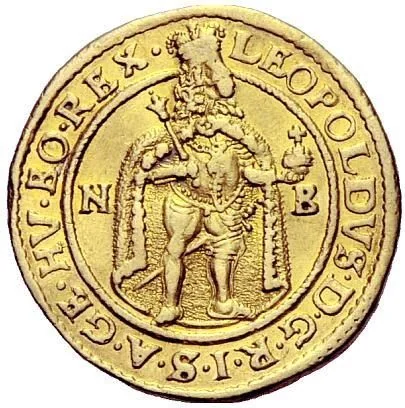
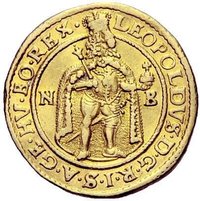
Hungarian ducat type. Crowned monarch facing front, holding orb and scepter, divides mintmark. Inscription within inner pearl circle.
Inscription:
LEOPOLD · D · G · R · I · S · A · G · H · B · REX
N B
N B
Script: Latin
Reverse
Description:
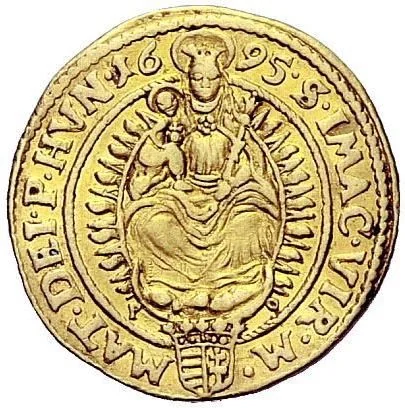
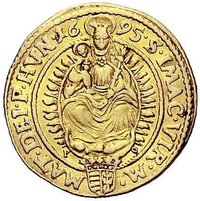
Radiant Madonna crowned and seated on a crescent, holding a scepter and the Child. An inscribed pearl circle surrounds her, with the crown dividing the date above.
Inscription:
S : IMMAC : VIR : MA : MAT : DEI : P : HVN : 16 99
Script: Latin
Edge
Plain
Mints
| Name | Mark |
|---|---|
| Baia Mare | NB |
Mintings
| Year | Mint Mark | Mintage | Quality | Collection |
|---|---|---|---|---|
| 1693 | N-B | — | ||
| 1695 | N-B | — | ||
| 1696 | N-B | — | ||
| 1697 | N-B | — | ||
| 1698 | N-B | — | ||
| 1699 | N-B | — | ||
| 1702 | N-B | — | ||
| 1703 | N-B | — |
Historical background
In 1693, Hungary’s currency situation was chaotic and deeply influenced by the ongoing Great Turkish War (1683-1699). The Habsburg monarchy, ruling the Kingdom of Hungary, was financing its massive military campaigns against the Ottoman Empire primarily through debasement—reducing the precious metal content in coins. This was especially true for the small-denomination copper and silver coins used in everyday Hungarian trade, such as the denár and krajcár. The Vienna Court Chamber repeatedly authorized the minting of these debased coins, leading to rapid inflation and a severe loss of public trust in the currency.
The monetary landscape was further fragmented by the circulation of older, higher-quality silver thalers (like the Joachimsthaler) alongside the new debased coins, creating a complex and unstable system of exchange. People hoarded older, full-value coins, following Gresham’s Law where "bad money drives out good." Additionally, various foreign coins, particularly Turkish akçe and Dutch leeuwendaalders, circulated in the war-torn regions, adding to the confusion. This environment of unreliable currency stifled commerce and placed a heavy burden on the peasantry and soldiers, who were often paid in the rapidly depreciating coins.
Despite the disorder, 1693 fell within a period of attempted reform. A few years earlier, in 1690, Leopold I had introduced the X poltura tariff system to standardize the value of the myriad circulating coins, but it proved difficult to enforce. The constant fiscal demands of the war undermined any lasting stabilization. Thus, the currency situation in 1693 was defined by a tense struggle between the crown’s short-term military financial needs and the long-term economic health of the kingdom, resulting in a precarious and inflationary monetary environment that would persist until more comprehensive reforms were enacted after the war’s conclusion.
The monetary landscape was further fragmented by the circulation of older, higher-quality silver thalers (like the Joachimsthaler) alongside the new debased coins, creating a complex and unstable system of exchange. People hoarded older, full-value coins, following Gresham’s Law where "bad money drives out good." Additionally, various foreign coins, particularly Turkish akçe and Dutch leeuwendaalders, circulated in the war-torn regions, adding to the confusion. This environment of unreliable currency stifled commerce and placed a heavy burden on the peasantry and soldiers, who were often paid in the rapidly depreciating coins.
Despite the disorder, 1693 fell within a period of attempted reform. A few years earlier, in 1690, Leopold I had introduced the X poltura tariff system to standardize the value of the myriad circulating coins, but it proved difficult to enforce. The constant fiscal demands of the war undermined any lasting stabilization. Thus, the currency situation in 1693 was defined by a tense struggle between the crown’s short-term military financial needs and the long-term economic health of the kingdom, resulting in a precarious and inflationary monetary environment that would persist until more comprehensive reforms were enacted after the war’s conclusion.

✨ Legendary