

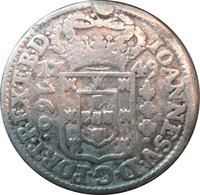
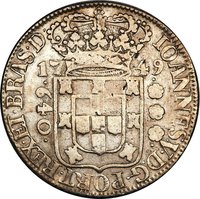
Obverse
Description:
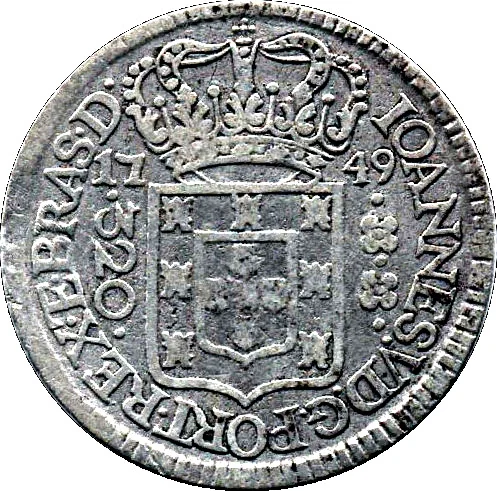
Portuguese arms between 320 and flowers, with date.
Inscription:
IOHANNES.V.D.G.PORT.REX.E.BRAS.D.
1749
320
1749
320
Script: Latin
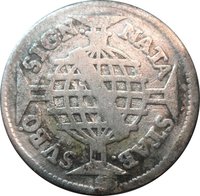
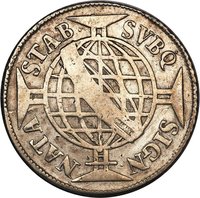
Reverse
Description:
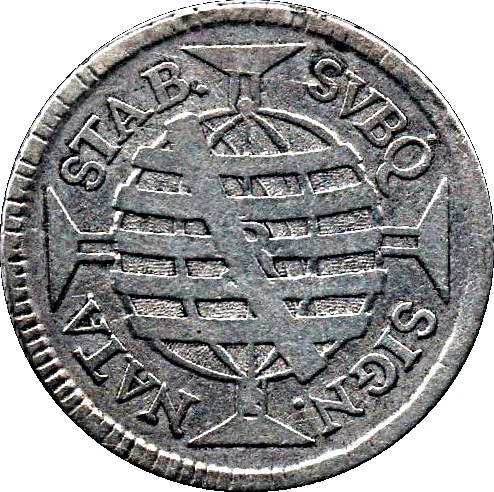
An armillary sphere before the Order of Christ cross.
Inscription:
SVBQ. SIGN. NATA. STAB.
Script: Latin
Edge
Plain
Mints
| Name | Mark |
|---|---|
| Imprensa Nacional - Casa da Moeda | — |
| Casa da Moeda do Brasil | R |
Historical background
In 1748, Brazil's currency situation was characterized by profound scarcity and fragmentation, a direct legacy of its colonial status under Portugal. The Portuguese Crown, adhering to mercantilist principles, systematically extracted gold from the Minas Gerais region but prohibited the establishment of a mint in Brazil until 1694. Even after mints were founded, their primary function was to coin gold for shipment to Portugal, leaving the domestic economy chronically starved of official circulating medium. This created a heavy reliance on inconsistent shipments of Portuguese copper and silver coins, which were insufficient for local trade.
Consequently, a chaotic multiplicity of alternative currencies filled the void. The most widespread was sugar, which officially served as a tax payment unit in some captaincies. More commonly, makeshift "provincial money" circulated—irregularly cut and stamped pieces of silver and gold, often of dubious purity and weight. Perhaps the most unusual and pervasive form was "fumo e panos" (tobacco and cloth), especially in regions like Maranhão and Pará. Rolls of low-grade tobacco and bolts of coarse cotton cloth, their values set by local authorities, became standardized barter currencies for all transactions, from slaves to foodstuffs, highlighting the economy's primitive and localized nature.
This monetary chaos severely hindered internal commerce and fiscal administration. The Crown recognized the problem, and the mid-18th century saw increasing, though still inadequate, shipments of low-denomination copper coins (réis) from Portugal to facilitate small-scale trade. The pivotal change, however, was still decades away; it would not be until the 1760s under the Marquis of Pombal that a concerted effort to rationalize the system began, including the recall of provincial coinage and the establishment of more systematic minting in Brazil. Thus, in 1748, Brazil remained mired in a pre-monetary economy, its wealth in gold paradoxously coexisting with a daily reality of barter and commodity money.
Consequently, a chaotic multiplicity of alternative currencies filled the void. The most widespread was sugar, which officially served as a tax payment unit in some captaincies. More commonly, makeshift "provincial money" circulated—irregularly cut and stamped pieces of silver and gold, often of dubious purity and weight. Perhaps the most unusual and pervasive form was "fumo e panos" (tobacco and cloth), especially in regions like Maranhão and Pará. Rolls of low-grade tobacco and bolts of coarse cotton cloth, their values set by local authorities, became standardized barter currencies for all transactions, from slaves to foodstuffs, highlighting the economy's primitive and localized nature.
This monetary chaos severely hindered internal commerce and fiscal administration. The Crown recognized the problem, and the mid-18th century saw increasing, though still inadequate, shipments of low-denomination copper coins (réis) from Portugal to facilitate small-scale trade. The pivotal change, however, was still decades away; it would not be until the 1760s under the Marquis of Pombal that a concerted effort to rationalize the system began, including the recall of provincial coinage and the establishment of more systematic minting in Brazil. Thus, in 1748, Brazil remained mired in a pre-monetary economy, its wealth in gold paradoxously coexisting with a daily reality of barter and commodity money.
💎 Very Rare