

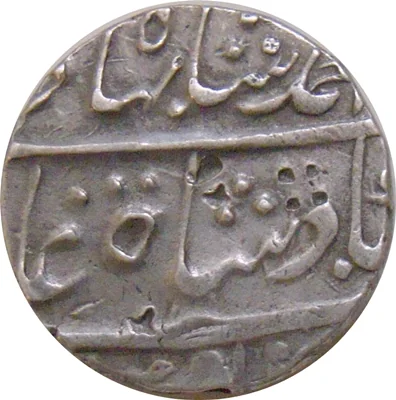
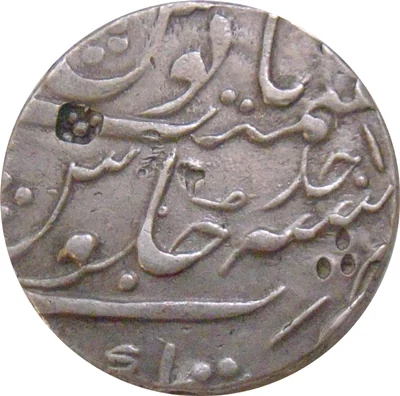
1 Rupee – Mughal Empire
India
Context
Years: 1161–1167
Country: India 
Issuer: Mughal Empire
Ruler: Ahmad Shah Bahadur
Currency:
(1540—1842)
Demonetized: Yes
Material
Diameter: 22.6 mm
Weight: 10.95 g
Silver weight: 10.95 g
Shape: Irregular round
Composition: Silver
Magnetic: No
Technique: Hammered
References
KM: #Click to copy to clipboard446.38
Numista: #77357
Value
Bullion value: $31.67
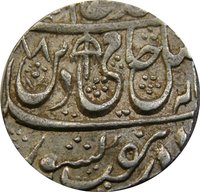
Obverse
Description:
Ahmad Shah Bahadur, gold coin.
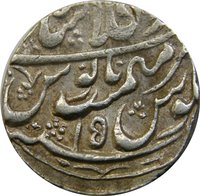
Reverse
Description:
Manus Maimanat: Sunday, 1st Cuttack Zarb Session.
Edge
Mintings
| Year | Mint Mark | Mintage | Quality | Collection |
|---|---|---|---|---|
| — | — | — |
Historical background
The year 1161 in the Hijri calendar corresponds to 1748-49 CE in the Gregorian calendar, a period of severe political and economic crisis for the Mughal Empire. The currency situation was a direct reflection of the empire's fragmentation following Nader Shah's devastating invasion of 1739. The imperial treasury in Delhi had been looted of an estimated 700 million rupees worth of coins, jewels, and the legendary Peacock Throne, causing a massive drain of precious metals, particularly silver, which was the backbone of the rupee.
Consequently, the authority to mint coins, once a tightly held imperial prerogative, became increasingly decentralized. Powerful regional governors and emerging successor states like Bengal, Awadh, and the Maratha Confederacy began issuing their own rupees, often of varying weight and purity. While the Mughal standard, the silver rupee (weighing approximately 11.5 grams), remained a theoretical benchmark, its production in Delhi dwindled. The gold mohur continued to be minted but was used more for hoarding and high-value transactions than everyday trade, which relied on copper dams and the increasingly fragmented silver coinage.
This period marked a transition from a unified imperial currency system to one of competing monetary zones. The scarcity of silver led to debasement in some areas and heightened economic uncertainty. Furthermore, the rising influence of European trading companies, particularly the English East India Company, began to introduce another layer of monetary complexity, as their trade rupees and gold pagodas started to circulate in coastal regions. Therefore, in 1161 AH, the Mughal currency system was less an empire-wide standard and more a patchwork of local issues, symbolizing the erosion of central authority and the empire's descent into political and economic disarray.
Consequently, the authority to mint coins, once a tightly held imperial prerogative, became increasingly decentralized. Powerful regional governors and emerging successor states like Bengal, Awadh, and the Maratha Confederacy began issuing their own rupees, often of varying weight and purity. While the Mughal standard, the silver rupee (weighing approximately 11.5 grams), remained a theoretical benchmark, its production in Delhi dwindled. The gold mohur continued to be minted but was used more for hoarding and high-value transactions than everyday trade, which relied on copper dams and the increasingly fragmented silver coinage.
This period marked a transition from a unified imperial currency system to one of competing monetary zones. The scarcity of silver led to debasement in some areas and heightened economic uncertainty. Furthermore, the rising influence of European trading companies, particularly the English East India Company, began to introduce another layer of monetary complexity, as their trade rupees and gold pagodas started to circulate in coastal regions. Therefore, in 1161 AH, the Mughal currency system was less an empire-wide standard and more a patchwork of local issues, symbolizing the erosion of central authority and the empire's descent into political and economic disarray.
✨ Legendary