

1 Rupee – Mughal Empire
India
Context
Years: 1186–1787
Country: India 
Issuer: Mughal Empire
Ruler: Shah Alam II
Currency:
(1540—1842)
Demonetized: Yes
Material
Diameter: 20.75 mm
Weight: 11.1 g
Silver weight: 11.10 g
Thickness: 4 mm
Shape: Irregular round
Composition: Silver
Magnetic: No
Technique: Hammered
References
KM: #Click to copy to clipboard709.2
Numista: #64068
Value
Bullion value: $32.07
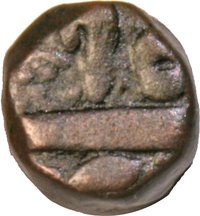
Obverse
Description:
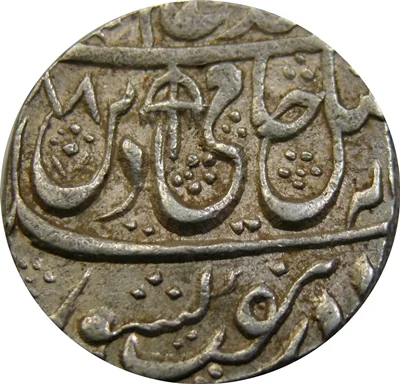
"Shadow of the Divine Favour"
Inscription: Struck coin in the seven climes, the Shadow of the Divine Favour, the Defender of Faith, Muhammad Shah Alam, Emperor.
Inscription: Struck coin in the seven climes, the Shadow of the Divine Favour, the Defender of Faith, Muhammad Shah Alam, Emperor.
Inscription:
٨٨
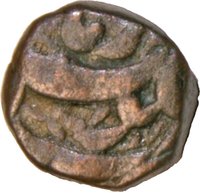
Reverse
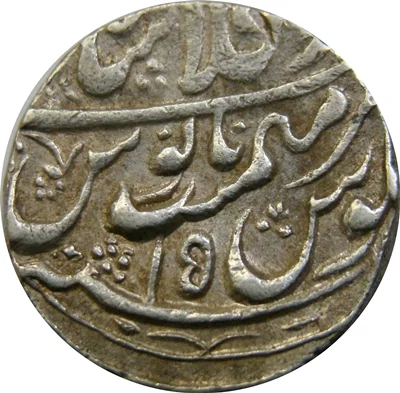
Description:
Struck at the Caliphate's Seat, Shahjahanabad, Year 15 of the Prosperous Reign.
Edge
Mintings
| Year | Mint Mark | Mintage | Quality | Collection |
|---|---|---|---|---|
| — | — | — | ||
| 1773 | — | — | ||
| 1773 | — | — | ||
| 1774 | — | — | ||
| 1775 | — | — | ||
| 1776 | — | — | ||
| 1777 | — | — | ||
| 1778 | — | — | ||
| 1779 | — | — | ||
| 1780 | — | — | ||
| 1781 | — | — | ||
| 1782 | — | — | ||
| 1783 | — | — | ||
| 1784 | — | — | ||
| 1785 | — | — | ||
| 1786 | — | — | ||
| 1787 | — | — |
Historical background
The year 1186 (approximately 593 AH) predates the establishment of the Mughal Empire by over three centuries. This period falls within the late 12th century, when the Indian subcontinent was dominated by a constellation of rival Hindu and Muslim kingdoms. The Delhi Sultanate, the first major Muslim empire in the region, would not be founded until 1206. Therefore, there was no "Mughal" currency situation in 1186. The Mughal dynasty, founded by Babur in 1526, derived its name from the Persian word for "Mongol," reflecting its Timurid heritage.
In the late 12th century, the northern regions that would later form the heart of the Mughal Empire were under the control of the Ghurid Sultanate. The Ghurid rulers, particularly Mu'izz ad-Din Muhammad Ghori, were actively expanding their territory from their base in modern-day Afghanistan into the Punjab and Gangetic plains. Their campaigns directly set the stage for the subsequent Delhi Sultanate. The currency in circulation would have been primarily the Ghurid dinar (gold) and dirham (silver), along with a variety of regional coinage from the defeated Hindu Shahi and Rajput kingdoms, which often featured Sanskrit inscriptions and iconography.
The monetary system was fragmented and metallistic, with the value of coins intrinsically tied to their weight and purity of metal. The concept of a standardized, empire-wide currency issued by a central authority was not yet established in the subcontinent. The Ghurid administrative and monetary models, which themselves drew upon earlier Islamic and Persian traditions, would later be refined by the Delhi Sultans and, centuries after that, reach their zenith under the Mughals with the impeccably standardized gold mohur and silver rupiya. Thus, 1186 represents a point of transition, where the coinage reflected the turmoil of conquest rather than the consolidated administration of a mature empire.
In the late 12th century, the northern regions that would later form the heart of the Mughal Empire were under the control of the Ghurid Sultanate. The Ghurid rulers, particularly Mu'izz ad-Din Muhammad Ghori, were actively expanding their territory from their base in modern-day Afghanistan into the Punjab and Gangetic plains. Their campaigns directly set the stage for the subsequent Delhi Sultanate. The currency in circulation would have been primarily the Ghurid dinar (gold) and dirham (silver), along with a variety of regional coinage from the defeated Hindu Shahi and Rajput kingdoms, which often featured Sanskrit inscriptions and iconography.
The monetary system was fragmented and metallistic, with the value of coins intrinsically tied to their weight and purity of metal. The concept of a standardized, empire-wide currency issued by a central authority was not yet established in the subcontinent. The Ghurid administrative and monetary models, which themselves drew upon earlier Islamic and Persian traditions, would later be refined by the Delhi Sultans and, centuries after that, reach their zenith under the Mughals with the impeccably standardized gold mohur and silver rupiya. Thus, 1186 represents a point of transition, where the coinage reflected the turmoil of conquest rather than the consolidated administration of a mature empire.
💎 Extremely Rare