

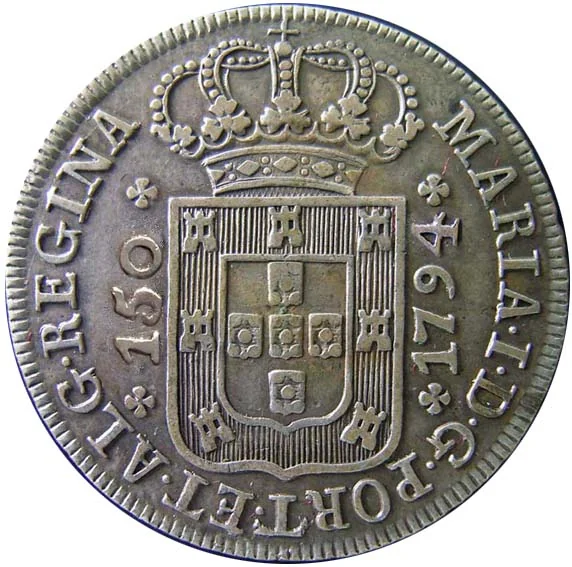
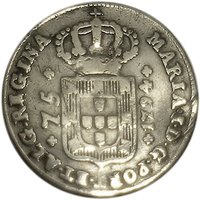
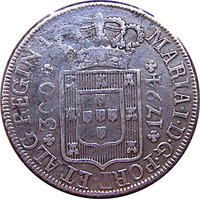
Obverse
Description:
Royal arms of Portugal
Inscription:
MARIA·I·D·G·PORT·ET·ALG·REGINA
150 1794
150 1794
Script: Latin
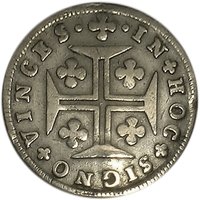
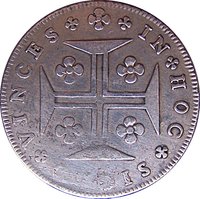
Reverse
Description:
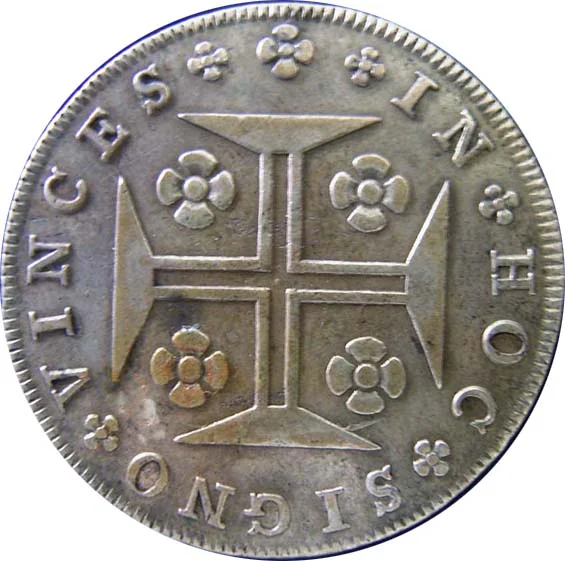
Cross of the Military Order of Christ with corner florals.
Inscription:
IN * HOC *SIGNO * VINCES
Script: Latin
Edge
Plain
Categories
| Symbols> Coat of Arms |
| Symbol> Crown |
Mintings
| Year | Mint Mark | Mintage | Quality | Collection |
|---|---|---|---|---|
| 1794 | — | — | ||
| 1795 | — | — | ||
| 1798 | — | — |
Historical background
In 1794, the Azores, an archipelago under Portuguese rule, operated within the broader monetary system of the Portuguese Empire, but with significant local challenges. The official currency was the Portuguese real, with higher-value transactions often referenced in the milréis. However, the islands' remote location in the mid-Atlantic and their role as a vital stopping point for transoceanic shipping led to a chronic shortage of official coinage. This scarcity was exacerbated by Portugal's own economic difficulties, including the outflow of Brazilian gold and the disruptive effects of the Napoleonic Wars in Europe, which strained the metropole's ability to supply its distant territories.
Consequently, the local economy in the Azores relied heavily on a mix of foreign coins that entered through trade and naval movements. Spanish pieces of eight (reales), British guineas and shillings, and Brazilian coins circulated widely alongside the official Portuguese issues, their values determined by fluctuating exchange rates and intrinsic metal content. Barter for goods and services also remained a practical necessity, especially in rural areas and smaller transactions. This created a complex and sometimes chaotic monetary environment where merchants and officials had to constantly assess and negotiate the worth of various coins.
The situation was further complicated by the archipelago's strategic importance. As a key port of call for whalers, merchantmen, and naval vessels, particularly from Britain and the newly independent United States, foreign currency influx was constant but unpredictable. Local authorities had limited power to control this de facto multi-currency system. Therefore, in 1794, an Azorean merchant or farmer would have navigated a daily economy defined by coin scarcity, the practical use of barter, and the handling of a diverse array of foreign and domestic metallic money, all while being tethered to an imperial Portuguese economic system that was struggling to function effectively at such a distance.
Consequently, the local economy in the Azores relied heavily on a mix of foreign coins that entered through trade and naval movements. Spanish pieces of eight (reales), British guineas and shillings, and Brazilian coins circulated widely alongside the official Portuguese issues, their values determined by fluctuating exchange rates and intrinsic metal content. Barter for goods and services also remained a practical necessity, especially in rural areas and smaller transactions. This created a complex and sometimes chaotic monetary environment where merchants and officials had to constantly assess and negotiate the worth of various coins.
The situation was further complicated by the archipelago's strategic importance. As a key port of call for whalers, merchantmen, and naval vessels, particularly from Britain and the newly independent United States, foreign currency influx was constant but unpredictable. Local authorities had limited power to control this de facto multi-currency system. Therefore, in 1794, an Azorean merchant or farmer would have navigated a daily economy defined by coin scarcity, the practical use of barter, and the handling of a diverse array of foreign and domestic metallic money, all while being tethered to an imperial Portuguese economic system that was struggling to function effectively at such a distance.
💎 Extremely Rare