

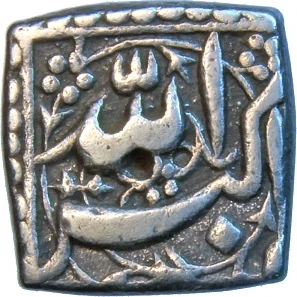
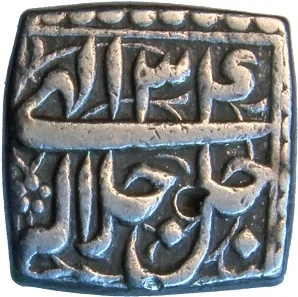
1 Rupee – Mughal Empire
India
Context
Years: 1585–1600
Country: India 
Issuer: Mughal Empire
Ruler: Akbar
Currency:
(1540—1842)
Demonetized: Yes
Material
References
KM: #Click to copy to clipboard91.1
Numista: #76206
Value
Bullion value: $32.49
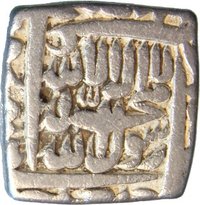
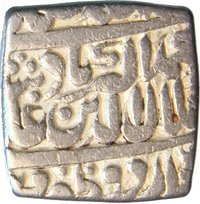
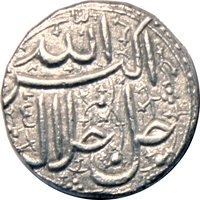
Obverse
Inscription:
Allahu Akbar
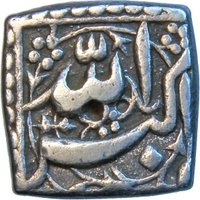
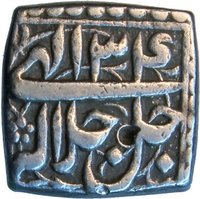
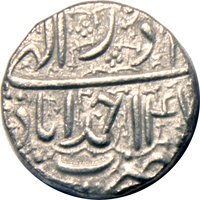
Reverse
Inscription:
Jallu Jalalahu
Ilahi Date 34
Ilahi Date 34
Edge
Plain
Mintings
| Year | Mint Mark | Mintage | Quality | Collection |
|---|---|---|---|---|
| — | — | — |
Historical background
In 1585, the Mughal Empire under Emperor Akbar was in the midst of a profound monetary and fiscal consolidation, following decades of territorial expansion. The empire's currency system was a complex bimetallic structure, primarily based on the silver rupee and the gold mohur, with a vast array of copper dam serving as the ubiquitous fractional currency for daily transactions. However, the uniformity and purity of these coins varied significantly across the newly conquered regions, as Akbar had yet to fully implement his centralising reforms. The empire was still digesting the annexation of rich provinces like Gujarat (1573) and Bengal (1576), which brought important mint towns and access to international bullion flows into the Mughal fold, setting the stage for greater standardisation.
Akbar’s administration was actively working to impose imperial control over minting. While royal mints (dar-ul-zarb) operated in major cities like Delhi, Agra, and Lahore, many local and former ruling dynasties still operated their own mints, leading to inconsistencies in weight and fineness. A key development around this time was the increasing use of the Ilahi calendar, introduced in 1584, which would soon be stamped on coins to mark their regnal year, aiding administration and reducing fraud. Furthermore, Akbar’s government was beginning to rigorously assess and standardise the exchange rates between the copper dam, silver rupee, and gold mohur to streamline revenue collection and bureaucratic salaries, which were calculated in dams but often paid in rupees.
The currency situation in 1585, therefore, was one of transition. Akbar’s vision of a unified imperial currency was not yet fully realised, but the critical policies and administrative machinery were being put in place. The influx of American silver via Europe and the Ottoman Empire into the Indian Ocean trade, particularly through Gujarat, was starting to boost the silver supply, facilitating the rupee's eventual dominance. Thus, this period represents the foundational moment before the full implementation of Akbar’s sophisticated fiscal system, which would go on to support the empire’s immense wealth and administrative efficiency for over a century.
Akbar’s administration was actively working to impose imperial control over minting. While royal mints (dar-ul-zarb) operated in major cities like Delhi, Agra, and Lahore, many local and former ruling dynasties still operated their own mints, leading to inconsistencies in weight and fineness. A key development around this time was the increasing use of the Ilahi calendar, introduced in 1584, which would soon be stamped on coins to mark their regnal year, aiding administration and reducing fraud. Furthermore, Akbar’s government was beginning to rigorously assess and standardise the exchange rates between the copper dam, silver rupee, and gold mohur to streamline revenue collection and bureaucratic salaries, which were calculated in dams but often paid in rupees.
The currency situation in 1585, therefore, was one of transition. Akbar’s vision of a unified imperial currency was not yet fully realised, but the critical policies and administrative machinery were being put in place. The influx of American silver via Europe and the Ottoman Empire into the Indian Ocean trade, particularly through Gujarat, was starting to boost the silver supply, facilitating the rupee's eventual dominance. Thus, this period represents the foundational moment before the full implementation of Akbar’s sophisticated fiscal system, which would go on to support the empire’s immense wealth and administrative efficiency for over a century.
💎 Extremely Rare