

1 Penny – Scotland
United Kingdom
Context
Year: 1614
Country: United Kingdom 
Issuer: Scotland 
Ruler: James VI
Currency:
(1136—1707)
Demonetized: Yes
Total mintage: 200,000
Material
Diameter: 14 mm
Weight: 1.22 g
Shape: Irregular round
Composition: Copper
Magnetic: No
Technique: Hammered
References
KM: #Click to copy to clipboard36
Numista: #76082
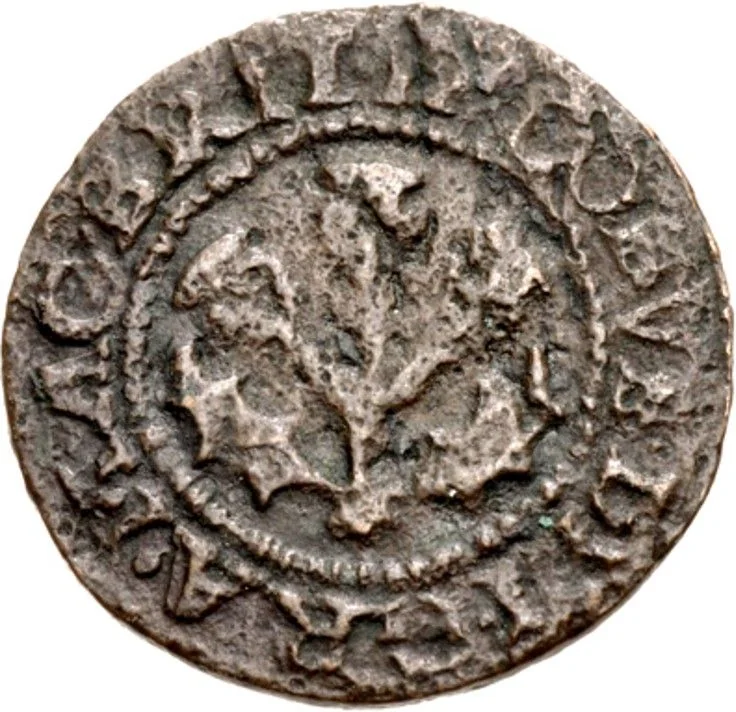
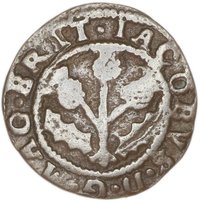
Obverse
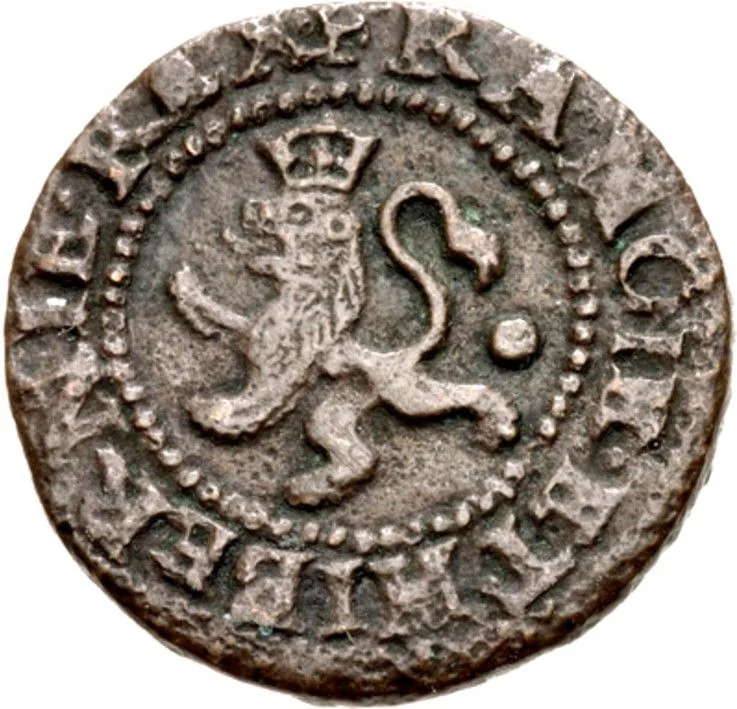
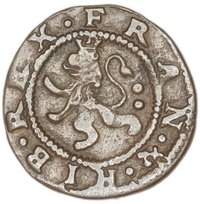
Reverse
Description:
Rampant lion crowned, left-facing, with a pellet to the right.
Inscription:
· FRANCIE · ET · HIBERNIE · REX
Script: Latin
Edge
Plain
Mints
| Name | Mark |
|---|---|
| Edinburgh | — |
Mintings
| Year | Mint Mark | Mintage | Quality | Collection |
|---|---|---|---|---|
| 1614 | — | 200,000 |
Historical background
In 1614, Scotland’s currency situation was a complex and troubled legacy of the 16th century, characterised by severe debasement and economic instability. The reign of James VI had seen repeated "cry-ups" (official revaluations) and "cry-downs" (devaluations) of the coinage, as well as the issuance of underweight, base metal coins to finance royal expenditures. By the early 1600s, the Scottish pound (£ Scots) had drastically depreciated against its English counterpart, with an exchange rate fixed at £1 Sterling = £12 Scots in 1603 upon the Union of the Crowns. This reflected the poor silver content and low confidence in Scottish coinage, which hampered both domestic trade and international commerce.
The primary issue was a chronic shortage of high-value specie (gold and full-weight silver coins), leading to a circulation dominated by billon coins—debased silver pieces with a high copper content, such as the turner. These low-denomination coins were essential for everyday transactions but were easily counterfeited and subject to hoarding and export. Furthermore, a significant volume of foreign coin, particularly English, French, and Dutch, circulated in Scotland, often accepted at a premium over the inferior domestic issues. This monetary confusion created a dual problem: a lack of sound currency for substantial business and a unstable petty coinage that hurt the poor and disrupted market trade.
While James VI had attempted reforms after moving to London, the situation in 1614 was one of uneasy stasis rather than resolution. No major recoinage was undertaken at this specific date, and the kingdom muddled through with its mixed and degraded currency. The fundamental structural weakness persisted, as Scotland lacked the royal finances to call in and replace the entire circulating medium with sound coin. This monetary fragility would continue until the eventual reforms following the Treaty of Union in 1707, which finally integrated Scotland into England’s stable monetary system.
The primary issue was a chronic shortage of high-value specie (gold and full-weight silver coins), leading to a circulation dominated by billon coins—debased silver pieces with a high copper content, such as the turner. These low-denomination coins were essential for everyday transactions but were easily counterfeited and subject to hoarding and export. Furthermore, a significant volume of foreign coin, particularly English, French, and Dutch, circulated in Scotland, often accepted at a premium over the inferior domestic issues. This monetary confusion created a dual problem: a lack of sound currency for substantial business and a unstable petty coinage that hurt the poor and disrupted market trade.
While James VI had attempted reforms after moving to London, the situation in 1614 was one of uneasy stasis rather than resolution. No major recoinage was undertaken at this specific date, and the kingdom muddled through with its mixed and degraded currency. The fundamental structural weakness persisted, as Scotland lacked the royal finances to call in and replace the entire circulating medium with sound coin. This monetary fragility would continue until the eventual reforms following the Treaty of Union in 1707, which finally integrated Scotland into England’s stable monetary system.
✨ Legendary