

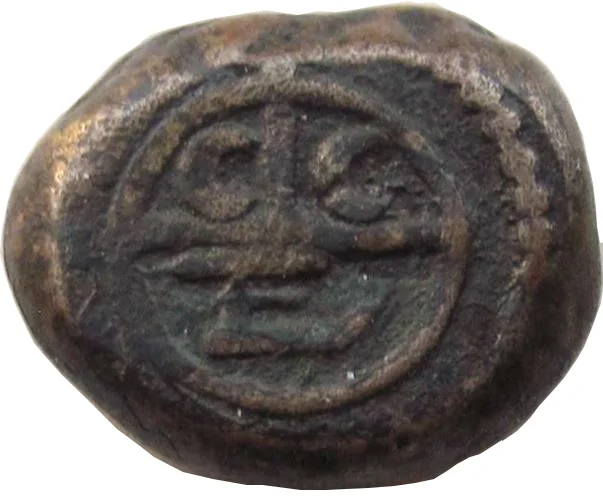

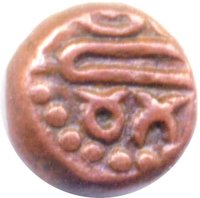
Obverse
Description:
CC/E or GC/E within beaded border.
Inscription:
CC
E
E
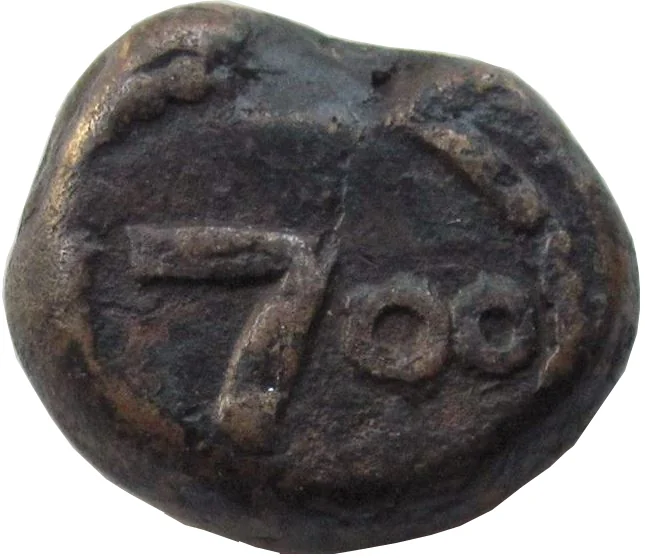
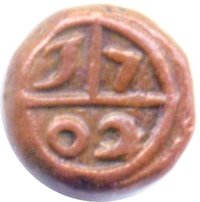
Reverse
Description:
Date in a raised circle.
Inscription:
1700
Edge
Plain
Mintings
| Year | Mint Mark | Mintage | Quality | Collection |
|---|---|---|---|---|
| 1700 | — | — |
Historical background
In 1700, the currency situation in the Madras Presidency was complex and transitional, reflecting its position as a major hub of the English East India Company (EIC) within a vibrant Indian Ocean trading network. The primary circulating medium was a mix of Indian and foreign coins. The most important local unit was the gold pagoda, a thick, dumpy coin issued by various South Indian rulers, particularly the Vijayanagara Empire and its successors. Alongside this, silver fanams (small gold coins) and copper cash coins facilitated smaller, everyday transactions. However, the influx of European traders also brought a plethora of foreign silver coins into the port city, most notably Spanish American pieces of eight and their fractional parts, which were valued for their high and consistent silver content.
The EIC, based at Fort St. George, faced significant challenges due to this monetary diversity. The absence of a unified, authoritative currency led to constant problems with valuation, exchange rates, and counterfeiting. Merchants and the Company itself had to rely on skilled "shroffs" (money-changers and assayers) to verify the weight and purity of countless coin types, a process that was both time-consuming and risky. Furthermore, the Company's need to finance its trade—purchasing Indian textiles for export—often drained silver specie from the Presidency, causing liquidity shortages and complicating local administration and salary payments for its soldiers and officials.
Consequently, the turn of the 18th century marked the beginning of the EIC's direct intervention in coinage. While the Presidency would not see a full, standardized coinage system until later decades, the groundwork was being laid. The Company started to more systematically mint its own gold pagodas imitating local types to gain credibility, and increasingly asserted its right to control currency as a sovereign prerogative. This period thus represents a pivotal shift from a market dominated by indigenous and imported bullion towards a system increasingly shaped by colonial authority, setting the stage for the eventual introduction of the rupee system in the region.
The EIC, based at Fort St. George, faced significant challenges due to this monetary diversity. The absence of a unified, authoritative currency led to constant problems with valuation, exchange rates, and counterfeiting. Merchants and the Company itself had to rely on skilled "shroffs" (money-changers and assayers) to verify the weight and purity of countless coin types, a process that was both time-consuming and risky. Furthermore, the Company's need to finance its trade—purchasing Indian textiles for export—often drained silver specie from the Presidency, causing liquidity shortages and complicating local administration and salary payments for its soldiers and officials.
Consequently, the turn of the 18th century marked the beginning of the EIC's direct intervention in coinage. While the Presidency would not see a full, standardized coinage system until later decades, the groundwork was being laid. The Company started to more systematically mint its own gold pagodas imitating local types to gain credibility, and increasingly asserted its right to control currency as a sovereign prerogative. This period thus represents a pivotal shift from a market dominated by indigenous and imported bullion towards a system increasingly shaped by colonial authority, setting the stage for the eventual introduction of the rupee system in the region.
✨ Legendary