

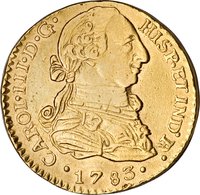
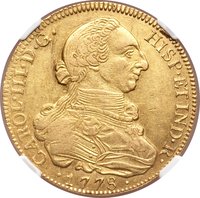
Obverse
Description:
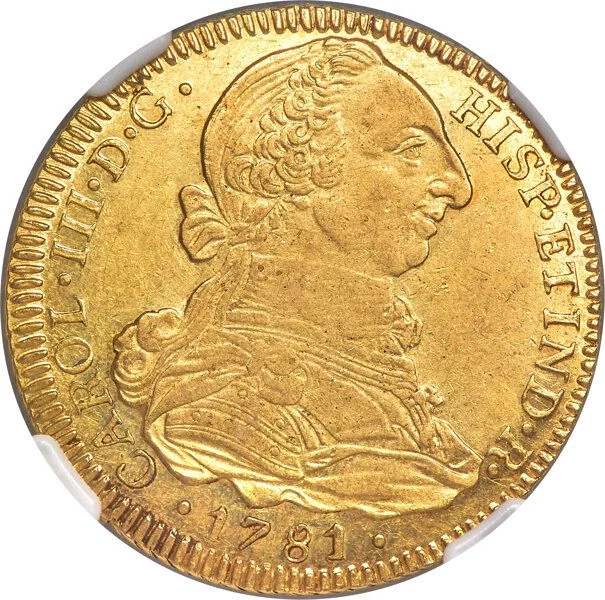
Bust right, legend around, date below.
Inscription:
CAROL • III • D • G • HISP • ET IND • R
• 1781 •
• 1781 •
Script: Latin
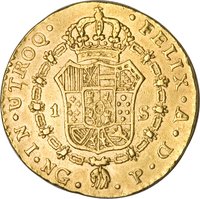
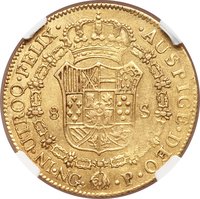
Reverse
Description:
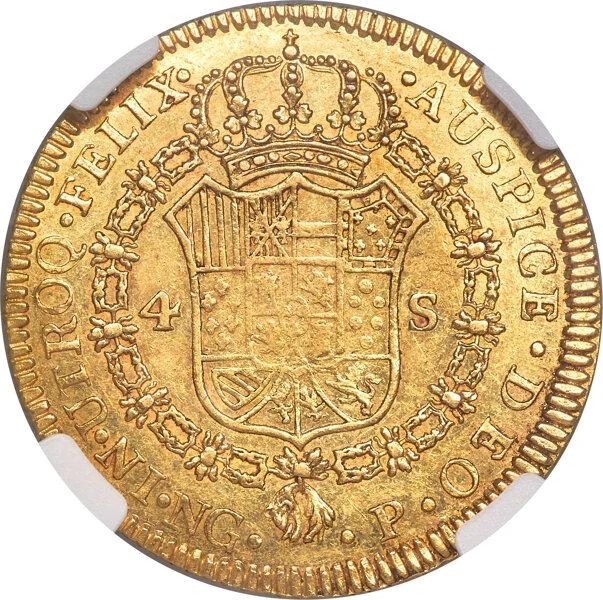
Arms shield with chain, legend around. Mint and initial below.
Inscription:
IN • UTROQ • FELIX • AUSPICE • DEO
4 S
• NG • • P •
4 S
• NG • • P •
Script: Latin
Edge
Reeded
Categories
| Symbols> Coat of Arms |
| Person> Monarch |
Mints
| Name | Mark |
|---|---|
| Casa de Moneda de Guatemala | NG |
Historical background
In 1778, the currency situation in the Kingdom of Guatemala (which included modern-day Guatemala, El Salvador, Honduras, Nicaragua, and Costa Rica) was characterized by a severe shortage of official coinage and a reliance on a chaotic system of substitute currencies. The Spanish Crown's primary mint for the region, located in Guatemala City, had ceased production of silver coins (reales) in 1733 due to a combination of high operating costs, a lack of accessible silver, and the Crown's preference to concentrate minting in Mexico and Peru. This left the regional economy without a sufficient supply of standardized, legal tender, crippling large-scale commerce and tax collection.
To facilitate daily transactions, the local economy depended on a variety of informal and often unstable substitutes. The most common was cacao beans, used for small purchases in a practice dating back to the pre-Columbian era. For larger transactions, merchants and officials used tlacos—lead or copper tokens issued by individual merchants, hacienda owners, and even municipalities—which promised future redemption in specie. This created a fragmented and unreliable monetary landscape, as the value of these tokens was only as good as the reputation of the issuer. Additionally, worn and clipped Spanish coins from other colonies, along with foreign coins (especially Peruvian pieces of eight), circulated at discounted and fluctuating values.
The Bourbon Reforms, aimed at increasing royal revenue and control, made this monetary disorder a pressing administrative issue. Authorities recognized that the lack of sound currency hindered economic growth and the Crown's ability to extract wealth. Consequently, 1778 fell within a period of active planning and petitioning. Just a few years prior, in 1774, the local authorities had requested the re-establishment of the mint, and by 1778, efforts were intensifying. This lobbying would eventually lead to the reopening of the Guatemala Mint in 1779, beginning a new chapter of monetary stability under the direct authority of the Spanish Crown.
To facilitate daily transactions, the local economy depended on a variety of informal and often unstable substitutes. The most common was cacao beans, used for small purchases in a practice dating back to the pre-Columbian era. For larger transactions, merchants and officials used tlacos—lead or copper tokens issued by individual merchants, hacienda owners, and even municipalities—which promised future redemption in specie. This created a fragmented and unreliable monetary landscape, as the value of these tokens was only as good as the reputation of the issuer. Additionally, worn and clipped Spanish coins from other colonies, along with foreign coins (especially Peruvian pieces of eight), circulated at discounted and fluctuating values.
The Bourbon Reforms, aimed at increasing royal revenue and control, made this monetary disorder a pressing administrative issue. Authorities recognized that the lack of sound currency hindered economic growth and the Crown's ability to extract wealth. Consequently, 1778 fell within a period of active planning and petitioning. Just a few years prior, in 1774, the local authorities had requested the re-establishment of the mint, and by 1778, efforts were intensifying. This lobbying would eventually lead to the reopening of the Guatemala Mint in 1779, beginning a new chapter of monetary stability under the direct authority of the Spanish Crown.
✨ Legendary