


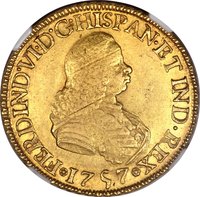
Obverse
Description:
Bust right, encircled by legend.
Inscription:
FERDIND • VI • D • G • HISP ETIND • REX
• 1755 •
• 1755 •
Script: Latin
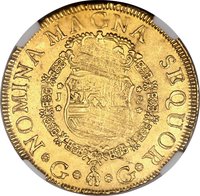
Reverse
Description:
Shield with crowned arms between initials and value, encircled by legend.
Inscription:
NOMINA MAGNA SEQUOR
J 2
G
J 2
G
Script: Latin
Edge
Categories
| Symbols> Coat of Arms |
Mints
| Name | Mark |
|---|---|
| Casa de Moneda de Guatemala | G |
Mintings
| Year | Mint Mark | Mintage | Quality | Collection |
|---|---|---|---|---|
| 1755 | G | — |
Historical background
In 1755, the currency situation in the Kingdom of Guatemala (a colonial audiencia spanning modern-day Central America and Chiapas, Mexico) was defined by a severe and chronic shortage of official coinage. The primary unit of account was the Spanish silver real, with 8 reales equaling one peso. However, the physical supply of these coins was inadequate for the region's economy. This scarcity stemmed from Guatemala's distance from the major silver mining centers of New Spain (Mexico) and Peru, combined with the Crown's policy of extracting precious metals to Spain, which drained coinage from the colonies. Most large transactions, especially for export crops like indigo and cacao, were conducted through complex credit arrangements and barter.
To facilitate everyday trade, the colony heavily relied on a system of provisional or token currencies. The most common of these was cacao beans, used for small-scale indigenous and local market exchanges, a practice with deep pre-Hispanic roots. More significantly, the Spanish authorities regularly issued moneda macuquina—crudely cut and stamped silver pieces, often from melted-down bullion or foreign coins. While officially valued, their inconsistent weight and purity caused friction in commerce. Furthermore, the widespread circulation of foreign coins, particularly Peruvian pesos and even coins from other empires, was tacitly accepted, adding to a chaotic and heterogeneous monetary environment.
This scarcity and inconsistency posed significant problems for the colonial administration and merchants alike. It hindered tax collection, complicated trade with other Spanish provinces, and created opportunities for fraud. The situation would eventually lead to a pivotal reform in 1759, when the Spanish Crown authorized the establishment of a mint in Guatemala City. While not yet operational in 1755, the planning and royal assent for this mint were likely underway, representing a direct response to the monetary crises of that decade. Thus, 1755 represents a point of acute strain, immediately preceding a major institutional change aimed at stabilizing the currency by producing a local and reliable supply of coinage.
To facilitate everyday trade, the colony heavily relied on a system of provisional or token currencies. The most common of these was cacao beans, used for small-scale indigenous and local market exchanges, a practice with deep pre-Hispanic roots. More significantly, the Spanish authorities regularly issued moneda macuquina—crudely cut and stamped silver pieces, often from melted-down bullion or foreign coins. While officially valued, their inconsistent weight and purity caused friction in commerce. Furthermore, the widespread circulation of foreign coins, particularly Peruvian pesos and even coins from other empires, was tacitly accepted, adding to a chaotic and heterogeneous monetary environment.
This scarcity and inconsistency posed significant problems for the colonial administration and merchants alike. It hindered tax collection, complicated trade with other Spanish provinces, and created opportunities for fraud. The situation would eventually lead to a pivotal reform in 1759, when the Spanish Crown authorized the establishment of a mint in Guatemala City. While not yet operational in 1755, the planning and royal assent for this mint were likely underway, representing a direct response to the monetary crises of that decade. Thus, 1755 represents a point of acute strain, immediately preceding a major institutional change aimed at stabilizing the currency by producing a local and reliable supply of coinage.

✨ Legendary