

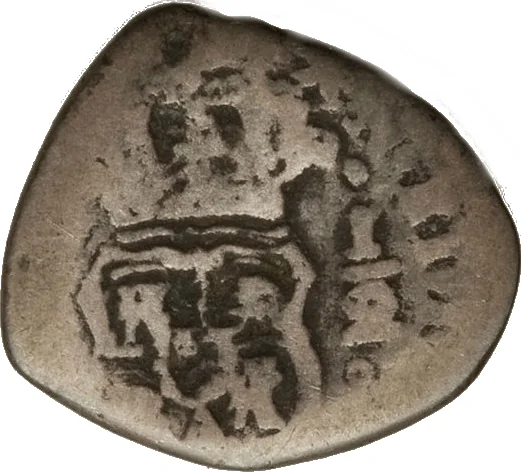
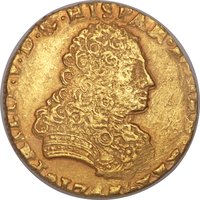
Obverse
Description:
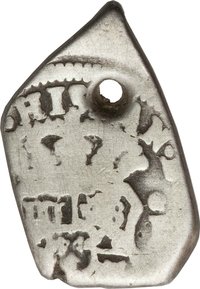
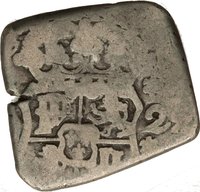
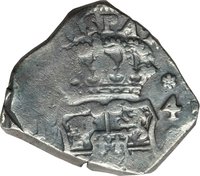
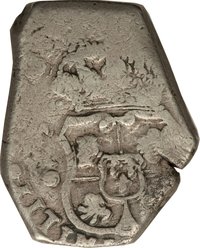
Shielded arms between initials and value. Circular legend, usually illegible or off-flan.
Script: Latin
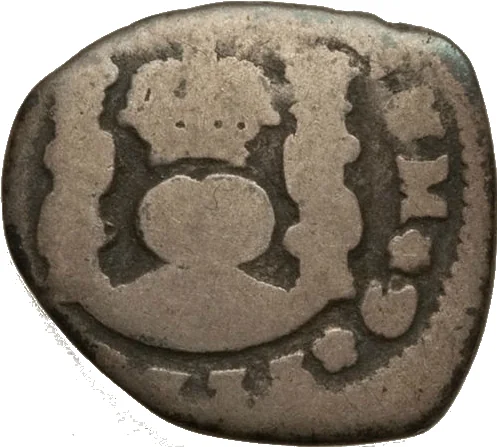
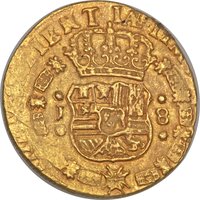
Reverse
Description:
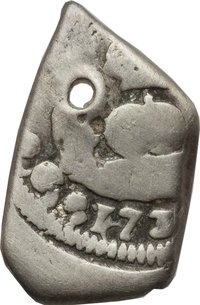
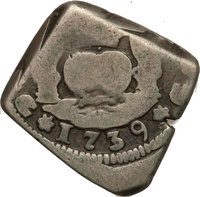
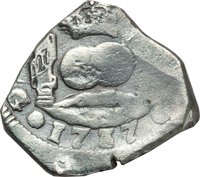
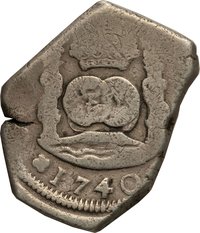
Crowned hemispheres between pillars, legend around, date below. (Usually off-flan.)
Script: Latin
Edge
Categories
| Symbols> Coat of Arms |
Mints
| Name | Mark |
|---|---|
| Casa de Moneda de Guatemala | — |
Mintings
| Year | Mint Mark | Mintage | Quality | Collection |
|---|---|---|---|---|
| 1733 | J | — | ||
| 1734 | J | — | ||
| 1735 | J | — | ||
| 1736 | J | — | ||
| 1737 | J | — | ||
| 1738 | J | — | ||
| 1739 | J | — | ||
| 1740 | J | — | ||
| 1741 | J | — | ||
| 1742 | J | — | ||
| 1743 | J | — | ||
| 1744 | J | — | ||
| 1745 | J | — | ||
| 1746 | J | — | ||
| 1747 | J | — |
Historical background
In 1733, Guatemala existed as the Captaincy General of Guatemala, a colonial administrative division of the Spanish Empire encompassing much of Central America. Its monetary system was entirely dictated by the Spanish Crown and was characterized by a chronic shortage of official coinage. The economy functioned on a dual system: high-value transactions, particularly in international trade and large-scale commerce, relied on scarce silver reales and gold escudos minted in Mexico or Peru. However, the vast majority of daily local trade and tribute payments were conducted using cacao beans as a traditional, deeply ingrained commodity currency, a practice dating back to the pre-Columbian Maya.
This currency scarcity was a direct result of mercantilist policies. Spanish law required all precious metals mined in the Americas to be shipped to Spain, primarily via the fleet system from Veracruz or Portobelo. Very little coinage was retained for local circulation in the colonies themselves. To mitigate this, the Crown authorized the establishment of a mint in Guatemala City in 1731, but it did not begin production until 1733, the very year in question. Its initial output of silver macacos (crude, hammer-struck coins) was minimal and insufficient to meet the demand of the regional economy.
Consequently, the daily economic life for most people in 1733 Guatemala was a complex blend of the old and new worlds. Prices for goods and labor were often quoted in both reales and cacao, with established exchange rates between them. The simultaneous use of official Spanish coin, makeshift tokens, and ancient indigenous commodities created a fragmented and often inefficient monetary environment. The new mint’s opening represented a long-awaited, though initially feeble, attempt by the Crown to impose monetary order and integrate the colony more fully into the imperial fiscal system, but the tangible effects of this change would only be felt gradually in the years following 1733.
This currency scarcity was a direct result of mercantilist policies. Spanish law required all precious metals mined in the Americas to be shipped to Spain, primarily via the fleet system from Veracruz or Portobelo. Very little coinage was retained for local circulation in the colonies themselves. To mitigate this, the Crown authorized the establishment of a mint in Guatemala City in 1731, but it did not begin production until 1733, the very year in question. Its initial output of silver macacos (crude, hammer-struck coins) was minimal and insufficient to meet the demand of the regional economy.
Consequently, the daily economic life for most people in 1733 Guatemala was a complex blend of the old and new worlds. Prices for goods and labor were often quoted in both reales and cacao, with established exchange rates between them. The simultaneous use of official Spanish coin, makeshift tokens, and ancient indigenous commodities created a fragmented and often inefficient monetary environment. The new mint’s opening represented a long-awaited, though initially feeble, attempt by the Crown to impose monetary order and integrate the colony more fully into the imperial fiscal system, but the tangible effects of this change would only be felt gradually in the years following 1733.
Series: 1733 Guatemala circulation coins
✨ Legendary