

1 Duit – Spanish Netherlands
Netherlands
Context
Year: 1700
Country: Netherlands 
Issuer: Spanish Netherlands
Ruler: Charles II
Currency:
(1506—1713)
Demonetized: Yes
Material
Diameter: 19.5 mm
Weight: 1.91 g
Thickness: 0.7 mm
Shape: Irregular round
Composition: Copper
Magnetic: No
Technique: Milled
Alignment: Coin alignment
flip
References
KM: #Click to copy to clipboard101
Numista: #71946
Obverse
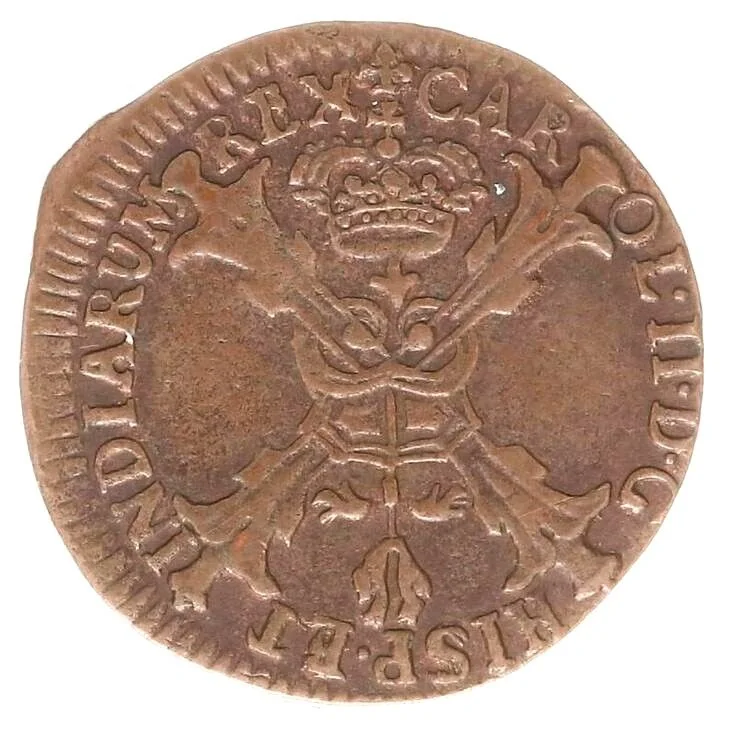
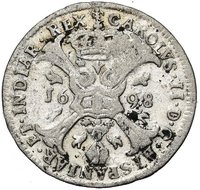
Description:
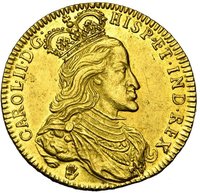
Saint Andrew's cross, crowned, with firesteel center and Golden Fleece jewel below. Fleur-de-lis mint mark above crown.
Inscription:
CAROL II D G HISP ET INDIARVM REX
Script: Latin
Reverse
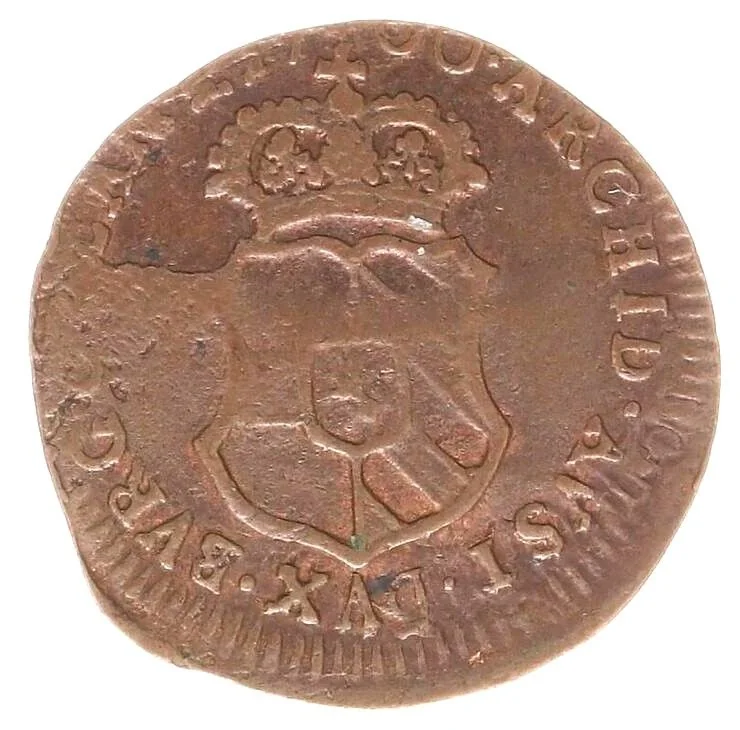
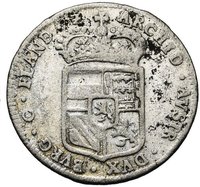
Description:
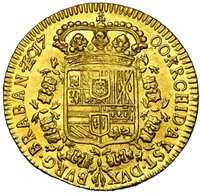
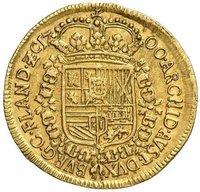
Crowned arms, date flanking crown.
Inscription:
ARCHID AVST DVX BVRG CO FLAN Z
Script: Latin
Edge
Plain
Categories
| Symbols> Coat of Arms |
Mints
| Name | Mark |
|---|---|
| Bruges | Lis |
Mintings
| Year | Mint Mark | Mintage | Quality | Collection |
|---|---|---|---|---|
| 1700 | — | — |
Historical background
By 1700, the currency situation in the Spanish Netherlands was one of profound instability and complexity, a direct legacy of decades of war and economic neglect. The region, a battleground in the Franco-Dutch War and the ongoing Nine Years' War, suffered from severe monetary debasement. Successive governments, both Spanish and later French during occupations, had resorted to lowering the silver content in coins to finance military campaigns. This created a chaotic mix of old "good" money (heavier in silver), new debased coins, and a plethora of foreign currencies from neighbouring states circulating simultaneously, leading to widespread confusion and loss of public trust.
The core of the problem was Gresham's Law in action: "bad money drives out good." Hoarders and merchants exported full-weight silver coins, while only the debased currency remained in common circulation, eroding purchasing power and disrupting trade. Attempts at reform, like the 1690 ordinance by the Spanish authorities, tried to fix exchange rates between the various coins, but these official rates often failed to match market reality. This created a dual system where everyday transactions were hampered, and international commerce required expert money-changers to navigate the dizzying array of values.
This monetary crisis unfolded against the pivotal political backdrop of the impending War of the Spanish Succession (1701-1714). With the childless Charles II of Spain dying in 1700, the region's sovereignty was contested between the French Bourbon and Austrian Habsburg claimants. The unstable currency not only weakened the local economy on the eve of conflict but also became an immediate issue for whichever power sought to control the territory. Securing revenue and stabilizing finances were paramount, meaning that monetary reform would become an urgent priority for the eventual victor, the Austrians, who would later impose a more uniform system based on the kronenthaler.
The core of the problem was Gresham's Law in action: "bad money drives out good." Hoarders and merchants exported full-weight silver coins, while only the debased currency remained in common circulation, eroding purchasing power and disrupting trade. Attempts at reform, like the 1690 ordinance by the Spanish authorities, tried to fix exchange rates between the various coins, but these official rates often failed to match market reality. This created a dual system where everyday transactions were hampered, and international commerce required expert money-changers to navigate the dizzying array of values.
This monetary crisis unfolded against the pivotal political backdrop of the impending War of the Spanish Succession (1701-1714). With the childless Charles II of Spain dying in 1700, the region's sovereignty was contested between the French Bourbon and Austrian Habsburg claimants. The unstable currency not only weakened the local economy on the eve of conflict but also became an immediate issue for whichever power sought to control the territory. Securing revenue and stabilizing finances were paramount, meaning that monetary reform would become an urgent priority for the eventual victor, the Austrians, who would later impose a more uniform system based on the kronenthaler.
💎 Extremely Rare