


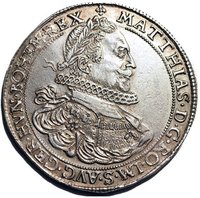
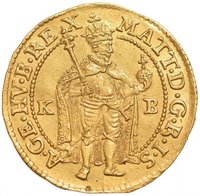
Obverse
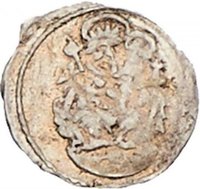
Description:
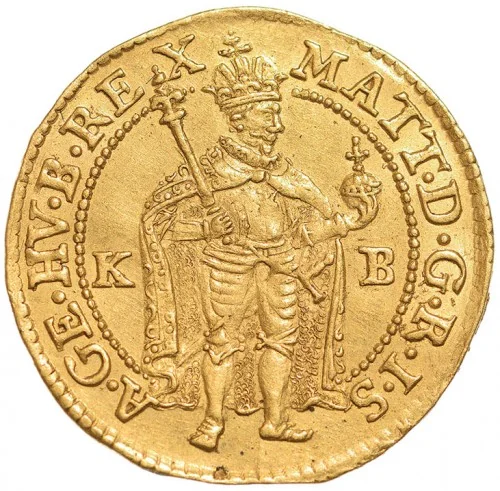
Crowned monarch in armor and vestment, holding orb and scepter, breaks inner circle by mintmark.
Inscription:
MATT · D · G · R · I · S · A · GE · HV · B · REX
K B
K B
Script: Latin
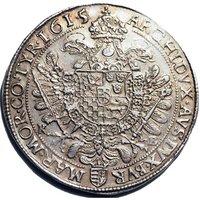
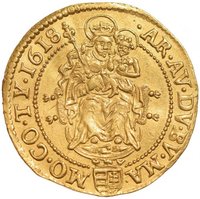
Reverse
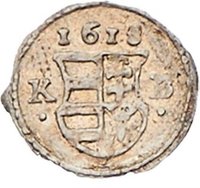
Description:
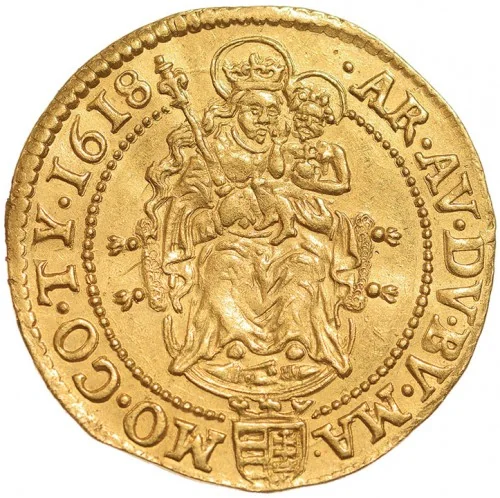
Madonna and Child seated on a cushion, holding a scepter. A crowned double Hungarian shield is beneath them.
Inscription:
• AR • AV • DV • BV • MA • MO • CO • TY • 1619
Script: Latin
Edge
Plain
Mints
| Name | Mark |
|---|---|
| Kremnica | KB |
Mintings
| Year | Mint Mark | Mintage | Quality | Collection |
|---|---|---|---|---|
| 1613 | K-B | — | ||
| 1614 | K-B | — | ||
| 1615 | K-B | — | ||
| 1616 | K-B | — | ||
| 1617 | K-B | — | ||
| 1618 | K-B | — | ||
| 1619 | K-B | — | ||
| 1620 | K-B | — |
Historical background
In 1613, Hungary existed as a fractured kingdom divided into three parts: Royal Hungary under Habsburg rule in the north and west, the Ottoman-occupied central region, and the semi-independent Principality of Transylvania in the east. This political fragmentation directly caused a chaotic and multi-layered currency situation. The Habsburgs minted silver thalers and copper denars in Royal Hungary, while the Ottomans circulated their own silver akçe and gold sultani. Transylvania, under the ambitious Prince Gábor Bethlen, issued its own coinage to assert economic sovereignty. This resulted in a bewildering mix of coins of varying metal content and value circulating simultaneously, leading to widespread confusion and facilitating debasement.
The period was marked by severe currency debasement, particularly in the Habsburg-ruled territories. To finance continuous warfare against the Ottomans and internal strife, the Vienna court frequently reduced the silver content in coins minted in Nagybánya (today's Baia Mare, Romania) and other mints. The most notorious was the proliferation of low-quality copper denars, which were officially overvalued against silver. This practice, essentially a form of war financing through inflation, eroded public trust, drove good silver coinage out of circulation (Gresham's Law), and caused prices to soar, severely burdening the peasantry and soldiers paid in the debased currency.
For ordinary Hungarians, this monetary chaos compounded the hardships of near-constant warfare and Ottoman occupation. Daily transactions became fraught with uncertainty, as the value of coins could change abruptly based on royal decree or the origin of the mint. The instability discouraged trade and complicated tax collection, further weakening the kingdom's economic foundations. Thus, in 1613, Hungary's currency was not merely an economic tool but a stark reflection of its political disintegration, serving as a vehicle for the financial exploitation of its people by competing powers and contributing to the general economic decline of the region.
The period was marked by severe currency debasement, particularly in the Habsburg-ruled territories. To finance continuous warfare against the Ottomans and internal strife, the Vienna court frequently reduced the silver content in coins minted in Nagybánya (today's Baia Mare, Romania) and other mints. The most notorious was the proliferation of low-quality copper denars, which were officially overvalued against silver. This practice, essentially a form of war financing through inflation, eroded public trust, drove good silver coinage out of circulation (Gresham's Law), and caused prices to soar, severely burdening the peasantry and soldiers paid in the debased currency.
For ordinary Hungarians, this monetary chaos compounded the hardships of near-constant warfare and Ottoman occupation. Daily transactions became fraught with uncertainty, as the value of coins could change abruptly based on royal decree or the origin of the mint. The instability discouraged trade and complicated tax collection, further weakening the kingdom's economic foundations. Thus, in 1613, Hungary's currency was not merely an economic tool but a stark reflection of its political disintegration, serving as a vehicle for the financial exploitation of its people by competing powers and contributing to the general economic decline of the region.
✨ Legendary