

1 Thaler – Hungary
Hungary
Context
Years: 1616–1620
Issuer: Hungary 
Ruler: Matthias II
Currency:
(1526—1754)
Demonetized: Yes
Total mintage: 37,000
Material
References
KM: #Click to copy to clipboard59
Numista: #71725
Value
Bullion value: $71.55
Obverse
Description:
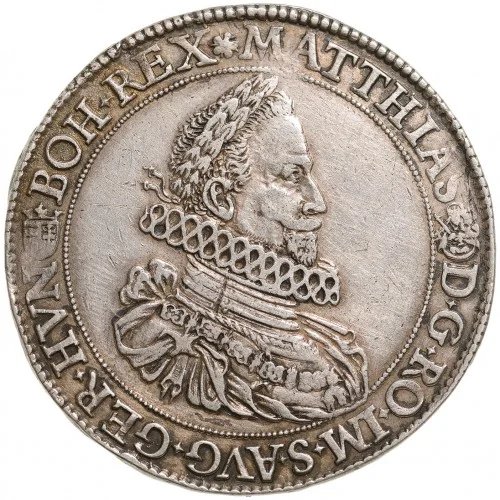
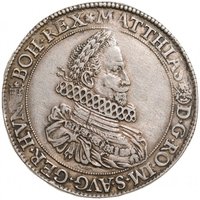
Laureate head of Matthias facing right, with Golden Fleece necklace. Crowned Hungarian shield behind, Madonna and child on crescent at right.
Inscription:
MATTHIAS· D·G·RO·IM·S·AVG·GER·HVN· BOH·REX
Script: Latin
Reverse
Description:
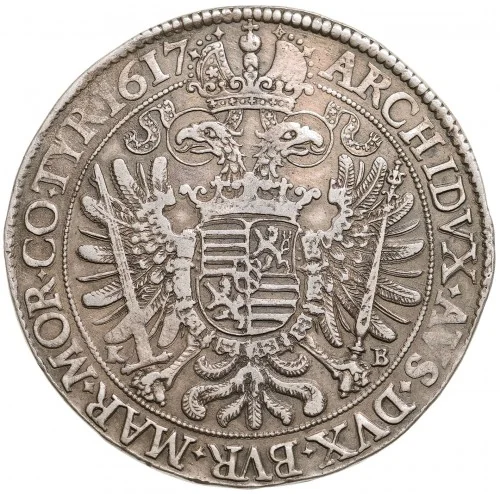
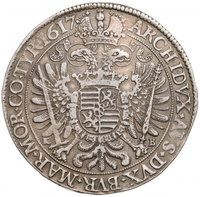
Imperial eagle with crown, sword, scepter, and orb. On its breast, a quartered shield of Árpád stripes and Bohemian lions, with an Austrian-Burgundian chest shield. Mintmarks flank the eagle.
Inscription:
ARCHIDVX·AVS·DVX·BVR·MAR·MOR·CO·TYR·1617
Script: Latin
Edge
Plain
Mints
| Name | Mark |
|---|---|
| Kremnica | KB |
Mintings
| Year | Mint Mark | Mintage | Quality | Collection |
|---|---|---|---|---|
| 1616 | K-B | — | ||
| 1617 | K-B | — | ||
| 1618 | K-B | — | ||
| 1619 | K-B | 37,000 | ||
| 1620 | K-B | — |
Historical background
In 1616, the Kingdom of Hungary was grappling with a severe and protracted currency crisis, a direct consequence of its integration into the Habsburg Monarchy. The financial policies emanating from Vienna, particularly under Emperor Matthias, prioritized the broader imperial needs over Hungarian economic stability. The Habsburgs systematically exploited Hungary's rich gold and silver mines, minting vast quantities of debased coinage—primarily denars—at the Nagybánya (today's Baia Mare, Romania) and Körmöcbánya mints. This deliberate debasement, where the silver content of coins was steadily reduced while their face value remained the same, was a form of war financing and wealth extraction, flooding the Hungarian economy with unstable currency.
The social and economic effects within Hungary were devastating. The influx of "bad money" drove out the older, full-value coins (Gresham's Law), crippling everyday trade and causing rampant price inflation. This disproportionately harmed wage earners, soldiers on fixed pay, and the lesser nobility, while enriching those who controlled the minting and those who could demand payment in kind or in stable foreign currency. The crisis eroded trust in the monetary system and became a source of intense political friction between the Hungarian Diet and the Habsburg court, with the nobility viewing the debasement as a violation of their rights and a drain on the kingdom's wealth.
This monetary instability was not an isolated issue but a key grievance that fed into the growing political and religious tensions of the era. It undermined the economic foundations of the nobility and contributed to the widespread discontent that would soon erupt into open rebellion. Within a decade, the currency crisis would become intertwined with the broader anti-Habsburg struggles, most notably under Gabriel Bethlen, Prince of Transylvania, who would seize the Körmöcbánya mint in 1619, seeking to control this crucial financial lever in his war against the emperor.
The social and economic effects within Hungary were devastating. The influx of "bad money" drove out the older, full-value coins (Gresham's Law), crippling everyday trade and causing rampant price inflation. This disproportionately harmed wage earners, soldiers on fixed pay, and the lesser nobility, while enriching those who controlled the minting and those who could demand payment in kind or in stable foreign currency. The crisis eroded trust in the monetary system and became a source of intense political friction between the Hungarian Diet and the Habsburg court, with the nobility viewing the debasement as a violation of their rights and a drain on the kingdom's wealth.
This monetary instability was not an isolated issue but a key grievance that fed into the growing political and religious tensions of the era. It undermined the economic foundations of the nobility and contributed to the widespread discontent that would soon erupt into open rebellion. Within a decade, the currency crisis would become intertwined with the broader anti-Habsburg struggles, most notably under Gabriel Bethlen, Prince of Transylvania, who would seize the Körmöcbánya mint in 1619, seeking to control this crucial financial lever in his war against the emperor.
Series: 1616 Hungary circulation coins

✨ Legendary