


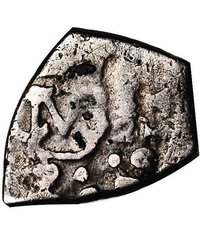
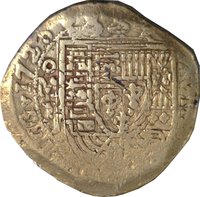
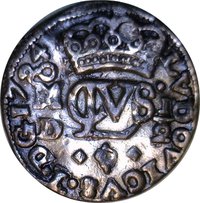
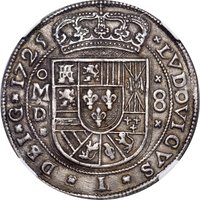
Obverse
Description:
Louis I's coat of arms.
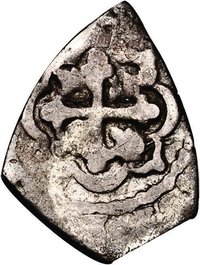
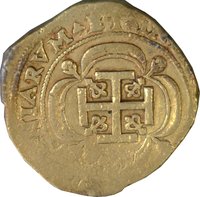
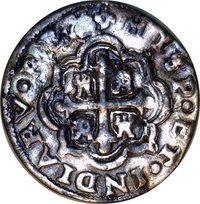
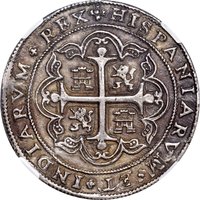
Reverse
Description:
Spanish weapons.
Edge
Mintings
| Year | Mint Mark | Mintage | Quality | Collection |
|---|---|---|---|---|
| 1724 | D | — | ||
| 1725 | D | — |
Historical background
In 1724, the currency situation in the Kingdom of New Spain was characterized by a severe and persistent shortage of circulating specie (coin), a problem that had plagued the viceroyalty for decades. Despite being the economic heart of the Spanish Empire, funneling vast quantities of silver from mines like Zacatecas and Guanajuato through the Mexico City mint, the actual coin in local circulation was insufficient. This was due to several structural factors: heavy remittances to Spain (the situado), the outflow of silver to pay for Asian goods via the Manila Galleon, and the hoarding of coin by merchants and the church. The result was a strained economy where trade was often hampered, and alternative means of payment, like credit notes and cacao beans in some regions, were commonplace.
The primary response to this crisis was the continued production of debased, low-denomination coins. Since the 1670s, the Mexico City mint had been authorized to strike vast quantities of moneda de plata de baja ley (low-grade silver coin), often called macuquinas or cobs. These coins, crudely hammered and with a silver content sometimes reduced by half, were intended to provide a medium for everyday transactions and to remain in the colony rather than be exported. By 1724, these debased coins dominated the local economy, leading to a complex system of dual pricing and valuation where goods might have one price in "good silver" (plata de ley) and another in the widely circulating "weak money" (moneda feble).
This monetary instability created significant social and economic tensions. The crown's policy of debasement was effectively a hidden tax, eroding purchasing power and disproportionately harming wage earners, the poor, and those on fixed incomes. It also fostered distrust in the currency and complicated commerce with other parts of the empire, which often refused the debased coins. Therefore, in 1724, the currency situation was one of contradiction: New Spain was a global source of silver wealth, yet its own internal economy struggled with a dysfunctional and inflationary monetary system that would not see a comprehensive reform until the introduction of milled, high-quality coins in the 1730s under the proyecto de monedas of 1728.
The primary response to this crisis was the continued production of debased, low-denomination coins. Since the 1670s, the Mexico City mint had been authorized to strike vast quantities of moneda de plata de baja ley (low-grade silver coin), often called macuquinas or cobs. These coins, crudely hammered and with a silver content sometimes reduced by half, were intended to provide a medium for everyday transactions and to remain in the colony rather than be exported. By 1724, these debased coins dominated the local economy, leading to a complex system of dual pricing and valuation where goods might have one price in "good silver" (plata de ley) and another in the widely circulating "weak money" (moneda feble).
This monetary instability created significant social and economic tensions. The crown's policy of debasement was effectively a hidden tax, eroding purchasing power and disproportionately harming wage earners, the poor, and those on fixed incomes. It also fostered distrust in the currency and complicated commerce with other parts of the empire, which often refused the debased coins. Therefore, in 1724, the currency situation was one of contradiction: New Spain was a global source of silver wealth, yet its own internal economy struggled with a dysfunctional and inflationary monetary system that would not see a comprehensive reform until the introduction of milled, high-quality coins in the 1730s under the proyecto de monedas of 1728.
Series: 1724 New Spain circulation coins

✨ Legendary