

1⁄24 Thaler – Brunswick-Lüneburg-Calenberg-Hannover
Germany

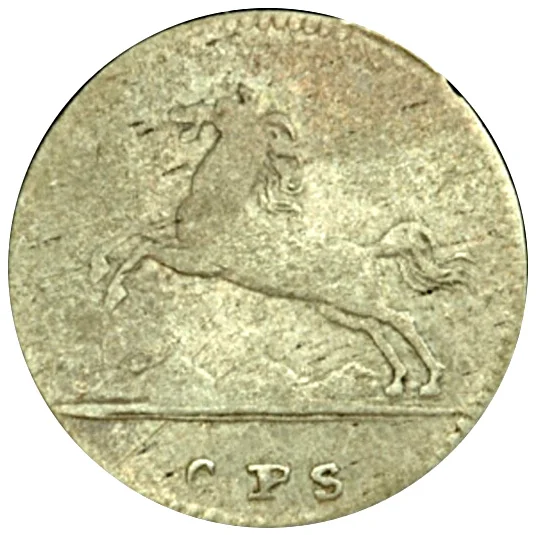
Obverse
Description:
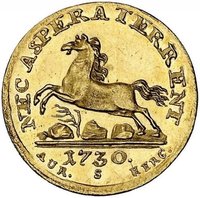
Rearing horse left, over mintmaster initials.
Inscription:
C.P.S
Script: Latin
Engraver: Christian Philipp Spangenberg
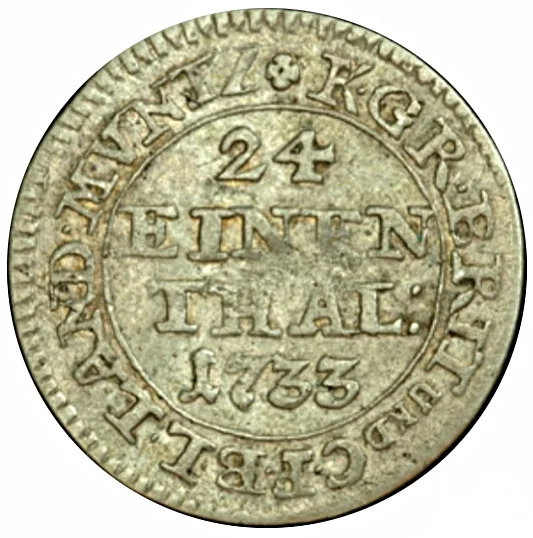
Reverse
Description:
Legend encircles a four-line inscription.
Inscription:
24
EINEN
THAL:
1733
*K.GR.BRIT.UND.C.B.P.L.LAND.MVNTZ
EINEN
THAL:
1733
*K.GR.BRIT.UND.C.B.P.L.LAND.MVNTZ
Script: Latin
Edge
Plain
Mints
| Name | Mark |
|---|---|
| Clausthal | — |
Mintings
| Year | Mint Mark | Mintage | Quality | Collection |
|---|---|---|---|---|
| 1733 | — | — | ||
| 1735 | — | — |
Historical background
In 1733, the currency situation in the Duchy of Brunswick-Lüneburg, specifically the Principality of Calenberg (with its capital in Hanover), was characterized by significant complexity and instability. The region operated within the fragmented monetary system of the Holy Roman Empire, where numerous states issued their own coinage. Hanover itself circulated a variety of coins, including its own Thalers, Gute Groschen, and Mariengroschen, alongside the currencies of neighbouring states like Brunswick-Wolfenbüttel and the powerful Reichsthaler from the Empire. This proliferation of coins of varying intrinsic values, weights, and denominations created a chaotic environment for trade and daily transactions.
The core problem was chronic debasement. Successive rulers had often reduced the silver content in their coinage to generate short-term revenue, especially to finance military engagements, such as those during the Great Northern War. By 1733, this practice had led to a severe loss of public confidence in the local currency. "Bad money" (debased coinage) tended to drive "good money" (full-weight silver coins) out of circulation, as people hoarded the valuable coins or melted them down. This Gresham's Law effect resulted in a circulating medium that was unreliable and hindered economic activity, particularly as Hanover was an increasingly important political entity, with its ruler also serving as King of Great Britain.
Recognizing the economic damage, the Hanoverian government under Elector George II Augustus (King George II of Great Britain) was actively pursuing reform. The year 1733 fell within a period of preparation for a major monetary reorganization. This culminated in the pivotal Hanoverian Coinage Edict of 1734, which aimed to standardize the coinage, define fixed exchange rates between denominations, and strictly regulate silver content to restore stability and trust. Therefore, the situation in 1733 was one of lingering monetary disorder on the brink of a concerted, state-led effort to impose order and modernize the principality's financial system.
The core problem was chronic debasement. Successive rulers had often reduced the silver content in their coinage to generate short-term revenue, especially to finance military engagements, such as those during the Great Northern War. By 1733, this practice had led to a severe loss of public confidence in the local currency. "Bad money" (debased coinage) tended to drive "good money" (full-weight silver coins) out of circulation, as people hoarded the valuable coins or melted them down. This Gresham's Law effect resulted in a circulating medium that was unreliable and hindered economic activity, particularly as Hanover was an increasingly important political entity, with its ruler also serving as King of Great Britain.
Recognizing the economic damage, the Hanoverian government under Elector George II Augustus (King George II of Great Britain) was actively pursuing reform. The year 1733 fell within a period of preparation for a major monetary reorganization. This culminated in the pivotal Hanoverian Coinage Edict of 1734, which aimed to standardize the coinage, define fixed exchange rates between denominations, and strictly regulate silver content to restore stability and trust. Therefore, the situation in 1733 was one of lingering monetary disorder on the brink of a concerted, state-led effort to impose order and modernize the principality's financial system.
✨ Legendary