

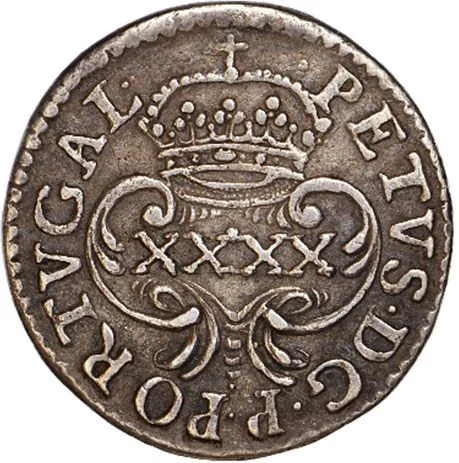
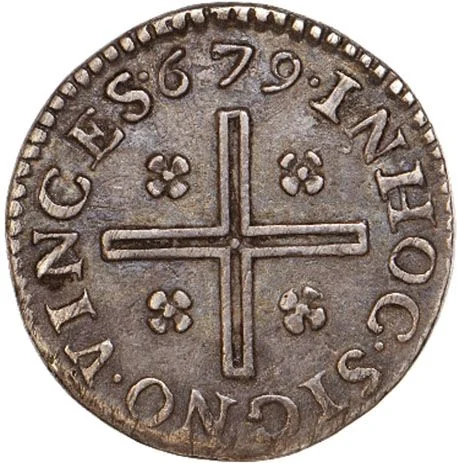
XXXX Réis "2 Vinténs" – Portugal
Portugal

Mints
| Name | Mark |
|---|---|
| Imprensa Nacional - Casa da Moeda | — |
Mintings
| Year | Mint Mark | Mintage | Quality | Collection |
|---|---|---|---|---|
| 1679 | — | — |
Historical background
In 1679, Portugal’s currency system was in a state of profound crisis and transition, a direct legacy of the Restoration War (1640-1668) against Spain. The prolonged conflict had drained the treasury, leading the Crown to repeatedly debase the coinage, particularly the ubiquitous real. By minting coins with progressively lower silver content while maintaining their face value, the monarchy sought to create short-term revenue. This practice, however, triggered severe inflation, eroded public trust in the currency, and disrupted both domestic commerce and international trade, as foreign merchants demanded payment in older, purer coins or gold.
The monetary chaos was compounded by a confusing circulation of multiple coin types. Older, full-weight coins from before the war (known as moeda velha) circulated alongside the newer, debased moeda nova, creating a dual system where their values were constantly negotiated. Furthermore, a flood of foreign currency, especially Spanish silver reales and gold from Brazil, circulated within the kingdom, further complicating transactions. The economy effectively operated on a system of bullion by weight rather than trusting the stamped face value of coins.
Recognizing the destabilizing effects, the government under King Pedro II had already begun to address the issue. The 1688 monetary reform, which would introduce a stable gold standard based on Brazilian gold, was being planned in this period. Therefore, 1679 represents a pivotal moment near the end of this turbulent era. The state was grappling with the immediate consequences of debasement—price instability and fiscal weakness—while laying the groundwork for the forthcoming solution that would ultimately stabilize Portuguese currency through the influx of Brazilian gold.
The monetary chaos was compounded by a confusing circulation of multiple coin types. Older, full-weight coins from before the war (known as moeda velha) circulated alongside the newer, debased moeda nova, creating a dual system where their values were constantly negotiated. Furthermore, a flood of foreign currency, especially Spanish silver reales and gold from Brazil, circulated within the kingdom, further complicating transactions. The economy effectively operated on a system of bullion by weight rather than trusting the stamped face value of coins.
Recognizing the destabilizing effects, the government under King Pedro II had already begun to address the issue. The 1688 monetary reform, which would introduce a stable gold standard based on Brazilian gold, was being planned in this period. Therefore, 1679 represents a pivotal moment near the end of this turbulent era. The state was grappling with the immediate consequences of debasement—price instability and fiscal weakness—while laying the groundwork for the forthcoming solution that would ultimately stabilize Portuguese currency through the influx of Brazilian gold.
✨ Legendary