

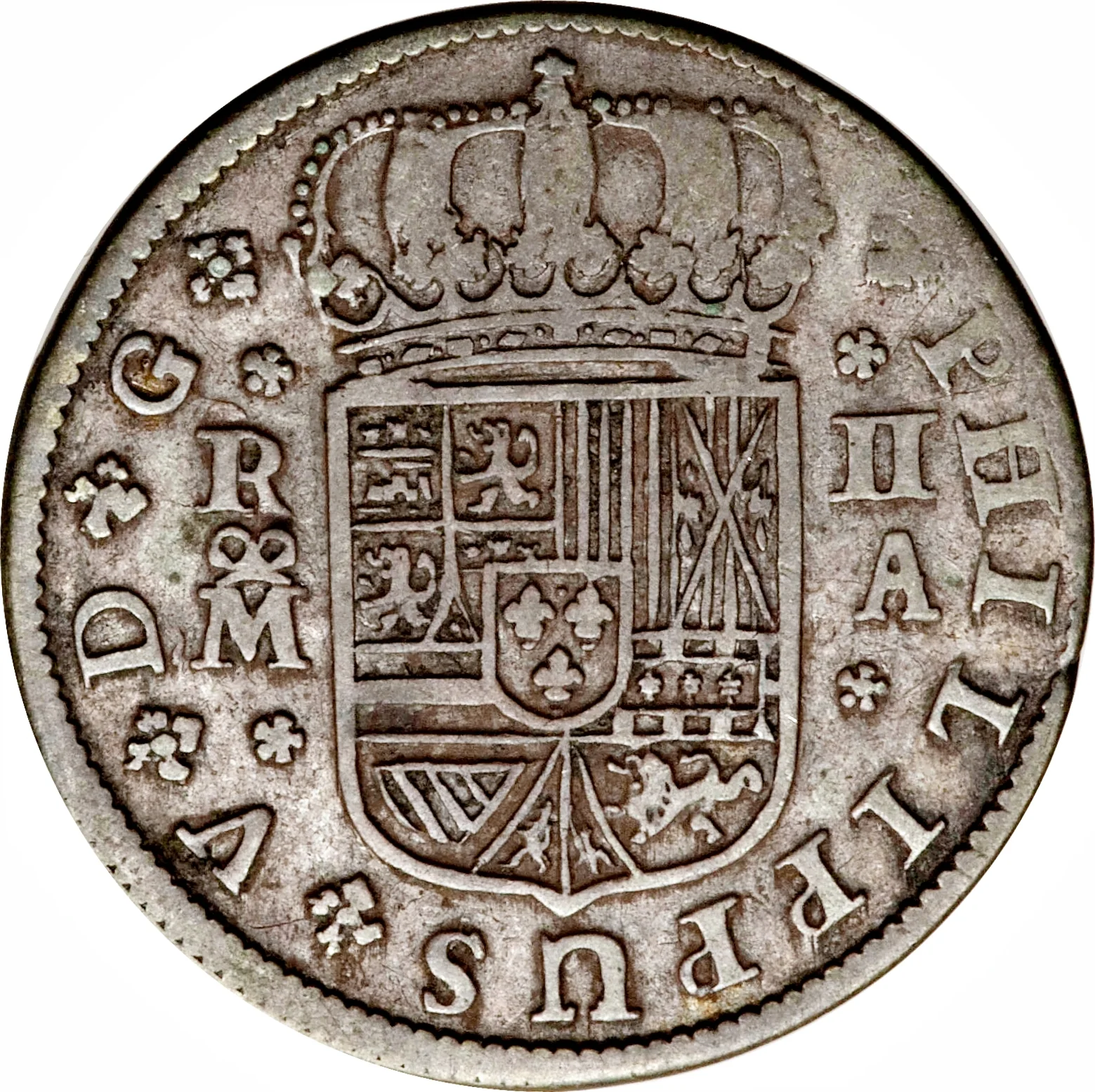
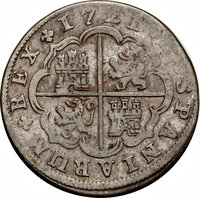
Obverse
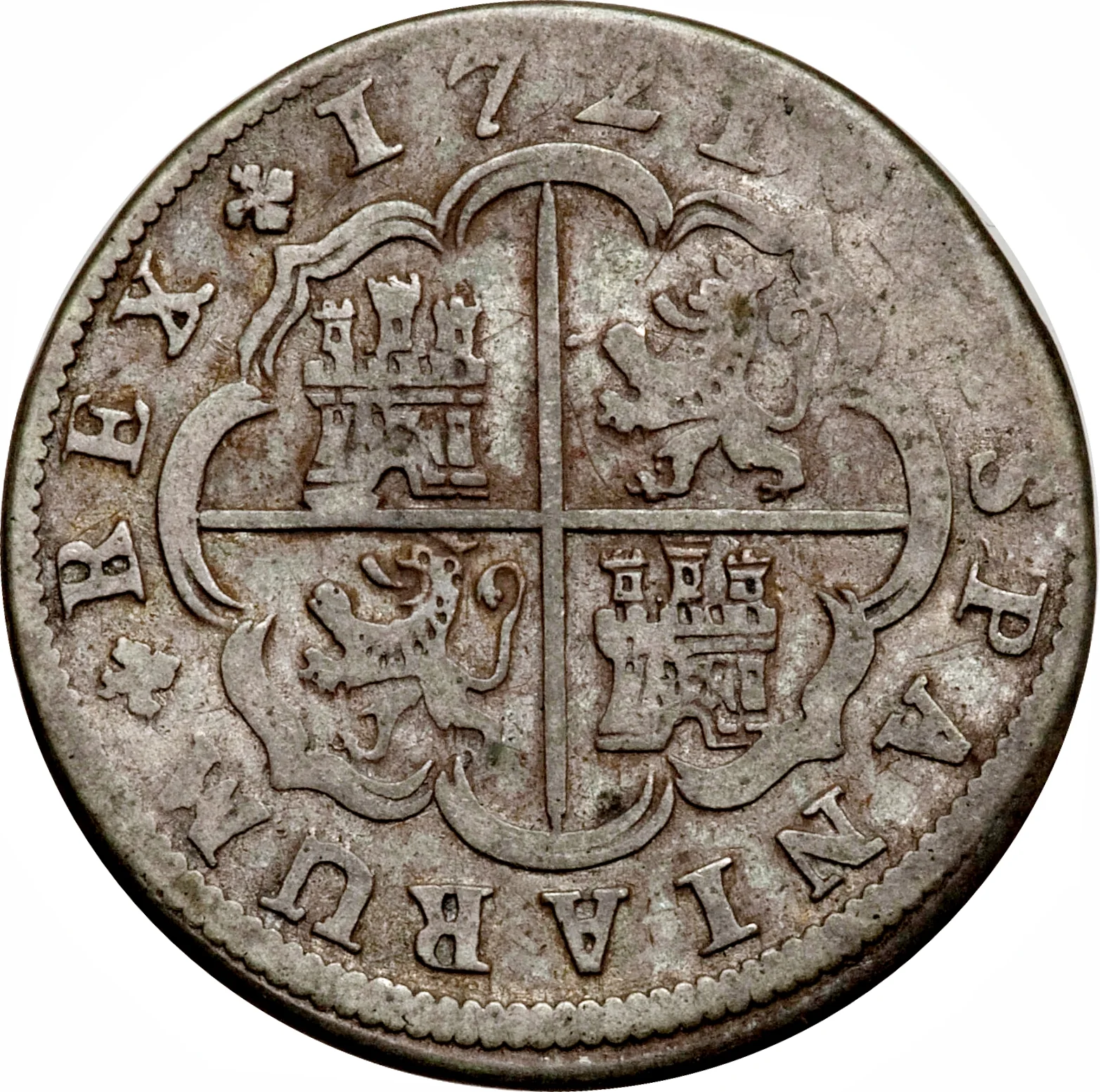
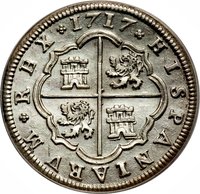
Reverse
Description:
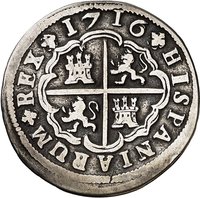
Castile and León's coat of arms in an octolobe.
Inscription:
✤ 1721 ✤ HISPANIARUM ✤ REX
Script: Latin
Edge
Categories
| Symbols> Coat of Arms |
Mints
| Name | Mark |
|---|---|
| Royal Mint of Madrid | (M) |
Mintings
| Year | Mint Mark | Mintage | Quality | Collection |
|---|---|---|---|---|
| 1716 | MJ | — | ||
| 1717 | MJ | — | ||
| 1719 | MJ | — | ||
| 1720 | MJJ | — | ||
| 1721 | MA | — | ||
| 1722 | MA | — | ||
| 1723 | MA | — | ||
| 1724 | MA | — | ||
| 1725 | MA | — | ||
| 1730 | MJJ | — | ||
| 1735 | MJF | 318,164 | ||
| 1737 | MJF | 614,999 | ||
| 1740 | MJF | 327,596 |
Historical background
In 1716, Spain’s currency situation was complex and unstable, a direct legacy of the recent War of the Spanish Succession (1701-1714). The prolonged conflict had drained the royal treasury, leading successive monarchs—first the Habsburg Charles II and then the victorious Bourbon Philip V—to repeatedly debase the coinage. This meant reducing the precious metal content in coins like the real and the escudo to fund military expenses, thereby increasing the money supply but causing severe inflation and a loss of public confidence in the currency's value. The economy was further strained by the fragmentation of the mint system, with different regions operating under distinct monetary standards.
The political outcome of the war, however, set the stage for reform. With the Nueva Planta decrees (1707-1716), Philip V was systematically abolishing the separate laws and institutions of the Crown of Aragon (including Catalonia, Valencia, and Aragon proper), which had opposed him in the war. This centralization process extended to currency. In 1716, a key decree aimed to standardize the monetary system across these newly integrated territories, aligning them with the Castilian system used in the rest of the kingdom. The principal unit became the real de vellón, a copper-based coin with a fluctuating value against the older silver real and gold escudo.
Despite this push for unification, the currency system remained problematic. The widespread circulation of heavily debased copper coinage (vellón) fueled inflation and hampered trade, while the state still struggled with massive debt. Furthermore, the reforms were administrative and political, not immediately backed by a sound fiscal policy or fresh inflows of American silver, which had declined in the previous century. Thus, in 1716, Spain was in a transitional period: moving forcibly toward a unified national currency under a stronger absolute monarchy, but still grappling with the deep-seated economic weaknesses and inflationary pressures that would challenge the Bourbon regime for decades to come.
The political outcome of the war, however, set the stage for reform. With the Nueva Planta decrees (1707-1716), Philip V was systematically abolishing the separate laws and institutions of the Crown of Aragon (including Catalonia, Valencia, and Aragon proper), which had opposed him in the war. This centralization process extended to currency. In 1716, a key decree aimed to standardize the monetary system across these newly integrated territories, aligning them with the Castilian system used in the rest of the kingdom. The principal unit became the real de vellón, a copper-based coin with a fluctuating value against the older silver real and gold escudo.
Despite this push for unification, the currency system remained problematic. The widespread circulation of heavily debased copper coinage (vellón) fueled inflation and hampered trade, while the state still struggled with massive debt. Furthermore, the reforms were administrative and political, not immediately backed by a sound fiscal policy or fresh inflows of American silver, which had declined in the previous century. Thus, in 1716, Spain was in a transitional period: moving forcibly toward a unified national currency under a stronger absolute monarchy, but still grappling with the deep-seated economic weaknesses and inflationary pressures that would challenge the Bourbon regime for decades to come.
🌟 Limited